
In this article, Dr David Lobb of the University of Manitoba examines why riparian buffers often fail to filter contaminants from agricultural runoff, particularly in cold climate regions
There is an abundance of research data and field observations which demonstrate that riparian areas do not always work as filters of potential contaminants in runoff from agricultural land, and should not be promoted as a ‘silver-bullet’ Best Management Practice for agricultural watersheds. This is certainly the case in cold climate regions such as the Northern Great Plains of North America.
This is contrary to the common belief amongst policy-makers and technical advisors, and bears serious consideration. There are a number of reasons why riparian areas are often not effective as filters in such regions, and there are a number of unconventional practices that could be employed to make them more effective as filters.
Understanding riparian areas in agricultural landscapes
Riparian areas are an integral part of the agricultural landscape with several valuable functions. We often think of riparian areas as the land that lies between agricultural fields and surface waterways and water bodies. They can be major landscape features along rivers and around lakes, but are also associated with ponds and ditches. They have wetland vegetation and wetland soils, and they can shift over time as hydrologic conditions change. In many agricultural watersheds, riparian areas can account for 5 to 10% of the farm area, and in some regions, such as the Prairie Pothole Region of the NGP, they can be as much as 25% of the farm area.
Riparian areas are ecologically critical as wildlife habitat and corridors. They are also valued for recreational activities, such as hiking, snowmobiling, canoeing and fishing. They also provide aesthetic value to properties. Riparian areas can also serve as a setback or barrier, providing a buffer between agricultural operations, such as pesticide and manure application, and surface waters. As a setback, they also improve farm safety. This is often forgotten. In the small community where I grew up, two farmers operating equipment too close to streams rolled their tractors and drowned.
Riparian areas can also be managed to reduce runoff from agricultural land and filter sediments and nutrients in that runoff. Over the past couple of decades, much attention has been given to the potential of riparian areas to filter nutrients in agricultural runoff and to reduce the load of nutrients being carried downstream to sensitive water bodies.
Challenges in the Northern Great Plains
In the Northern Great Plains, we face considerable challenges in managing our surface waters. Most notable is the eutrophication of Lake Winnipeg and the algae blooms in the freshwater bodies across the Lake Winnipeg Basin (which extends across four Canadian provinces and four American states). There is a great public and political desire to reduce nutrient runoff from agricultural land, particularly the runoff of phosphorus, to improve the state of our surface waters, and riparian areas are seen as a fantastic solution.
The use of riparian areas to clean up agricultural runoff has been promoted in government programs, policies and regulations across North America. However, these initiatives have not given serious consideration to whether or not riparian areas actually work as nutrient filters in cold climates. The research used to support the use of riparian areas as nutrient filters has been carried out in different regions with different climates: They have focused on southern climates with long growing seasons, and focused on dispersed, low-velocity surface flow over engineered and managed (harvested) vegetative filter strips or on shallow subsurface flow of nutrients through riparian areas.
Why riparian areas fail as filters in cold climates
Research we have carried out in the Northern Great Plains has demonstrated that riparian areas are not effective in filtering sediments and nutrients in runoff from agricultural land. Why is this?
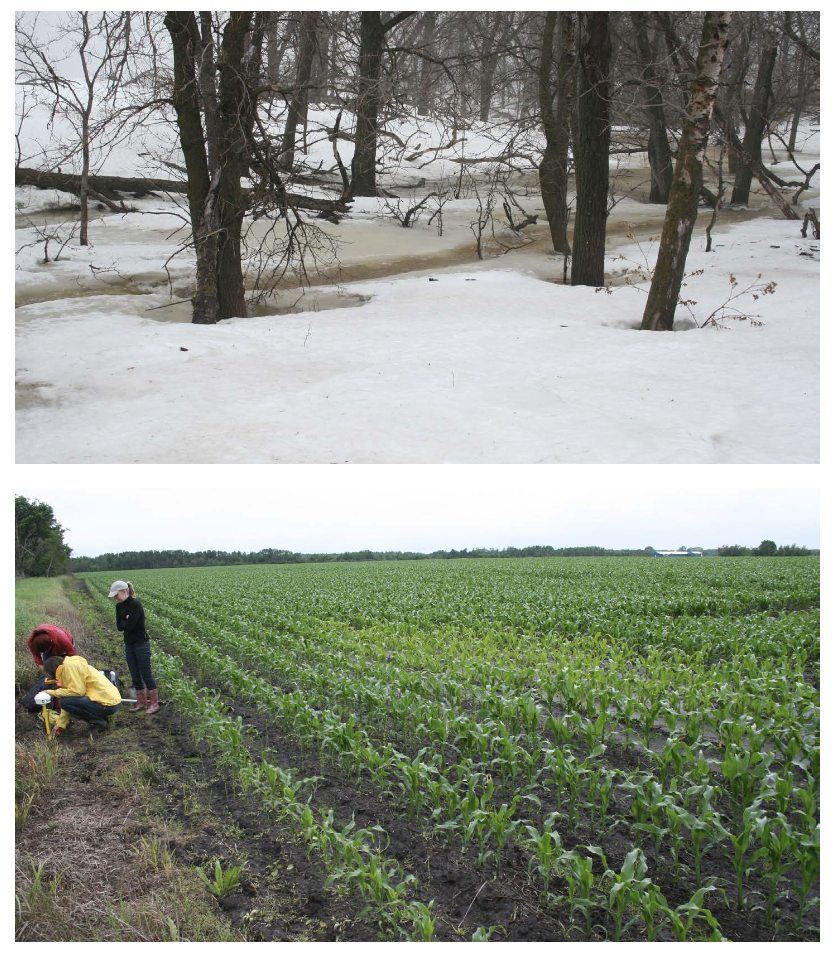
The first reason is that in the cold climate of this region, about 80-85% of runoff water and nutrients occur during snowmelt when the ground is impermeable and vegetation is dormant or dead and not capable of consuming water and nutrients.
Secondly, most of the nutrients in runoff from agricultural land are dissolved and are not physically trapped by vegetation, or the snow, for that matter.
In theory, riparian areas could filter significant sediments and nutrients from rainfall runoff during the growing season. Unlike the snowmelt period, surface water is infiltrating, vegetation is growing, consuming water and nutrients and acting as a physical filter for sediments. But water runs off land in concentrated flows along surface drainage paths, and this flow passes through the riparian area in a very limited zone that allows for very little, if any, filtration. In multiple surveys of flow paths through unmanaged riparian areas, it was consistently found that only 1-2% of the length of the field-edge vegetation intercepts surface runoff. This is the third reason why riparian areas are not effective.
It is important to note that even if the vegetation in a riparian area were able to take up significant quantities of nutrients, unless the vegetation is harvested and removed, it will simply become a source of nutrients. This is a photo (bottom right) from one of only a few riparian study sites where sediments and nutrients were clearly being filtered out by the vegetation on the flow path. Ultimately, such sinks for nutrients will become saturated and begin to serve as a source of nutrients delivered to surface waters. This is the fourth reason.
Opportunities to reduce contaminants in runoff
There are a couple of clear conclusions from our research: (i) To reduce sediment and nutrient delivery to surface waters, we must manage soils and crops to reduce the runoff, sediments and nutrients leaving agricultural land and entering riparian areas, and (ii) we must manage the vegetation in riparian areas as crops – harvest the vegetation (remove nutrients). Obviously, this is a challenge for maintaining natural riparian areas.
It is important to take a broad view of riparian areas and their management for filtering sediments and nutrients. In-field surface drains and drainage ditches represent a massive opportunity to manage riparian areas for nutrient filtering and removal. On the Red River Plain, the major source of nutrients delivered to Lake Winnipeg, each section of land (1.6 km by 1.6 km) has about 20 to 25 km of in-field surface drains, with 40 to 60 surface drain outlets to 4 to 6 km of drainage ditches.
Beyond the field, these riparian areas are not managed for the purposes of nutrient filtering and removal, but if they were, it may be possible to achieve considerable reduction in nutrient levels in surface waters. A more sensible approach to reducing nutrients loss from the farm to the watershed and beyond is managing the runoff at the farm scale using on-farm techniques for collection, storage and use of runoff water, such as restoring wetlands, small dams, and drainage water retention