
Debra Inglis provides an overview of the Canadian grape and wine industry’s challenges and innovations through the Cool Climate Oenology and Viticulture Institute (CCOVI) at Brock University
Wines have been made in Canada for over 200 years, but the current industry – focused largely on European Vitis vinifera varieties like Chardonnay, Riesling, Pinot Noir and Cabernet Franc, to name a few — only developed in the past 50 years. (1) Today, the economic impact of Canada’s grape and wine sector is estimated at $11.6 billion CAD, supporting more than 45,000 jobs across the country in agriculture, grape and wine processing, tourism, transportation, research, restaurants, and retail on 31,000 acres. (2) Grape and wine are significant components of Canada’s overall agriculture and agrifood sector, which generated $149.2bn CAD in gross domestic product (GDP) in 2024. (3)
Challenges impacting grape and wine production
Despite its successes, our industry has faced challenges. Climate change has led to heat and drought stress in vineyards, winter injury to vines, new disease pressures on fruit, changing insect behaviour that can damage fruit, and the establishment of new invasive insect species in grape-growing regions. Still, consumers continue to demand high-quality wine and consistency year after year.
For Canadians, a challenge means an opportunity, which in turn inspires innovation.
In 1996, the industry joined forces with Brock University, supported by federal (Canada Foundation for Innovation) and provincial (Ontario Innovation Trust) programs, to establish Canada’s first grape and wine research institute: the Cool Climate Oenology and Viticulture Institute (CCOVI). CCOVI’s activities are based on three pillars: quality, innovation, and sustainability, addressing industry priorities through research, outreach for technology transfer back to end users, and professional and continuing studies.
A recent funding boost from the Ontario Research Fund Research Excellence program (ORF RE) will support a multi-institutional project led by CCOVI Director Debra Inglis with co-investigators across the country that aims to drive resilience in domestic grape and wine production. The project also builds on earlier funding from the federal government’s Sustainable Canadian Agricultural Partnership for projects led by Inglis and Jim Willwerth (Associate Professor and CCOVI Researcher, Brock University). (4) When combined with cash and in-kind support from industry partners and Brock University, the project, ‘Viticulture Innovation and Next-generation Oenology (VINO) Solutions: Strengthening Ontario’s Grape and Wine Sector for Climate Resilience, Innovation Excellence and Global Economic Leadership’ totals $7.4 million CAD over four years.
VINO Solutions for climate-smart agriculture
The VINO Solutions project will develop new grape-growing and fermenting approaches to help the industry combat threats from climate change, such as new pests, plant viruses, and changing growing seasons that require resiliency strategies.
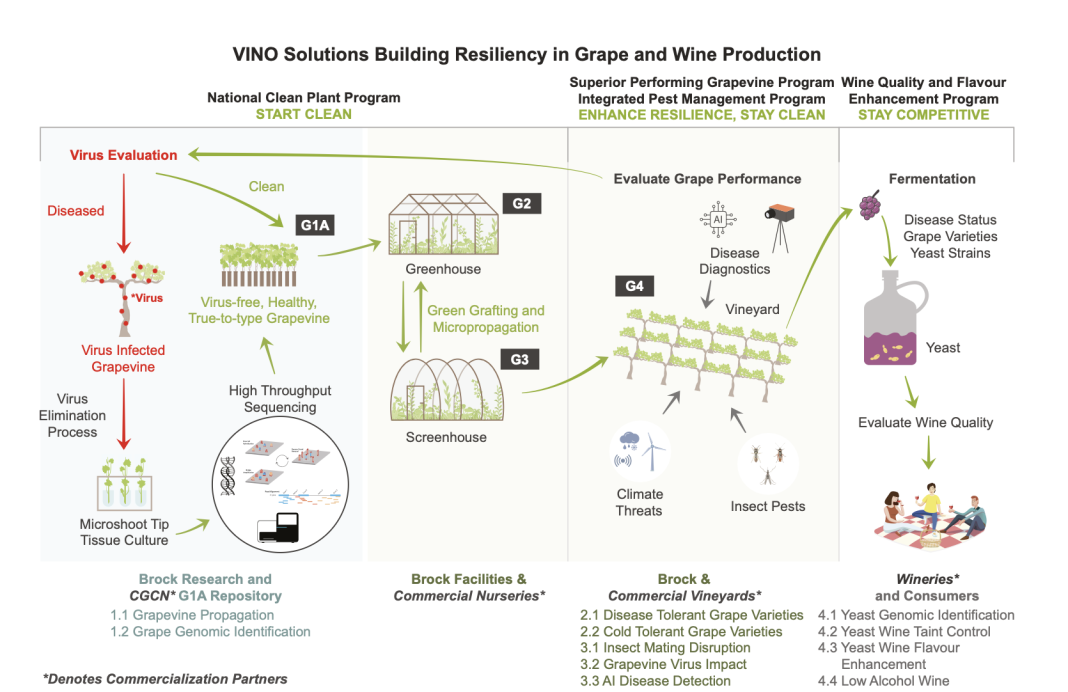
VINO Solutions consists of 11 subprojects under the categories Start Clean, Enhance Resilience, Stay Clean and Stay Competitive (see Figure 1). Researchers will use state-of-the-art equipment and facilities at Brock’s Research Farm, which recently received funding from the federal and Ontario governments. (5)
Start Clean will develop cutting-edge techniques, such as micro-shoot tip tissue culture therapy, green tissue culture grafting and high-throughput sequencing, to produce healthy, virus-free vines while ensuring their genetic identity for the Canadian grapevine clean plant program.
Enhance Resilience will assess the suitability of new varieties for the Ontario climate, including their cold tolerance and disease resistance, along with new vine treatments to improve grapevine cold hardiness. Superior performing plant material will enter Brock’s germplasm collection.
Stay Clean will develop Artificial Intelligence methods to detect grapevine viruses in vines and identify pheromones to disrupt the mating patterns of insect vectors of virus. These activities are part of an integrated pest management program to prevent infection and control the spread of viral diseases.
Stay Competitive will focus on wine quality and flavour research to support the global competitiveness of Ontario wine. Researchers will isolate, identify and characterize unique yeast that can overcome fruit breakdown issues in grapes, enhance wine aroma and reduce alcohol content. The team will also assess the quality of wine from new disease-resistant varieties and evaluate their suitability for use in low-alcohol wines.
The integrated program aims to commercialize tools to create:
- Domestically generated disease-free grapevine material for nurseries for further propagation.
- Testing services for grapevine and yeast identification.
- New commercial products for controlling vineyard insect pests.
- Unique Ontario yeasts to overcome climate-change-driven fermentation challenges.
- Knowledge translation programs.
- New grapevine propagation techniques.
- New wine styles.
Partners working with Brock University researchers include Niagara College, University of Guelph, Vineland Research and Innovation Centre, the Canadian Food Inspection Agency, Ontario Grape and Wine Research Inc., Canadian Grapevine Certification Network, Seeger Vineyards, Schenck Farms and Greenhouses, Illumina, Upper Canada Growers, Cave Springs Vineyard, ABAzyne BioSciences, Synergy Semiochemical Corporation and Stouck Vineyards.
Through the VINO Solutions program, Canada’s first grapevine Clean Plant Program will be commercialized, demonstrating sustainable plant production devoid of economically devastating viruses and showcasing a national repository of clean plant material available to nurseries for propagation. This will also include innovative integrated pest management (IPM) programs using AI to prevent future infection once vines are planted in farmers’ fields. Grapevine and rootstock choices for Canada’s erratic weather will be identified, with vine selections included in the Clean Plant Program to ensure long-term industry sustainability.
Evaluating wine produced from these selections will assist the industry with increasing wine domestic market share via quality enhancement, including commercializing novel yeast selections from local vineyards that enrich flavour, and by producing low alcohol wines to meet consumer demands using innovative techniques. As part of the Clean Plant Program, whole genome-based high-throughput sequencing (HTS) diagnostic methods will be commercialized to identify grapevine varieties and differentiate clonal selections. These technologies will be applied to yeast and virus identification for commercial purposes, enabling CCOVI to expand its Clean Plant Program national testing platform and allowing wineries to leverage their own microbial terroir.
The future looks bright for Canadian grape and wine with climate-smart agriculture approaches.