
The recent volume “Organized Science Denial. An Action Plan for Solutions” edited by Elena Bruni and Lianne M. Lefsrud, hosts the voices of scholars in organization theory to reflect about the collective dynamics of denial and its implications in this currently complex world
Science Under Attack
In September 2025, TIME reported that Florida’s proposal to remove all vaccine mandates could trigger a rise in preventable childhood illnesses, hospitalizations, and potentially deaths. While no single policy decision can fully account for public health trajectories, the episode exemplifies a broader and increasingly influential anti-expertise agenda promoted by political actors who challenge long-established scientific consensus and weaken trust in science-based health policies (Williams 2025).
In the same period, the U.S. Secretary of Energy visited Brussels and Vienna to advocate for expanded fossil fuel development. He presented a report that downplayed the overwhelming scientific evidence on the urgency of reducing carbon emissions to mitigate severe climate impacts (Berwyn 2025). This effort mirrored an organizational pattern long documented in the climate arena: fossil fuel actors strategically manufacture doubt to delay regulation and sustain current economic models.
These two examples illustrate a recurrent dynamic: organized actors mobilize resources, rhetoric, and infrastructures to obscure scientific consensus, shape public opinion, and influence policy. Scholars define this strategic, coordinated behaviour as science denialism: a collective project aimed at discrediting established knowledge and eroding trust in the institutions that generate it.
The Co-Edited Volume and its Purpose
Our edited volume brings together leading scholars in organization theory to examine these patterns not as isolated controversies but as deeply social and organizationally embedded phenomena. Denialism is not merely the product of individuals rejecting uncomfortable truths; it is sustained by organizations – corporations, advocacy groups, media systems, political campaigns – and by the institutional contexts in which they operate.
We examine cases ranging from the tobacco industry and organizational greenwashing to anti-vaccination movements, media, and the Xylella Fastidiosa epidemic that devastated olive trees in Southern Italy. Each illustrates how collective actors shape – often distort – the public understanding of science.
The Framework: A Multi-Level Rhetorical Approach
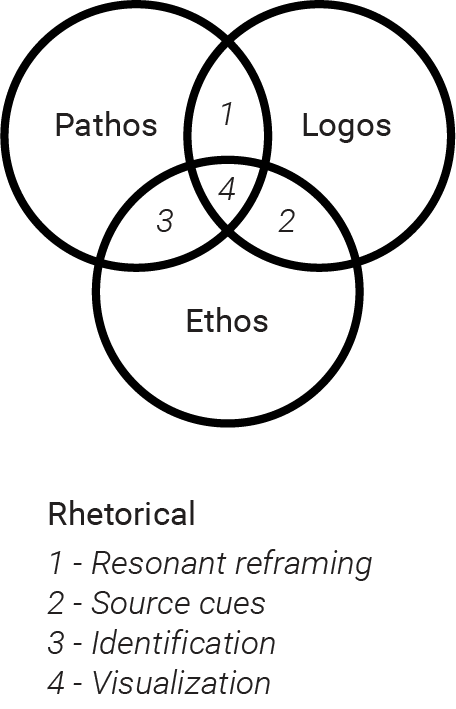
We offer a framework that can be used for communicating science more effectively and countering organized denialism. At the foundation of the framework lies framing theory: effective frames diagnose a problem, propose a solution, and motivate action (Benford and Snow 2000). For a scientific message to be effective, it must resonate not only intellectually but emotionally and culturally. Resonant reframing (1 in Fig. 1) aligns emotional appeal (pathos) and scientific evidence (logos). For example, describing vaccination as “an act of solidarity that protects the vulnerable” reframes it from an individual health choice into a moral and collective responsibility. Similarly, climate change can be reframed as “an opportunity for innovation and stewardship,” shifting public attention from crisis to agency and constructive engagement.
A second component (2 in Fig 1) is source validation: scientific communication must clearly indicate the source of knowledge. Linking findings to credible sources – such as peer-reviewed studies or reputable media outlets – reinforces the alignment between evidence (logos) and credibility (ethos). This is essential in contexts where denialist actors deliberately blur the boundaries between expertise and opinion.
The third component, identification (3 in Fig 1), draws on Kenneth Burke’s notion that persuasion often depends on perceived shared identity. People are more receptive when they see communicators as aligned with their values and beliefs. One of the examples cited in the book is organ donation: campaigns are more effective when they appeal to shared local identity (e.g., West Virginians helping fellow West Virginians), rather than relying solely on general statistics (Dillow and Weber 2016). The same principle applies to climate or public health communication, where identification can counteract distrust and polarization.
The fourth dimension is visualization (4 in Fig 1). Visuals – graphs, maps, animations – serve both cognitive (logos) and emotional (pathos) functions, while creating connection (ethos). They simplify complex processes, evoke empathy, and create memorable narratives. Contemporary journalism offers powerful examples: Skynews’s diagrams illustrating the human toll of COVID-19 (Skynews 2025), or the New York Times’s climate graphics (Rosen 2021). These multimodal tools translate abstract knowledge into intelligible and compelling stories.
In the book, we highlight a particularly effective case: the European Food Safety Authority’s (EFSA) video explaining how Xylella Fastidiosa spread through olive groves in Southern Italy. The Xylella crisis was accompanied by intense denialist narratives accusing scientists of fabricating or exaggerating the threat. EFSA’s video made the scientific process visible – its rigor, uncertainties, and collective nature – while clearly explaining the bacterium’s mechanisms and the rationale behind containment measures. This visualization helped to rebuild trust by demystifying science and showing its social purpose (Bruni et al. 2025).
Science Denialism: A Social Problem that Concerns Us All
At the individual level, denial refers to the tendency to dismiss or downplay threatening information to preserve one’s identity or psychological equilibrium (Gorman and Gorman 2017). Individuals use cognitive shortcuts to construct a more identity-aligned version of reality: in this sense, denial can serve a protective function.
Understanding denialism as a collective phenomenon is crucial. When organizations, networks, and institutions actively cultivate denial, the stakes shift dramatically. Denialism becomes a coordinated, institutionally disruptive practice (Bardon 2019). It mobilizes rhetorical strategies, political alliances, digital infrastructures, and media channels to transform private doubts into public controversy, undermining trust in scientific institutions and contributing to systemic uncertainty (Eyal 2019).
This is not an abstract concern. Calls from academia and reports alike (Bardon, 2019; Oreskes, 2019; Edelman Trust Barometer, 2024, 2025) – highlight how denialism fuels polarization, weakens democratic governance, and can trigger social unrest. Our book responds to these calls, by presenting a multilevel framework for responding to denialism that can be used policymakers, scientific institutions, and organizational leaders. Countering denialism requires more than correcting facts: it demands new ways of communicating, new modes of public engagement, and an explicit recognition that science denial is a social problem that concerns us all.
CLICK HERE for references