
Dynamic PRA provides sustainable flood risk decision support by identifying costs to present and future generations
PRA is a structured and logical analysis method assessing risks in complex systems to improve safety and performance. Within PRA, risk is defined as likelihood per negative consequence magnitude. A PRA goal is to explicitly describe the impact of uncertainty, which is lack of knowledge, to risk. It has been in widespread use since the 1980s and 1990s.
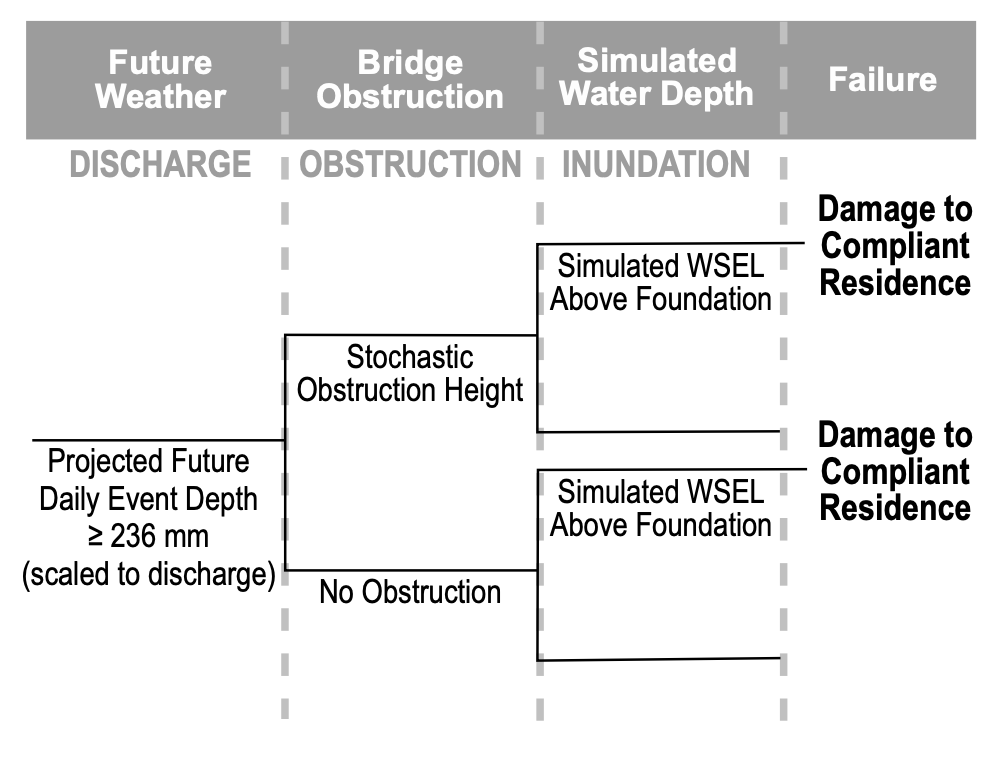
PRA uses scenarios, which are sequences of events, to describe the likelihood of system failure. Scenarios provide characterization of multiple threats that can only be realized as the result of a chain of events. They begin with an initiating event, representing departure from expected conditions. After initiation, assessment identifies pivotal events that may occur and that continue progression towards negative consequences. The sequence of pivotal events is represented with an event tree; an example is shown on Figure 1. Each event must happen for evaluation to continue to the next event. All events must occur to trigger failure.
Each event is represented with a probability distribution that describes event uncertainty. Monte Carlo techniques provide evaluation of the event tree and the means to determine overall failure likelihood by combining likelihoods for event occurrences. Traditionally, PRA is a static exercise using fixed probability distributions.
Dynamic PRA can be achieved by varying probability distributions across assessment time and by evaluating the tree at regular time intervals ( Martin et al., 2022).
Normalize negative consequences using cost
Consequence magnitudes need to be normalized to relative cost to compare independent scenarios. As an example, what is the bigger negative consequence, a 9+ magnitude earthquake adjacent to the city of Seattle or a nuclear-related terrorist incident in Seattle? A relative cost allocation is a simple way to compare and evaluate these two unthinkable tragedies. Relative cost is recommended because it is impossible to accurately predict the future and precisely account for all negative consequences accruing from a hypothetical future event.
Decision support for Sustainability
Sustainability is meeting the needs of the present without compromising the ability of future generations to meet their needs. It should be the minimum goal for planning because the core concept is parsimonious distribution of a fixed resource base. Sustainability is putting it back as good as you found it, so that future generations have equivalent access to resources.
PRA provides sustainable water resources decision support, and water is a fundamental component of sustainable development strategies. Future water supply and availability are largely determined by future weather. It is sub-daily weather, and not 30-year averages of weather, that controls water supply and availability for a segment of the global water cycle.
PRA can be used for risk assessment water resources management risk. for water supply (Martin, 2021a), water availability (Martin, 2021b), and water-related hazards (Martin et al., 2022). Because water resources are so fundamentally affected by weather and because weather is highly variable across multiple time scales encompassing a range of hours to centuries, water-related assessments must leverage dynamic PRA.
Currently, future weather is uncertain, and historical weather is a poor estimator for future conditions because of climate change. Uncertainty is described to PRA via the variance, or spread, of probability distributions. Increasing the spread of the distributions within a scenario produces a wider range of 1) likelihoods for failure and 2) consequence magnitudes.
Martin et al. (2025) provide an example PRA that implements sustainable planning for flooding threats. The primary purposes of this example PRA are 1) illustrate the use of PRA for sustainable planning and 2) identify approaches for incorporation of the full range of uncertainties that control water resources management risk.
Describing uncertainty is the key to assessing future risk
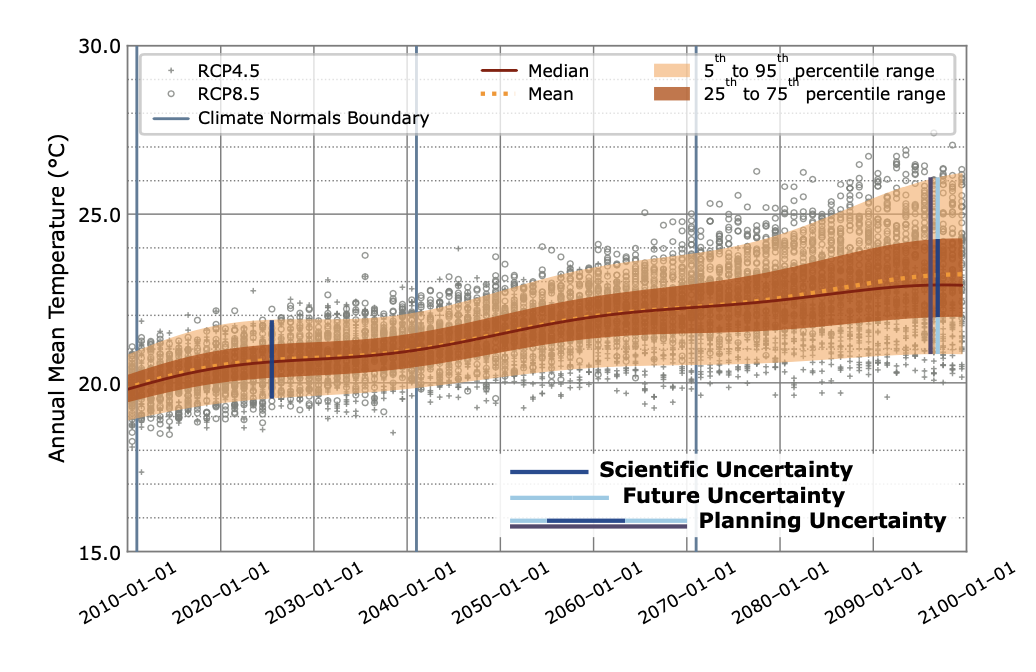
The complete range of uncertainty includes the concepts of exact value, scientific, and future uncertainty. Exact value uncertainty is the traditional uncertainty description used in engineering design. It assumes the target value is known, and it is not applicable to future conditions. Scientific uncertainty incorporates considerations for hypothesis testing such as the target value uncertainty and risk from an incorrect hypothesis.
Future conditions uncertainty extends scientific uncertainty to include variance for unknowable future changes. For planning, future conditions and scientific uncertainty should be aggregated for a comprehensive uncertainty description as shown in Figure 2.
References
- Martin, N., 2021a. Watershed-Scale, Probabilistic Risk Assessment of Water Resources Impacts from Climate Change. Water 13, 40.
- Martin, N., 2021b. Risk Assessment of Future Climate and Land Use/Land Cover Change Impacts on Water Resources. Hydrology 8, 1–21.
- Martin, N., Nicholaides, K., Southard, P., 2022. Enhanced Water Resources Risk from Collocation of Disposal Wells and Legacy Oil and Gas Exploration and Production Regions in Texas. JAWRA J. Am. Water Resour. Assoc. 58, 1433–1453.
- Martin, N., Peña, F., Powers, D., 2025. Probabilistic Risk Assessment (PRA) for Sustainable Water Resource Management: A Future Flood Inundation Example. Water 17, 816.