
Weeds pose the most persistent and costly threat to crop production in Canada, driving widespread herbicide use and accelerating the rise of herbicide-resistant species. This article explores how emerging AI- and trait-based decision tools can transform weed management and usher in a new era of precise, sustainable herbicide stewardship
Weeds are the most consistent, recurring and damaging biotic threat to crop production in Canada. Without the use of herbicides, yield losses due to weeds can easily exceed 50% (1,2). Herbicides are applied on almost all Canadian fields and account for over 75% of total pesticides used in Canada. Intensive prophylactic use of herbicides has selected for herbicide-resistant (HR) weed biotypes, which now infest about 24 million acres of the Canadian Prairies and cost producers over C$600 million annually (3). Herbicide resistance continues to rise. The issue is not unique to Canada.
Improved stewardship of existing herbicides is necessary for continued effective weed management, as commercialization of new herbicide modes of action has stalled over the past 4 decades. To improve herbicide stewardship on-farm, decision-making tools with enhanced site- and situation-specific accuracy are required, as not all weeds are equally competitive or uniformly distributed throughout fields. Not all weeds need herbicide treatment.
Underused decision tools: Thresholds and the critical weed-free period
Two underutilized weed management tools for better herbicide stewardship are weed management thresholds and the critical period of weed control. Thresholds are the density of weeds at which economic damage occurs to the crop, whereas the critical period of weed control defines the part of the crop life cycle during which the crop must be weed-free to prevent unacceptable yield losses (4). Both tools have limited adoption. Threshold densities are weed species-specific, and yield loss is affected by the relative time of emergence of the weeds as well as by crop management practices.
Accurate quantification of threshold density in large farm fields is impractical using traditional means.
Moving from a traditional density-based approach to a functional trait (i.e., ground cover, height) that captures real-time crop-weed interference irrespective of species and time of emergence appears to be a more robust and precise approach that is well suited to remote sensing. Combining thresholds and the critical weed-free period into one weed management decision-making tool that provides more accurate and site-specific estimation of crop-weed interference will be a technological achievement that will revolutionize herbicide stewardship.
Technology enabling the next generation of weed management
Technological advances, such as (i) the capability of precise herbicide dosage control at each sprayer nozzle, (ii) precise GPS-guided machinery and drones, and (iii) remote sensed high resolution image capture coupled with computer vision for plant identification and phenotyping, provide the backbone to develop site-specific weed management decision-support systems that can take herbicide stewardship to a new level while maintaining crop productivity.
The research team at the University of Manitoba is working with partners to develop a smart, AI-based decision-support system that will recommend treating weeds with herbicides based on canopy development rather than density. This, in combination with yield loss estimates, will refine herbicide applications and reduce the selection pressure for HR weeds.
The proposed smart decision-based system will also be able to monitor weed growth after treatment and thereby enable rapid post-spray detection of HR weed biotypes using remote sensing. Traditional pre- and post-spray scouting for weeds is labour-intensive, and resistant individuals and small patches are rarely detected before seed shed.
The rise of precision and site-specific weed management
Precision or site-specific weed management is an approach that can be used in conjunction with a plethora of management options. Precision weed management relies on spatially explicit detection and geo-location of weeds, classification of these by category, species or biotype and managing them with best practices. This is a true revolution in weed management, as weed management at the field scale has been based on observations at a few isolated locations within the field. Traditional weed scouting is labour- and time-intensive.
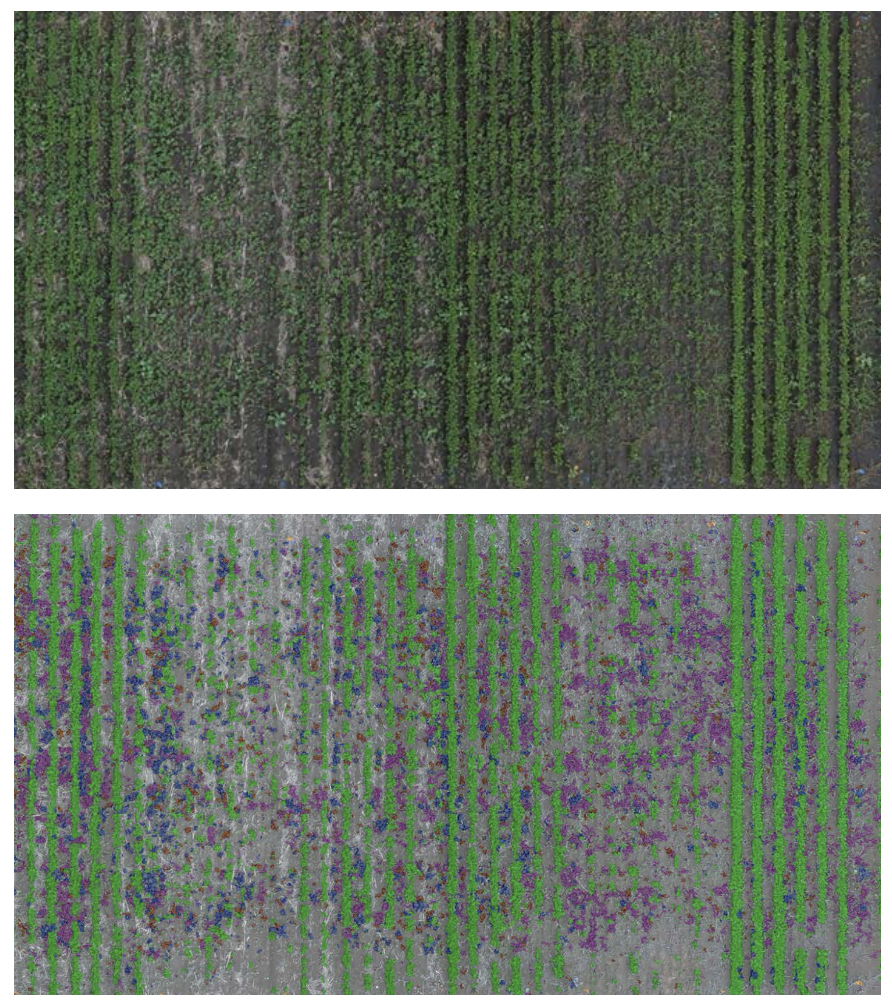
Key to these systems is computer vision and trained machine learning models that can identify and segment weeds either by category or species in a crop canopy (5). Models for weed segmentation in soybean (Fig. 1), canola and wheat have been developed and continue to be refined by the UM team. Computationally, weed categorization into broad categories is more efficient than speciation.
Toward a comprehensive, sustainable weed management future
Once operational, this comprehensive tool will provide excellent weed control, reduce pesticide costs for the producer and offer a safer way to produce food that meets the demands of discerning export markets while protecting the environment. The decision-making tool can also be used in conjunction with non-herbicidal weed management tools, such as in-crop tillage, laser-weeding or other site-specific weed management approaches. Furthermore, the computer vision algorithms will be very effective for early detection and rapid response to existing and new HR weeds via high-density remote sensing and detection of herbicide escapes growing in the understory.
References
- Soltani N et al. 2017. Weed Technology 31:148-154
- Soltani N et al. 2018. Weed Technology 32:342-346
- Beckie HJ et al. 2020. Weed Technology. 34:461-474
- Swanton CJ et al. 1999. Canadian Journal of Plant Science. 79:165-167
- Gomroki M et al. 2025. Smart Agriculture Technology. DOI: https://doi.org/110.1016/j.atech.2025.101472