
Adjunct Assistant Professor Zhongwei Huang and Dr. Paula Benny discuss perimenopause and ovarian ageing, highlighting the importance of future interventions focused on early detection, personalized treatments, and lifestyle modifications to improve health outcomes and longevity
Perimenopause is defined as the time preceding menopause, often lasting up to ten years (Cunningham et al, 2025). While menopause is more clearly identified with amenorrhea lasting for 12 continuous months, drastic hormonal shifts and symptoms such as hot flushes, perimenopause is less clearly recognized due to menstrual disturbances and a myriad of symptoms (e.g., vasomotor symptoms, sleep changes, etc) which make its clinical management and treatment challenging.
Concept of ovarian ageing
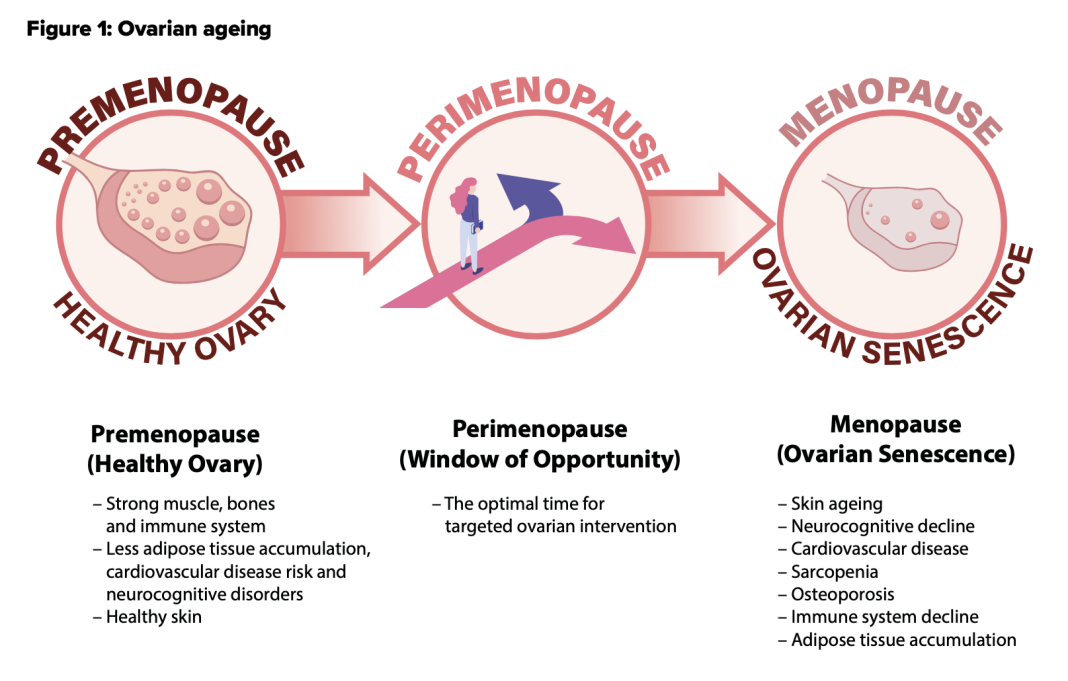
Ovarian follicles, comprised of an oocyte (egg), granulosa cells, and theca cells, support oocyte development and secrete female sex hormones (Qin et al, 2025). Ovarian ageing, due to a gradual loss of ovarian follicles, is often referred to as the pacemaker of female ageing, as it is linked to age-associated diseases such as osteoporosis, sarcopenia, cardiovascular disorders, and neurocognitive decline (Wu et al., 2025). With a rapidly ageing society, mitigating ovarian ageing has become a new focus of gerotherapeutics and women’s health research (Benny et al., 2025).
STRAW+10
The Stages of Reproductive Ageing Workshop (STRAW+10) criteria represent the current gold-standard in categorizing ovarian ageing through a combination of menstrual cycle patterns, endocrine markers (FSH- follicle stimulating hormone, LH- luteinizing hormone, Inhibin B), antral follicle count, and peri/menopausal symptoms (e.g., vasomotor symptoms, urogenital issues) (Harlow et al, 2012). The two distinct stages of perimenopause are the early transition stage (Stage -2), characterized by regular menstrual cycles with some irregularities, variable FSH levels, and low ovarian reserve, and the late transition stage (Stage -1), marked by prolonged amenorrhea lasting at least 60 days, high FSH levels, and low ovarian reserve.
More recently, other biomarkers (e.g., microbiome, small RNAs, menstrual blood markers) of women’s health have been explored to provide early indicators of perimenopause and menopause, toward the development of more effective therapeutics (Benny and Kuerec et al., 2025).
Symptoms of perimenopause
The perimenopause experience is unique to each woman, with the most common reported symptoms including hot flushes, brain fog, aches and pains, vaginal dryness, and joint pains, and these symptoms arise due to a gradual decline in female sex hormones (Santoro et al, 2021). Therefore, hormone replacement therapy remains one of the most effective treatments for menopausal symptoms as it aims to restore estrogen and progesterone levels (Flores et al, 2021).
Associations with healthspan
New research has shown that late age at natural menopause (ANM >55 years) was associated with a longer lifespan and reduced overall health risks in women, due to the beneficial effects of systemic estrogen protection (Xing et al., 2024). Of note, it has also been reported that late ANM was associated with ‘younger’ ovaries (Shuster et al, 2010). Women with premature menopause or early loss of ovarian function (<40 years old) experienced increased adverse effects on bone health, neurocognition, cardiovascular health, and an increased risk of early mortality (Faubion et al, 2015). Therefore, scientists and clinicians are now exploring the possibility of extending ovarian longevity beyond fertility to delay menopause and preserve overall health (Benny et al., 2025).
Future directions: focusing on perimenopause for healthy longevity
While perimenopause and midlife have been described as a vulnerable time in a woman’s life, it is also dynamic and amenable to meaningful change. Early screening, timely diagnosis, and personalized treatments (e.g., lifestyle modifications to optimize diet, physical activity, sleep, and stress; hormone replacement therapy; supplements; pathway-targeted activators and inhibitors; antioxidants) that target ovarian ageing would significantly enhance a woman’s healthspan and overall quality of life. Advocating for awareness, improving public health policies, and refining clinical guidelines for perimenopause management represent areas that would significantly improve women’s healthcare towards healthy longevity.
References
- Benny P, Kuerec AH, Yu J, Lee J, Yang Q, Maier AB, Huang Z. Biomarkers of female reproductive aging in gerotherapeutic clinical trials. Ageing Res Rev. 2025 Dec;112:102901.
- Benny P, Yuan X, Yang Q, Chavarro J, Kennedy B, Huang Z. Slowing down the clock on ovarian aging – does the ovary hold the secret to the fountain of youth? Geroscience. 2025 Sep 10.
- Cunningham, A.C., Hewings-Martin, Y., Wickham, A.P. et al. Perimenopause symptoms, severity, and healthcare seeking in women in the US. npj Womens Health 3, 12 (2025).
- Faubion SS, Kuhle CL, Shuster LT, Rocca WA. Long-term health consequences of premature or early menopause and considerations for management. Climacteric. 2015;18(4):483-91.
- Flores VA, Pal L MJ. Hormone Therapy in Menopause: Concepts, Controversies, and Approach to Treatment. Endocr Rev. 2021;42(6):720–52.
- Harlow SD, Gass M, Hall JE, Lobo R, Maki P, Rebar RW, Sherman S, Sluss PM, de Villiers TJ; STRAW+10 Collaborative Group. Executive summary of the Stages of Reproductive Aging Workshop +10: addressing the unfinished agenda of staging reproductive aging. Climacteric. 2012 Apr;15(2):105-14.
- Qin S, Chi X, Zhu Z, Chen C, Zhang T, He M, Gao M, Zhao T, Zhang J, Zhang L, Zheng W, Chen Z, Wang W, Zhou B, Xia G, Wang C. Oocytes maintain low ROS levels to support the dormancy of primordial follicles. Aging Cell. 2025 Jan;24(1):e14338.
- Santoro N, Roeca C, Peters BA, Neal-Perry G. The Menopause Transition: Signs, Symptoms, and Management Options. J Clin Endocrinol Metab. 2021 Jan 1;106(1):1-15.
- Shuster LT, Rhodes DJ, Gostout BS, Grossardt BR, Rocca WA. Premature menopause or early menopause: long-term health consequences. Maturitas. 2010 Feb;65(2):161-6.
- Xing Z KR. Age at natural or surgical menopause, all-cause mortality, and lifespan among postmenopausal women in the United States. Menopause. 2024;31(3):176.