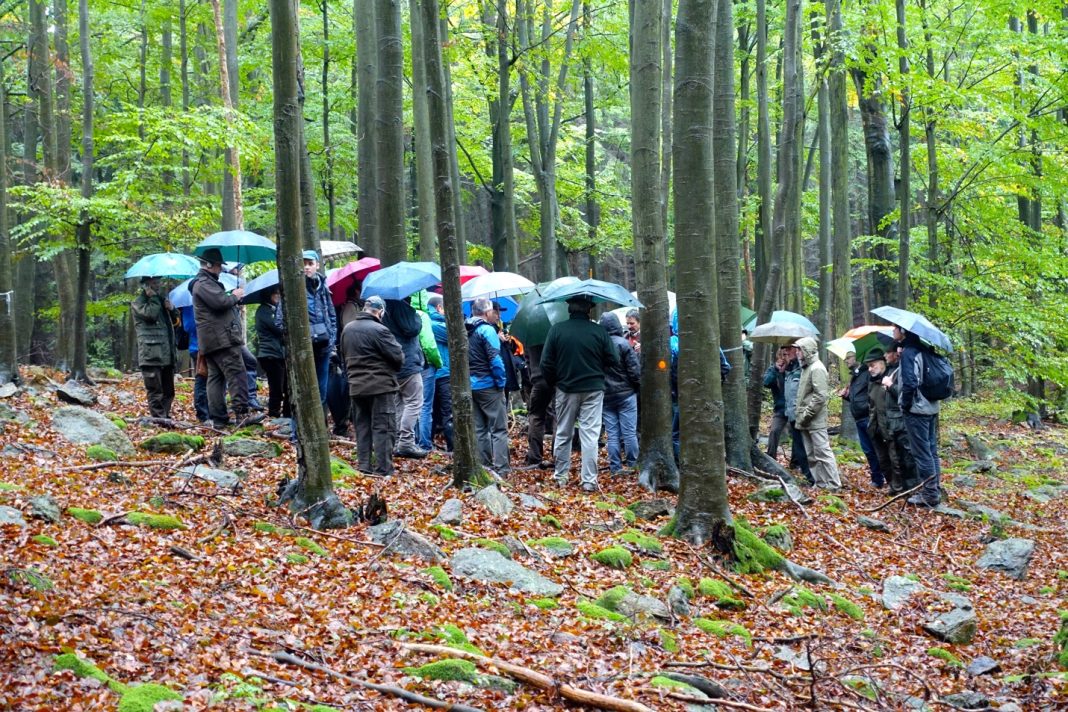
As climate and biodiversity crises grow more complex, productive exchange between researchers, practitioners and policymakers becomes crucial. This article outlines the hurdles to efficient dialogue and the approaches that can help build trust, shared understanding and real-world impact
The growing complexity of ecological and social challenges – such as mitigating and adapting to climate change – and the time pressure to address them demand pooled knowledge and expertise. Equally crucial for bridging the gap to practical management is intensive dialogue between research, practice and politics.
We need to talk, exchange and learn from each other
The first, non-trivial step is creating a shared technical language, as natural scientists, social scientists and experts from practice, administration and politics work within different realities, terminologies and vocabularies. Terms like “model” (a mental construct in social sciences versus mathematical equations or code in natural sciences) or “resilience” (ability to withstand change in social sciences versus recovery from disturbance in natural sciences) illustrate this.
Developing a common language requires time, openness and actors willing to leave their comfort zones; this is often the biggest early hurdle. Because many problems are now supraregional or global, dialogue across languages and borders is also essential – linguistic barriers remain significant even with emerging AI-based translation.
Our long-standing research on climate change impacts on forests and their ecosystem services shows that only holistic studies capturing multiple drivers and the complex interactions and feedback loops among ecological, social and economic processes can meaningfully influence policy and real-world decisions. Whether such insights are adopted ultimately depends on whether stakeholders feel addressed, participate genuinely, and trust not only the results but also the scientists personally. This trust is the key prerequisite for accepting potentially difficult scientific findings.
Transdisciplinarity as a key approach for knowledge exchange
Transdisciplinary research can generate new knowledge that supports real-world decision-making for sustainable development. An ideal transdisciplinary process typically involves:
- Forming a collaborative research team and motivated experts representing stakeholder interests;
- Jointly framing the problem to build a shared understanding;
- Defining research topics and questions together;
- Designing a methodological framework for collaborative knowledge production and integration; and
- Establishing transdisciplinary procedures and settings for this integration.
Following these steps helps avoid “research tourism,” where researchers conduct analyses but leave the region without reintegrating results – undermining project evaluation, reducing the likelihood that findings inform decisions, and weakening future stakeholder engagement. Long-term commitment to a case study region is therefore essential for successful transdisciplinary research.
Experience-based versus evidence-based know-how exchange?
Whether results from transdisciplinary studies influence real-world decisions ultimately depends on how they are communicated and whether they attract attention. Surveys show that experience-based sources – personal experience and direct exchanges with colleagues or experts – often matter more than only evidence-based sources like journal articles or professional guidelines. Once mutual trust is established, and given that practitioners have limited time to seek out new research, scientists should offer brief, target-group-specific summaries in national languages, shared through specialised websites or podcasts.
Stakeholder fatigue as an emerging challenge
Increasingly, research funding agencies require explicit stakeholder involvement to promote exchange and joint learning between research, practice, and policy. This creates two main problems: first, researchers must engage with stakeholders even if uninterested, or risk project rejection; second, some stakeholders lack interest or time to participate. Consequently, interested and supportive stakeholders are repeatedly consulted by motivated – or sometimes less motivated – researchers, resulting in inefficient dialogue, pro-forma integration, frustration, and ultimately stakeholder fatigue, which undermines both the research and the crucial dialogue.
Good practice examples as a key communication approach
Researchers are trained to focus on problems and failures and develop solutions accordingly. Yet examples of good practice often provide an ideal basis for successful interaction and joint learning: they reflect practitioners’ real-world solutions and serve as test environments for applying research, testing theories, and reality checks. Adjustments to management practices can be trialed within a manageable framework, progress monitored, and results communicated comprehensibly and tangibly. Such good practice examples can be seen as local responses to global challenges, as Nobel laureate Elinor Ostrom illustrated for water management – applicable directly to forest management.
The way forward
Research that matters and effectively addresses climate change adaptation, sustainable forest services, and biodiversity requires constructive, targeted dialogue between research and practice. Jointly designed and implemented projects can act as “game changers” for sustainability transformations.
Examples include:
- ETH Domain’s MainWood project, promoting construction timber use along the wood value chain to support the bioeconomy and contribute to a climate neutral society while respecting biodiversity;
- Mixed science/practice networks like the European Integrate Network, fostering integrated forest management that balances biodiversity and forestry;
- The TriNational FORESTLab, linking national and international networks (SwissForestLab, NFZ-Forestnet Nancy/ Fribourg/Zurich) with the stakeholder- oriented forest knowledge platform waldwissen.net;
- EU Horizon projects TRANSFORMIT and WILDCARD, promoting biodiversity and naturalness in European managed forests in close collaboration with experts from practice.
These efforts demonstrate effective transdisciplinarity and joint knowledge generation. Ultimately, these projects, networks and platforms rely on trust, reliability, and continuity, requiring careful maintenance, because what takes years to build up can be destroyed in a short time.
References
- European Union (2025) Special Eurobarometer 557 – European citizens’ knowledge and attitudes towards science and technology. DOI: 10.2777/6040908
- Fabian Y, et al. (2019) How to close the science-practice gap in nature conservation? Biological Conservation, 19:93-101.
- Huber R, Rigling A (2014) Commitment for continuous research as key factor in transdisciplinarity: Experience from the “Mountland”-project. Gaia, 23: 256-262.
- Integrate Network: https://integratenetwork.org/
- Krumm F, Schuck A, Rigling A (eds) (2020) How to balance forestry and biodiversity conservation – A view across Europe. European Forest Institute EFI, Swiss Federal Research Institute WSL, 650 pp.
- MainWood project: https://www.mainwood.ch/
- NFZ-Forestnet: https://www.nfz-forestnet.eu/
- Ostrom E, et al. (1999) Revisiting the Commons: Local Lessons, Global Challenges. Science, 284: 278-282.
- Pohl, C. (2011) What is progress in transdisciplinary research? Futures 43/6:618–626.
- The SwissForestLab: https://swissforestlab.wsl.ch/en/
- The TriNational ForestLab: https://trinational-forestlab.wsl.ch/en/
- TRANSFORMIT project: https://transformforests.eu/
- Waldwissen.net: https://www.waldwissen.net/en/
- WILDCARD project: https://wildcard-project.eu/