
Vision-based strawberry plant assessments are essential first steps towards increased automation, mitigating periodically high labour demands
In temperate regions such as Belgium and the Netherlands, strawberry plants are propagated on open-air tray fields. After the summer solstice, runner plantlets develop into young plants over the course of four to five months. In June-bearing varieties, shortening days trigger flower induction; in everbearing types, the first flowering flush begins. Once plants reach the right stage, they are cold-stored for later production.
Transforming labor-heavy propagation processes
Strawberry propagation involves many labour-intensive tasks, which include predicting runner production, plantlet harvest, plantlet quality control, installing in substrate, growth monitoring, young plant harvest, and final quality checks. These activities are unevenly spread across the season, creating strong labour peaks. The heaviest peaks occur in June, July, and August, during plantlet collection and field installation, and again in November and December when young plants are harvested, packed, and stored.
Today, these tasks depend on a large seasonal workforce. Business continuity – and any ambition to scale – relies heavily on the availability of skilled workers. Automation offers a clear opportunity, but also a challenge: human decisions must be translated into robotic actions.
The most promising pathway is AI-based image processing, which can enable high-throughput plant handling and quality control throughout the entire propagation workflow.
Identification of high-impact automation target
Although the use of camera systems and AI combined with automated solutions represents the future, implementing these technologies is not an end in itself. They are tools to achieve broader objectives. Goals that these technologies can support include labour savings, quality control, harvest forecasting, and work and logistics planning.
Within the Interreg project “PlantGoed”, we analysed the entire workflow with these objectives in mind and prioritized three pathways for AI application research:
- Identification of runner plantlets on strawberry mother plants in the greenhouse. Our aim is to build a foundation that could later enable the development of an automated runner harvesting system.
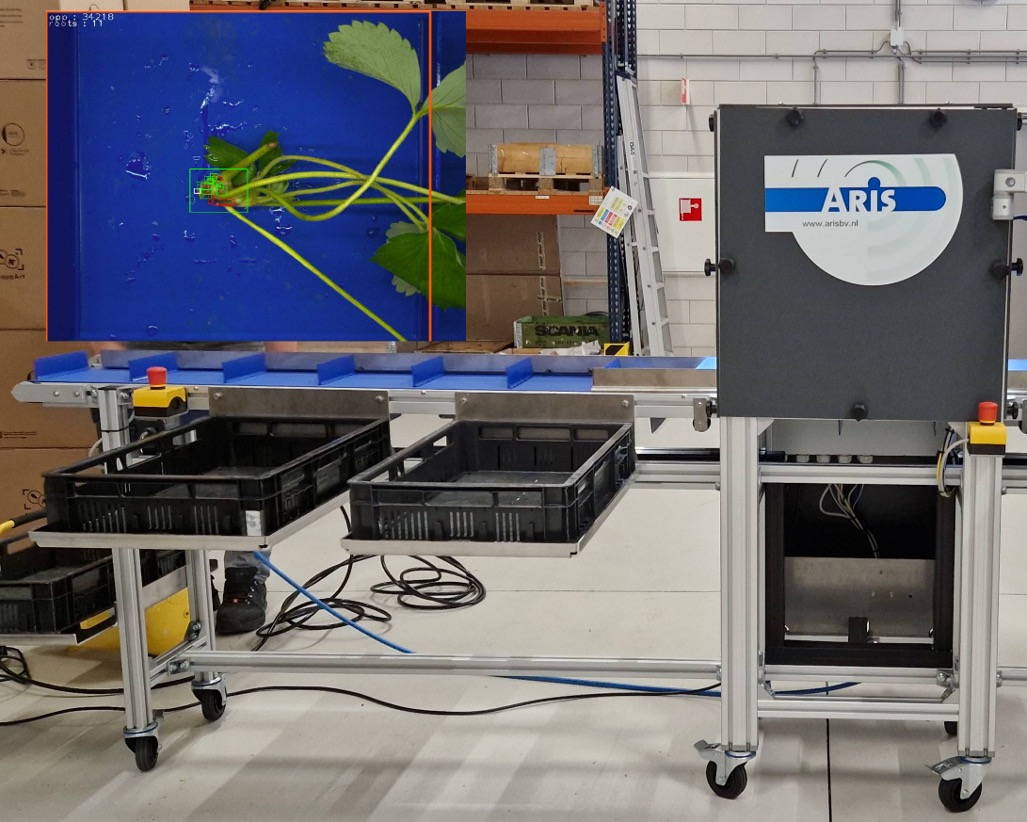
- Automated quality assessment of runner plantlets on a conveyor belt. By determining early whether a plantlet meets the desired quality standards, we prevent planting non-viable material. A camera can perform this task faster and more objectively than humans.
- Quality assessment of young plants at harvest. Here, the goal is to objectively and reliably sort these plants into several quality classes, which indicate their potential to produce more or fewer strawberries in the following year.
Building and testing AI solutions
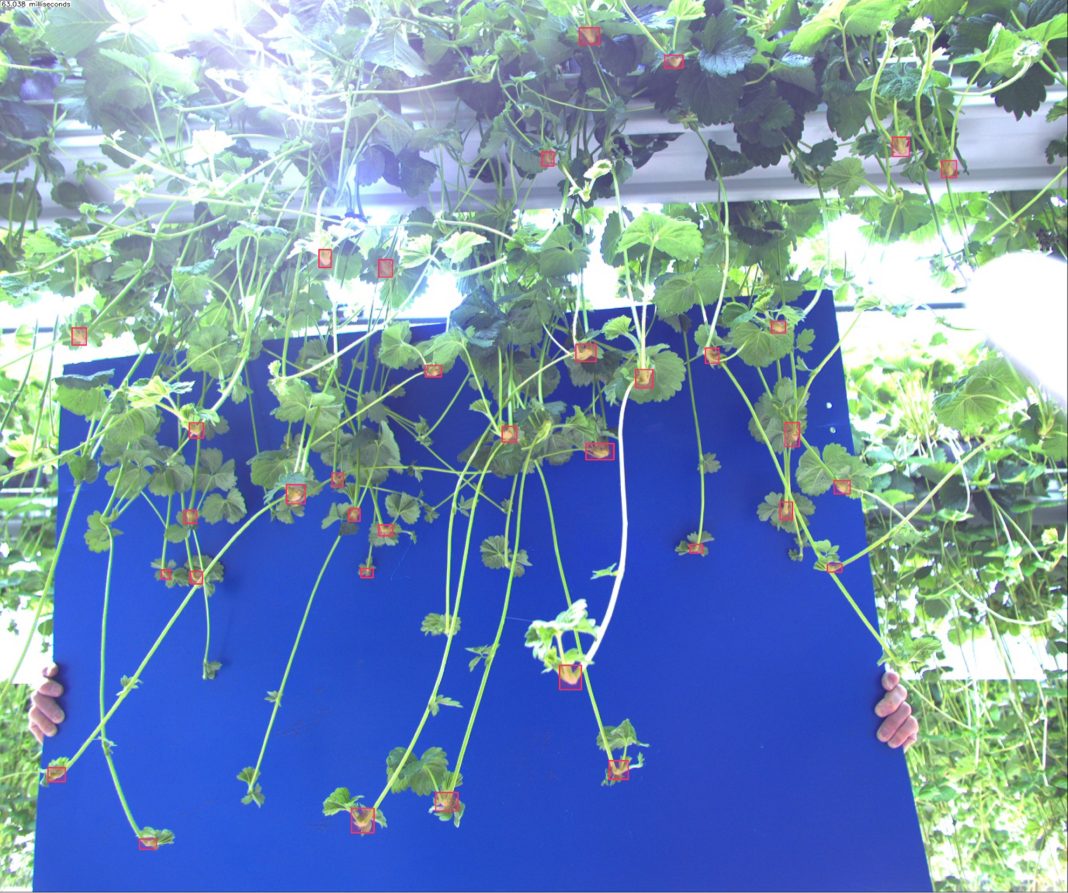
Identification of runner plantlets on strawberry mother plants was carried out using a color camera mounted on the harvesting platform, which moves horizontally and vertically along the rows of mother plants. Initially, we used a blue backplate to minimise light variations (sunny, cloudy, foggy conditions).
During a second run, we succeeded in both eliminating the requirement of a backplate and improving the recognition of runners on the plants. This demonstrates that it is possible to identify runners in a dense green environment. To serve as input for an automated harvesting system, sensor fusion must be applied. The goal is to link runner detection to the 3D coordinates of the cutting point. This process must also account for underlying runners that must not be damaged.
Selection of runner plantlets has been enabled through the use of an RGB camera combined with real-time image processing. Even in a dynamic environment, this prototype system successfully detected a significant number of suitable plantlets, focusing on the identification of emerging root tips. This provides valuable feedback to propagators for planning purposes. To further enhance the solution, a full 360-degree evaluation of each plantlet should be implemented.
For propagators, knowing the production potential of young plants before packing and selling is critical. Through a series of co-creative exercises with relevant stakeholders, key characteristics were identified and integrated into an image-based assessment tool. The next step is validation in a commercial setting prior to further development.
Future prospects
Although AI isn’t a goal on its own, the use of intelligent and automated solutions is the way forward. There is a significant shortage of available labour, which becomes even more costly and harder to fill during peak periods. In addition, the next links in the chain – strawberry growers and consumers – are becoming increasingly demanding, making objective quality control and harvest forecasting essential. Without automated solutions, the sector cannot achieve this higher level.
Developing and implementing these “robots” is highly challenging and time-consuming, with user expectations and system capabilities frequently misaligned. One common pitfall is designing automated solutions based on the exact workflow humans perform, which is often too complex, both technically and financially. Another is striving for 100% flawless automation, which is rarely realistic and typically very expensive.
It is therefore better to consider how technology can be deployed to assist people in their tasks. This includes supporting them with heavy and repetitive work. By integrating technology and human expertise into a hybrid solution, we can combine the strengths of both.