
The PRecycling project aims to recover high-quality polymeric materials from underutilized plastic waste streams, focusing on developing near-production-scale recycling processes to transform plastic waste into secondary raw materials, and enabling up to 100% recycled content incorporation in new products
Plastic waste from consumer electronics and electrical equipment (WEEE), toys, and textiles represents a key underutilized source of secondary raw materials in Europe. The PRecycling project, in response to stricter resource and climate targets, develops near-production-scale recycling processes to recover high-quality polymeric materials (recyclates) from these waste streams. The main goal is to transform plastic waste into secondary raw materials of sufficient quality to re-enter product value chains, supporting both closed- and open-loop circular models while leveraging digital product passports (DPP) to enhance traceability. Through advanced sorting, purification, decontamination, and reprocessing, PRecycling enables the recovery of high-purity polymer fractions (e.g. HIPS, ABS, PP, PET, PA), achieving up to 100% recycled content incorporation in new applications, unlocking the urban mining potential of plastic waste and setting the foundation for more transparent and resilient circular value chains.
EU regulatory landscape
Despite EU advances in setting recycled content targets, significant barriers hinder harmonized implementation across Member States, including inconsistent definitions of post- industrial, pre-consumer, and post- consumer waste, unclear distinctions between waste and by-products, the lack of harmonized End-of-Waste criteria, and loopholes in calculation methods for recycled content across materials and processes. This advocates for harmonized calculation and verification procedures, supported by accredited third-party certification, digital traceability tools (e.g., ‘raw material passports’), and clear eco-labelling schemes to improve consumer awareness.
Approaches, materials & methods
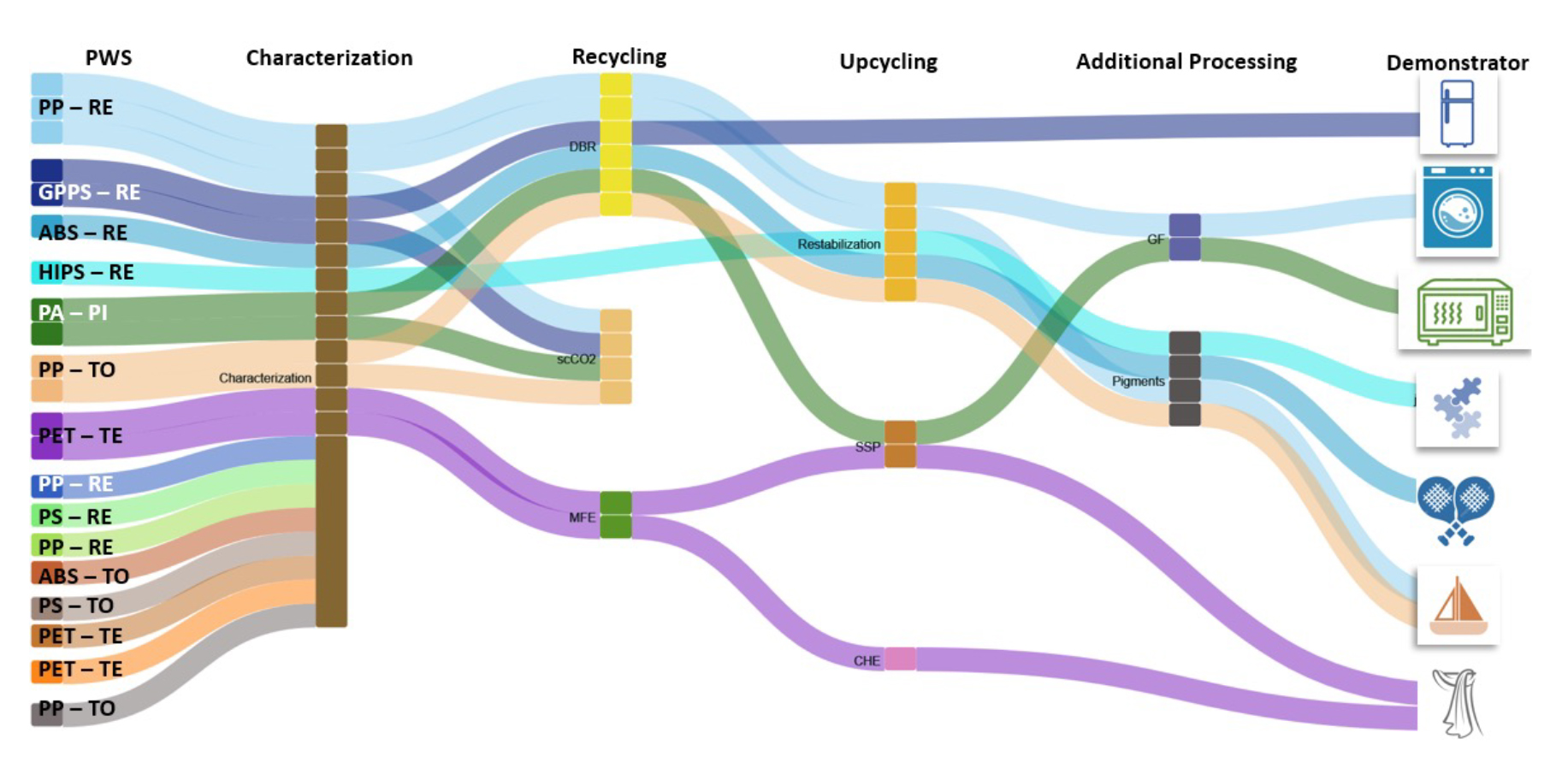
PRecycling targeted three waste streams: (1) WEEE plastics from discarded home appliances with high content of PP, ABS, HIPS, and PA, presence of legacy additives (e.g., flame retardants); (2) end-of-life toys, made from PP, PS, and mixed polymers; (3) discarded polyester-based textiles (garments, curtains). Initially, a comprehensive inventory and characterisation of incoming plastic waste streams (PWS) from several European regions, focusing on plastics from WEEE, end-of-life toys, and textiles has been conducted. Key waste types, volumes, and polymer compositions were estimated, highlighting substantial recycling potential compared with landfilling or incineration. Selected PWS were thoroughly characterised using consortium-state-of-the-art methods, verifying the sampling/homogenisation protocols developed and providing representative data on polymer composition and contaminant loads. Afterwards, advanced sorting techniques were employed, combining optical sorting and density separation to obtain a polymer-rich stream. Laser-Induced Breakdown Spectroscopy (LIBS) was selected as the preferred sensor technology for online sorting, contaminant detection, and polymer/additive identification based on the inventory and target requirements. Sorted polymer-rich streams were submitted to matching recycling and upcycling workflows.

Recycling & upcycling routes
Three recycling routes were demonstrated: mechanical melt-filtration recycling of legacy additives ‘clean’ polymer fractions, dissolution- based recycling (DBR), and supercritical CO2 extraction for purification of additive-rich streams. scCO2 proved highly effective for removing specific additives in single-polymer streams (and for textile spin-finishes where economically feasible), while DBR was validated as the preferred route for mixed, additive-rich WEEE and toy streams, achieving strong depletion of halogenated flame retardants and antimony. Upcycling and restabilisation strategies delivered promising results: tailored additive formulations stabilised rPP and rABS during reprocessing; reactive extrusion with chain extenders (REx) restored rPET’s intrinsic viscosity to spinning specifications; and solid- state polymerization (SSP) restored rPA’s mechanical and thermal properties, reaching performance levels comparable to virgin material, suitable for high-value applications. Obtained recyclate pellets were used to manufacture demonstrator products by injection moulding (toys, fabric, and home appliance parts) and to produce ABS and HIPS filament for 3D printing to demonstrate additive manufacturing of toys demonstrators.
Recyclate acceptance criteria & demo cases
To ensure recyclate quality and compliance for the final demonstrators, and to guide subsequent material development and validation activities, technical and regulatory parameters have been specified. Acceptance criteria for recyclates used in household appliances, toys, and textiles, addressing manufacturers’ technical requirements, material safety, and regulatory compliance, as well as consumer acceptance factors such as performance and sensory quality, have been defined. Consumer acceptance criteria, which focused on odor, color, and tactile properties, revealed that most recyclates met industrial and safety standards, particularly for toys, despite some minor mechanical variations. This confirms their suitability for use in consumer products. The successful integration of recycled polymers (HIPS, ABS, and PP) into toy manufacturing has been demonstrated through 3D printing and injection molding, achieving compliance with EN 71 safety standards. High-quality recycled polymers, when properly compounded and processed, can successfully replace virgin materials in selected household appliance components without compromising performance or safety. Each demo case, namely PP-based washing machine filter pump, PA66-based oven card holder, and HIPS-based refrigerator rail, has confirmed the material’s compatibility with existing industrial processes and functional needs. Closed-loop fibre-to-fibre recycling of polyester textiles is technically feasible and scalable, producing OEKO-TEX®- compliant fabrics entirely from recycled PET waste through optimized mechanical processing and molecular weight restoration via reactive extrusion or solid-state polymerization, marking a key step toward EU textile circularity goals.
Key findings
High-quality, safe recyclates have been produced through dissolution-based recycling and upcycling routes such as remelting-restabilisation (RR), SSP, and reactive extrusion. Comprehensive characterization of selected waste streams and produced recyclates was completed following optimized sample preparation and homogenization methods developed within the project, while acceptance criteria and analytical methods were established to ensure consistent recyclate performance. Tailored aging and accelerated aging protocols were validated, and a lifetime prediction model using QSPR methods has been built. The potential of PRecycling recyclates through prototype developments in key sectors such as toys, household appliances, and textiles has been demonstrated, indicating strong potential for industrial scale-up, emphasizing feedstock reproducibility, process consistency, and material performance, supporting the broader project objectives to enhance material circularity, reduce environmental impact, and promote sustainable polymer applications across several industrial sectors.
Digital Product Passports (DPPs) were implemented for toys, EEE products, and textiles, each featuring a unique QR code to ensure digital traceability. As the project enters its final phase, the LCA, LCC, and TEA assessments are under finalization, and the exploitation strategy concluding report is in preparation, consolidating PRecycling’s impact on circular plastics innovation.
Based on the in-depth mapping of existing definitions and gaps in recycling terminology, the PRecycling team has developed an interactive digital platform, the Plastic Recyclate Handbook Demo. This tool compiles essential recycling-related terminology and will be publicly launched at the project’s closure.
Lessons learned
The PRecycling results demonstrate that high-quality plastic recyclates can be produced from discarded EEE, toys, and textiles plastic waste streams, and that this is technically and economically feasible when supported by adequate collection, sorting, and purification infrastructure. The demonstration paves the way for new business models, e.g., established take-back schemes, recyclers offering ‘polymer-as-a-service’, and DPP tracking polymer origin and recyclate content. The need for incentives to support the collection and standardisation of recycled-content materials is highlighted, as are efforts to overcome remaining barriers, e.g., heterogeneous material blends, the presence of legacy additives, and regulatory uncertainties for recyclate use in sensitive applications. Scaling up will require investment in sorting and purification, standardisation of recycled material quality, and market acceptance of recycled-content products. Demonstrators in closed- and open- loops validate the concept of urban mining of plastic waste and provide a blueprint for scalable circular plastic value chains. The recommendation calls on industry, value-chain partners, and policymakers to collaborate to scale these processes, integrate design-for- recycling principles, and establish market conditions that foster the uptake of recycled content at the industrial level.