
Rare diseases (RDs) affect 3+ million people in Canada, yet for many patients and families, the journey to diagnosis, care, and support remains long, fragmented, and inequitable. The Canadian Rare Disease Network (CRDN) was launched in 2024 to help fill this gap
Canadian Rare Disease Network (CRDN) | Réseau Canadien des Maladies Rares (RCMR): Connecting Canada’s Rare Disease Ecosystem for Impact.
Despite world-class research, strong patient advocacy, and pockets of excellence in care delivery, Canada has historically lacked a coordinated, pan-Canadian mechanism to connect these efforts.
Administratively housed at the University of Calgary and enabled through initial support from One Child Every Child, CRDN is a pan-Canadian initiative designed to activate, connect, and coordinate key actors across research, healthcare, and patient communities. It is co-led by a diverse group of experts spanning disciplines, sectors, and lived experience.
Its strength lies not in replacing existing organizations or duplicating efforts, but in connecting what already exists and enabling it to work better together. More than a research consortium or advocacy organization, CRDN acts as the connective tissue that links people, priorities, and projects around a shared vision:
Innovative care and research so all patients and families affected by a RD are empowered to live to their full potential.
From innovation to impact: Integrating research and care
This vision goes beyond medical breakthroughs. It reflects a growing recognition – shared globally – that improving outcomes for people affected by RDs requires integrating research and care, so discoveries quickly translate into practice and real-world care experiences inform the next generation of research. It also acknowledges that the quality of life for people with RDs is shaped by a broad spectrum of needs. Medical care is essential, but it is not sufficient on its own. Psychological well-being, social inclusion, financial stability, education, and access to appropriate supports across the lifespan are all critical components that need to be addressed. CRDN’s work is therefore grounded in a whole-system perspective, with strong emphasis on coordination, equity, and learning.
Built with and for the rare disease community
Central to CRDN’s approach is the belief that patients and families must be partners, not afterthoughts. Lived experience is not simply consulted, but embedded across governance, priority-setting, and program design. Umbrella patient organizations like the Canadian Organization for Rare Disorders (CORD) and Regroupement Québécois des maladies rares (RQMO) play a central role in this work, ensuring that lived experience, community priorities, and equity considerations remain at the heart of collective action.
A strategic framework built by the community
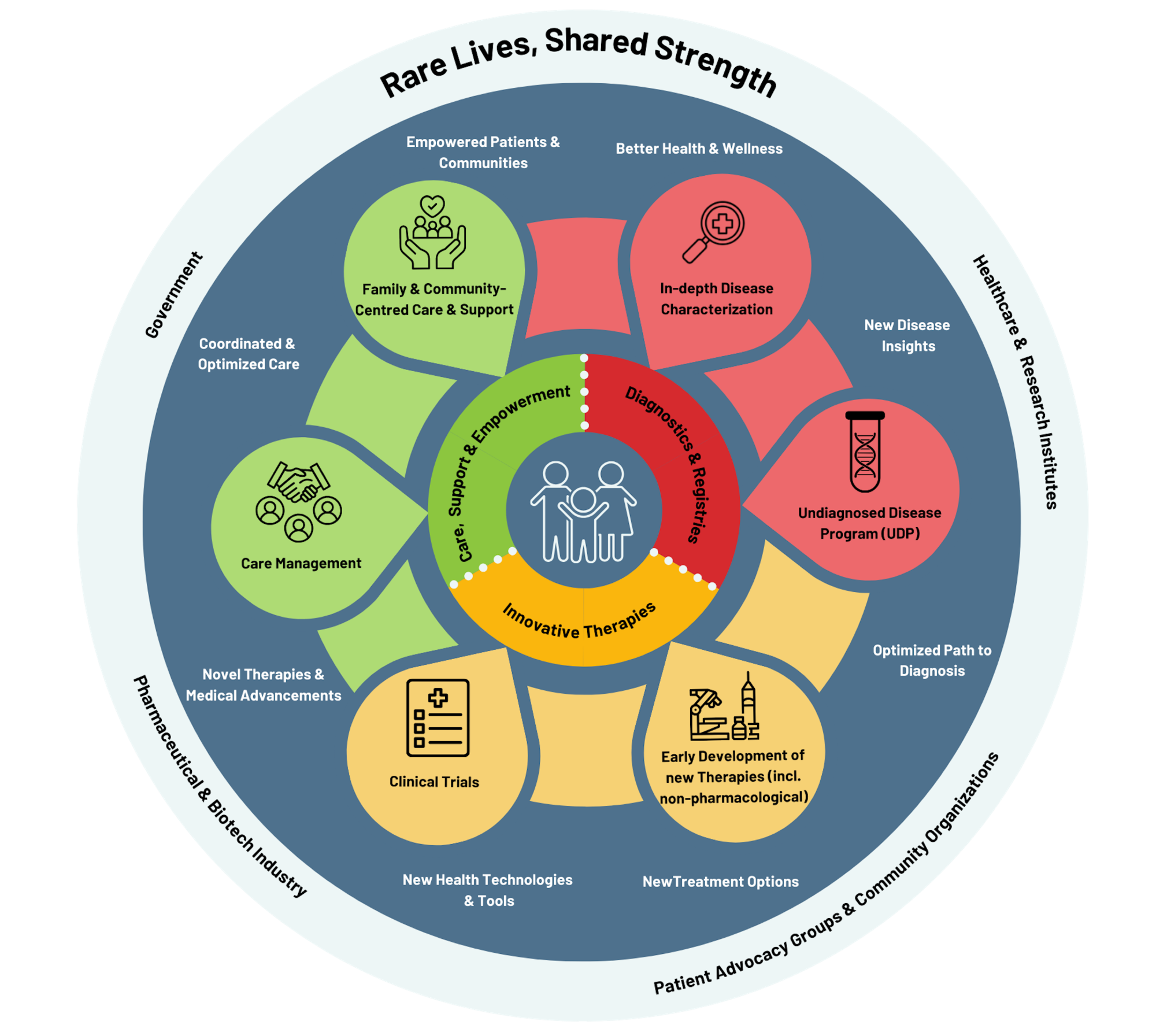
CRDN’s strategic framework, developed by and for Canada’s RD community, is organized around four interrelated pillars, each addressing a critical dimension of the RD landscape:
- Diagnostics and registries (Led by Dr Kym M. Boycott): This pillar focuses on improving equitable access to timely and accurate diagnosis, advancing harmonized newborn screening, and strengthening interoperable data systems and registries that enable learning, research, and care coordination.
- Innovative therapies (Led by Dr Leanne M. Ward): This pillar aims to strengthen Canada’s ability to design, test, and deliver promising therapies – both pharmacological and non-pharmacological – across the full pipeline from discovery and clinical trials to access and real-world implementation.
- Care, support, and empowerment (Led by Dr Ian Stedman): Recognizing that diagnosis and therapies alone are not enough, this pillar addresses the broader needs of people with RDs, including care navigation, psychosocial, educational, and financial support, and community-based services that enable individuals and families to thrive.
- National and global collaboration: RDs are, by definition, rare – making collaboration essential. This pillar focuses on aligning efforts across Canadian provinces, organizations, and sectors, while connecting Canada with global RD initiatives. Global collaboration accelerates learning, avoids duplication, and ensures Canada both contributes to and benefits from global progress.
Each pillar is designed with a dual lens: leverage and strengthen what already exists, while identifying and filling gaps with forward-looking systems that enable long-term, sustainable impact. This ensures the framework is both pragmatic and aspirational –grounded in current realities, yet ambitious enough to drive transformative change.
By fostering coordination, shared learning, and partnership across sectors and borders, CRDN is helping to build a more integrated, equitable, and responsive RD ecosystem in Canada. Its work offers insights not only for Canada, but for other jurisdictions grappling with similar challenges in rare disease policy, research, and care.