
In this first article in a series, Penelope J. Corfield explores living in an age of accelerating globalisation as part of the citizens of the world focus
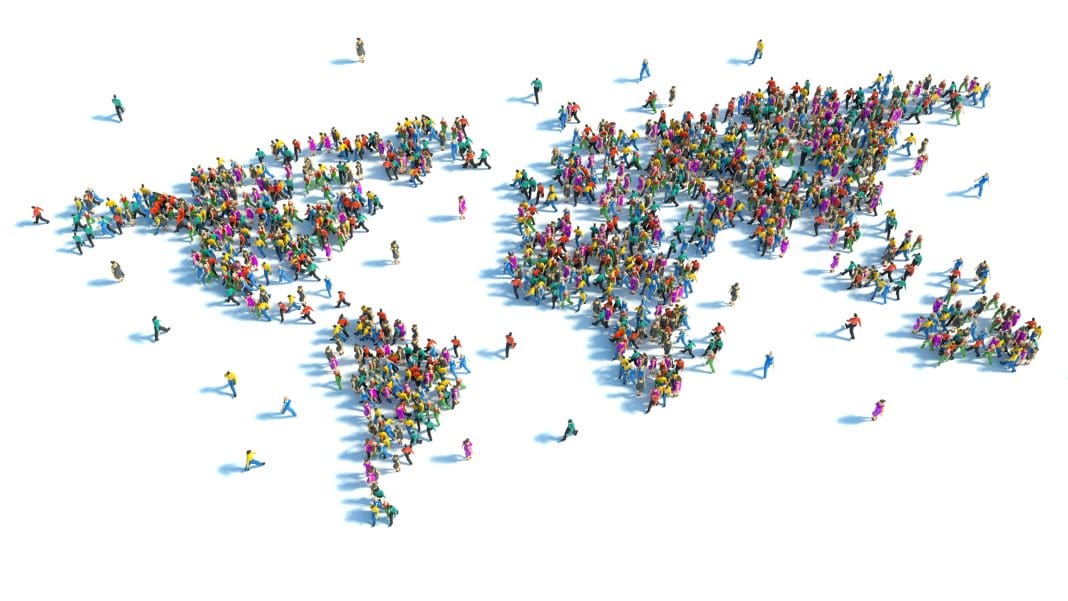
One ‘vast empire of human society’ spreads throughout the world – and throughout all time. And it flourishes, despite the many global variations in climate, languages, and manners – and despite many disagreements between these global citizens. The ardent young William Wordsworth expressed that viewpoint in 1800. And others – from Socrates in classical Greece to America’s Dr Martin Luther King Jnr in 1967 – have made the equivalent point, when declaring themselves to be ‘citizens of the world’.
In some obvious ways, of course, that allegiance was and is purely theoretical. Individuals today do not owe fealty to any one international authority. There are no global identity cards – no global passports (ready for a notional trip to the Moon?) – no global electoral registers.
Intensified globalisation
Yet all humans are living today in a long-term trend of intensified globalisation. Complex networks of trade, transport and tele-communications all routinely criss-cross the world. Global links are not necessarily eroding local, regional, national and other sectoral loyalties. But global ties are adding a further layer of cultural identification into the rich brew of human affiliations.
By the way, there have been a few self-declared ‘citizens of the world’ who have tried, unavailingly, to live outside all existing nation-states. Such actions indicate the fervour that acute global devotion can arouse. Here, however, the discussion refers simply to those millions of humans who have multi-layered loyalties, from highly local to pan-global.
The causative factors encouraging an intensified sense of global sharing have long been in operation. Here, the focus is on official links. A partner essay will follow later, exploring unofficial ties.
Sovereign states guard their rights zealously. They are all aware, however, that they do not exist in isolation. (Some, with hostile neighbouring states, are only too well aware of that grim fact!) So there has been a long history of inter-state cooperation of various kinds, from mutual treaties to larger group alliances. Such relationships are not devised to undermine the authority of individual states, but rather to safeguard their interests in a pluralist world.
Constructing a world alliance of all nation-states
Above all, there has been, since January 1920, a serious attempt at constructing a world alliance of all nation-states. It’s an ambitious project. And it is a journey that has known failure as well as success. The spur to founding the League of Nations in January 1920 was the emotions of horror and dismay at the ravages of the First World War. Global politicians sought to ensure that such mass carnage would never happen again. Hence, a broad-based League was established to promote peace and practical cooperation.
At its greatest extent, the League of Nations had enrolled fully 58 nation- states. Yet the U.S. from the start held aloof, even though its President Woodrow Wilson played a key role in the League’s foundation. There followed some successes – but also failures and secessions. Notably, in 1933, both Japan and Germany quit, followed by Italy in 1937 and Spain in 1939. Then the Soviet Union, which had joined in 1934, was expelled in 1939 for invading Finland. The international fabric was clearly rent. And, not much later in September 1939, the League collapsed de facto with the outbreak of the Second World War.
With the eventual return of peace, the world’s politicians were determined to try again. The United Nations, founded in October 1945, made a conscious effort to become – and to remain – as broad-based and ecumenical as possible. Today, its membership embraces the world’s full tally of 193 sovereign states – including (yes, Woodrow!) the U.S. The only territories that remain outside are either disputed enclaves (such as South Ossetia in Georgia) or those with special status (like Vatican City, the Roman Catholic HQ, which instead has observer status).
The United Nations examined
Furthermore, the UN has now reached the venerable age of 80 without experiencing any mass walk-outs. In 1965, Indonesia, under President Sukarno, withdrew. Yet its subsequent return in 1966, after the ousting of Sukarno, was accepted without demur. And there have been no expulsions. As a result, the UN survives, despite multiple tensions – and is widely (but not universally!) respected. Perspectives often vary according to where people live and whether they feel that their own nation needs international protection or otherwise.
Generally, however, the UN enshrines hopes for global peace and cooperation. Hence, its Charter pledges to protect human rights, to uphold international law, to deliver humanitarian aid and to promote sustainable development. Organisationally, too, all the League of Nations’ surviving agencies were in 1946 transferred to the UN.
Individuals may perhaps shrug and wonder what the UN means to them? After all, the world is still full of problems, including wars, famines, population migrations, economic turbulence and – becoming increasingly apparent – the damaging impact of global warming.
However, given all that, it’s all the more vital that we have an orderly global framework, which generally functions successfully. With that, international trade, traffic and tele-communications can flourish. Without that, we would live in a world of international chaos.
Other intergovernmental organisations
What’s more, people are often unaware that there is a dense network of other intergovernmental organisations (IGOs) which also sustain the global order. Some of these bodies depend upon the UN for their mandate. But far from all. Separate international treaties between participant nation-states founded some. All parties indicate a desire to establish a global framework.
One prime example of an independent IGO is INTERPOL. It was established to coordinate international policing by a separate international treaty in 1923. Another independent IGO is the World Bank, which provides financial support for specified purposes – such as aid for developing countries. One of its key components was founded by an international treaty in 1944 as the International Bank for Reconstruction & Development. And a third body, the International Maritime Organisation (with its HQ in London), was founded by the UN in 1959 to regulate all matters relating to shipping and maritime safety.
Furthermore, numerous other associations link groups of countries within world-regions. These include: the African Union, the European Union, the Association of South-Eastern Asian Nations, and the Union of South American Nations. All these bodies vary their roles according to circumstances, in what remains a continually dynamic process.
Towards inter-governmental cooperation and coordination
Given the extent of organisational links worldwide, it is clear that nation-states today are emphatically not alone. Nor are their citizens. In practice, it is too soon to tell precisely where this trend towards inter-governmental cooperation and coordination will eventually lead.
But an appropriate end to this brief survey is to note that there has been, since 1945, an International Court of Justice, operating under the authority of the United Nations. And the ICJ adjudicates upon all territorial and/or other disputes between nation-states that are referred to it.
Does the existence of this body mean an end to all wars between rival nations? As of today, it is very evident: No! But it may indicate a future alternative pathway to settle disputes without physical combat. Might, after all, is not always right. And the name of the ICJ’s majestic home at The Hague? It’s called the Peace Palace. Will the ever-strengthening global links eventually lead to an end to wars between rival nation-states? Here’s hoping.