
Dr Peter Verheyen from the Sola Society & Academy at Vienna University highlights key scientific advancements regarding evolution and the Universe
On 24 November 1859, Charles Darwin turned the world upside down with his publication “On the Origin of Species. By Means of Natural Selection or the Preservation of Favoured Races in the Struggle for Life”. Until that time, there was a general consensus reality and the world around us being static: all Earth life, even the whole Universe, was in a ‘steady state’. The arguments and proofs Darwin delivered were convincing: life changes over time. Life proved to be an ever-evolving organisation in its attempt to adapt to its Earth environment.
Albert Einstein revolutionised the laws of space and time with his ‘Special Relativity (1905)’ and his ‘General Relativity (1915)’. A Belgian priest and physicist, George Lemaitre, discovered something remarkable in Einstein’s equations: the Universe is not in a steady state! It has to be evolved out of a ‘Primeval Atom’. Convinced of the idea of a steady state Universe, Einstein introduced his cosmological constant, lambda, his biggest blunder, he admitted later. Though nowadays, lambda is proving to be a determining factor in the energy of the vacuum, yielding the Universe’s ongoing expansion over the past five billion years.
Earth life and the whole Universe are subject to evolution
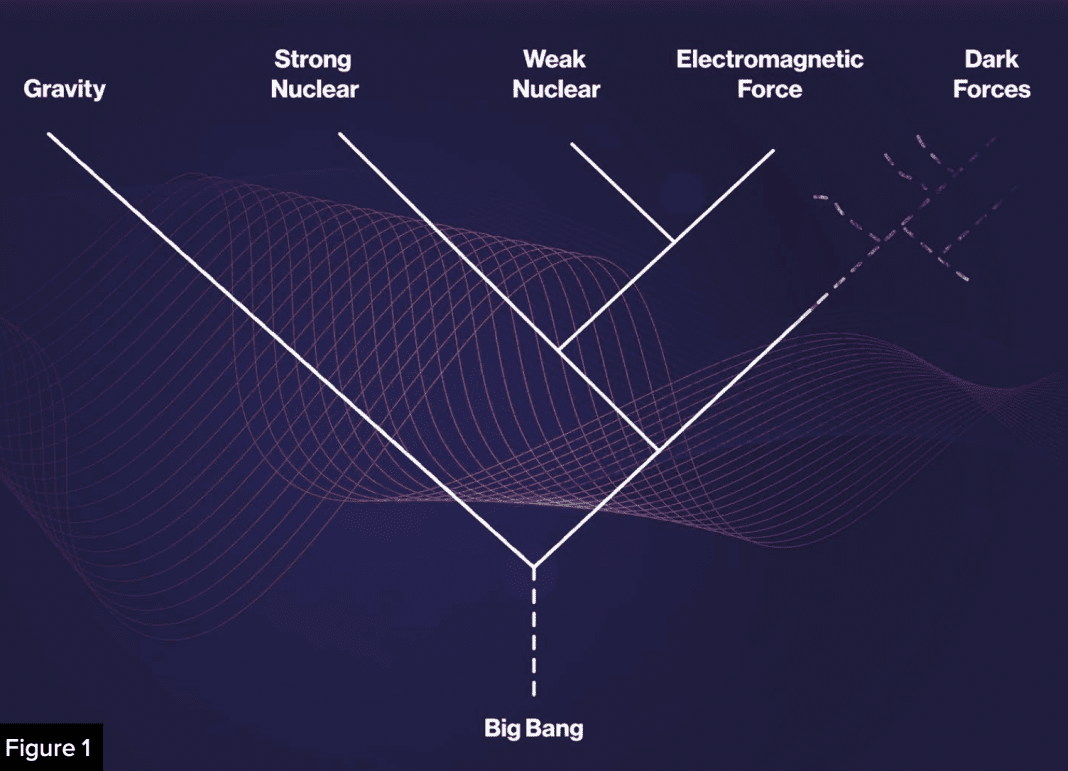
If we count down, in a quantum cosmological view of the Universe, to its very origin, space, time and natural laws did not exist. The tremendous amount of energy released by the inflaton, a fraction of a second after the Big Bang, heated the Universe to approximately 1.000 trillion degrees, enough energy to create the estimated 1050 tonnes of matter in our observable Universe. Quantum fields and fluctuations, scalar fields, lower temperatures and energies through the creation of expanding space, inflation, generated symmetry- breaking transitions, yielding our observable and familiar natural laws (Fig 1). And the exact values of our known natural constants, necessary to understand reality on the smallest scale. Thanks to the way they are, a biophilic Universe arose, with conditions that, as far as we know, created Earth’s life and its evolution.
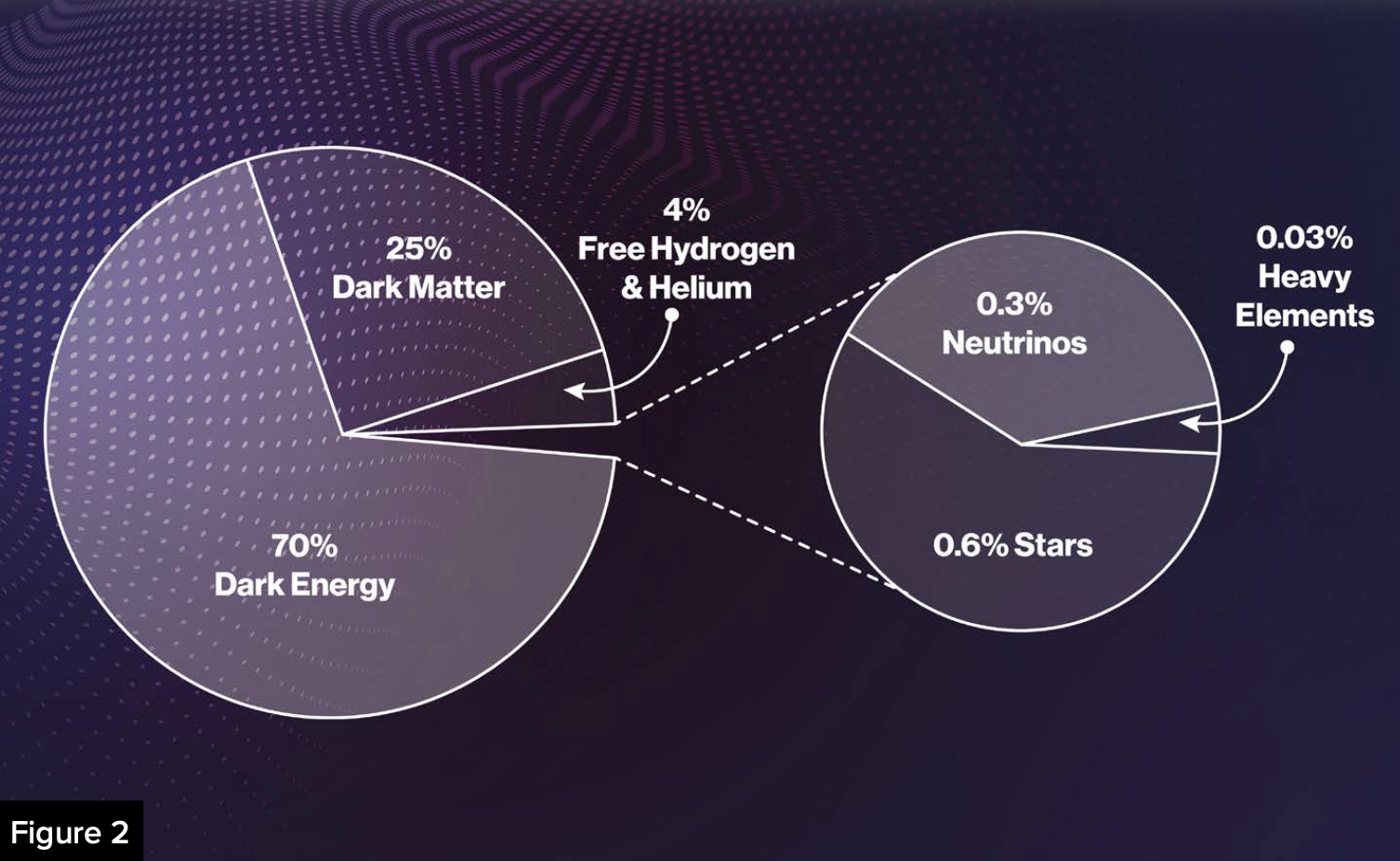
As Figure 2 shows, we are still missing the largest part of our Universe. What we do know is that our Universe started nuclear fusion, of creating new elements, of supernovas and colliding neutron stars and black holes, creating the elements and their appropriate chemistry that Earth itself and Earth’s life depend upon.
We may conclude that, in and after the Big Bang, a force emerged similar to gluons, photons, and Higgs bosons, evolutons, yielding the evolutionary force that drives our known Universe and creates the stardust we are made of. The weak nuclear force, W and Z bosons, had no reason for existence until heavy elements, subject to nuclear decay, appeared in the ever-evolving Universe.
Figure 1. ‘The tree of physical laws grew out of a series of symmetry-breaking transitions in the hot big bang. Unifying particle theories predict that this most ancient layer of evolution could have turned out very differently”. Courtesy Thomas Hertog, On the Origin of Time. Stephen Hawking’s Final Theory.
Figure 2. ‘A pie chart showing the matter and energy budget of the universe today. The bulk of it consists of dark energy that has been driving the acceleration of the expansion of the universe in the last few billion years. The remainder is mostly in the form of nonatomic, dark matter composed of unknown particles. Only a small fraction, roughly 5 percent, consists of ordinary, familiar matter and radiation’. Courtesy Thomas Hertog, On the Origin of Time. Stephen Hawking’s Final Theory.