

Astronomers have identified a rare type of planet wandering through the Milky Way without a host star
Roughly the mass of Saturn, the newly discovered object is a “rogue planet,” a world that drifts alone through interstellar space after being ejected from its original planetary system.
This discovery is significant because the scientists were able to directly measure both the planet’s mass and its distance from Earth, something that has been extremely difficult to achieve until now.
The breakthrough came from combining observations taken simultaneously from ground-based telescopes and a spacecraft in orbit, offering a new way to study some of the Galaxy’s most elusive planets.
A planet found by gravity
Most planets are discovered by the light they reflect or the subtle effects they have on their parent stars. Rogue planets are different.
Without a nearby star, they are cold, dark, and nearly invisible. Astronomers can detect them only when they pass in front of a distant background star and briefly bend its light through gravity, an effect known as gravitational microlensing.
These microlensing events are rare and short-lived, sometimes lasting only hours or days. While they can reveal the presence of a hidden object, they usually do not provide enough information to determine its mass or distance with confidence. That limitation has left many questions about how common rogue planets are and how they form.
Earth and space are working together
In this case, astronomers observed the same microlensing event from two very different locations: Earth and the Gaia space telescope. Because Gaia orbits far from Earth, the event appeared slightly different from each vantage point.
This tiny shift in timing and brightness, known as microlensing parallax, allowed researchers to calculate the planet’s physical properties with much greater precision.
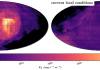
By combining this parallax effect with detailed modeling of how the background star’s light was distorted, the research team determined that the rogue planet has about 22 percent of Jupiter’s mass, placing it close to Saturn in size. The planet is located roughly 3,000 parsecs from the center of the Milky Way, far beyond our local stellar neighborhood.
The planet’s relatively low mass offers important clues about its origin. Objects this small are unlikely to have formed on their own, like stars or brown dwarfs. Instead, the evidence suggests that the planet formed in a normal planetary system and was later ejected.
These cosmic expulsions can occur when young planetary systems become gravitationally unstable. Close encounters with other planets or the influence of nearby stars can send smaller worlds flying into interstellar space, where they wander indefinitely.
A look into the future
Only a small number of rogue planets have been detected so far, but astronomers expect that to change. Future missions, especially NASA’s Nancy Grace Roman Space Telescope, scheduled for launch in 2027, are expected to detect many more microlensing events.
This discovery shows how combining ground- and space-based observations can transform brief, subtle signals into detailed planetary measurements. As techniques improve and new telescopes come online, scientists may soon uncover a vast hidden population of lonely worlds, reshaping our understanding of how planets form, evolve, and sometimes get cast adrift across the Galaxy.