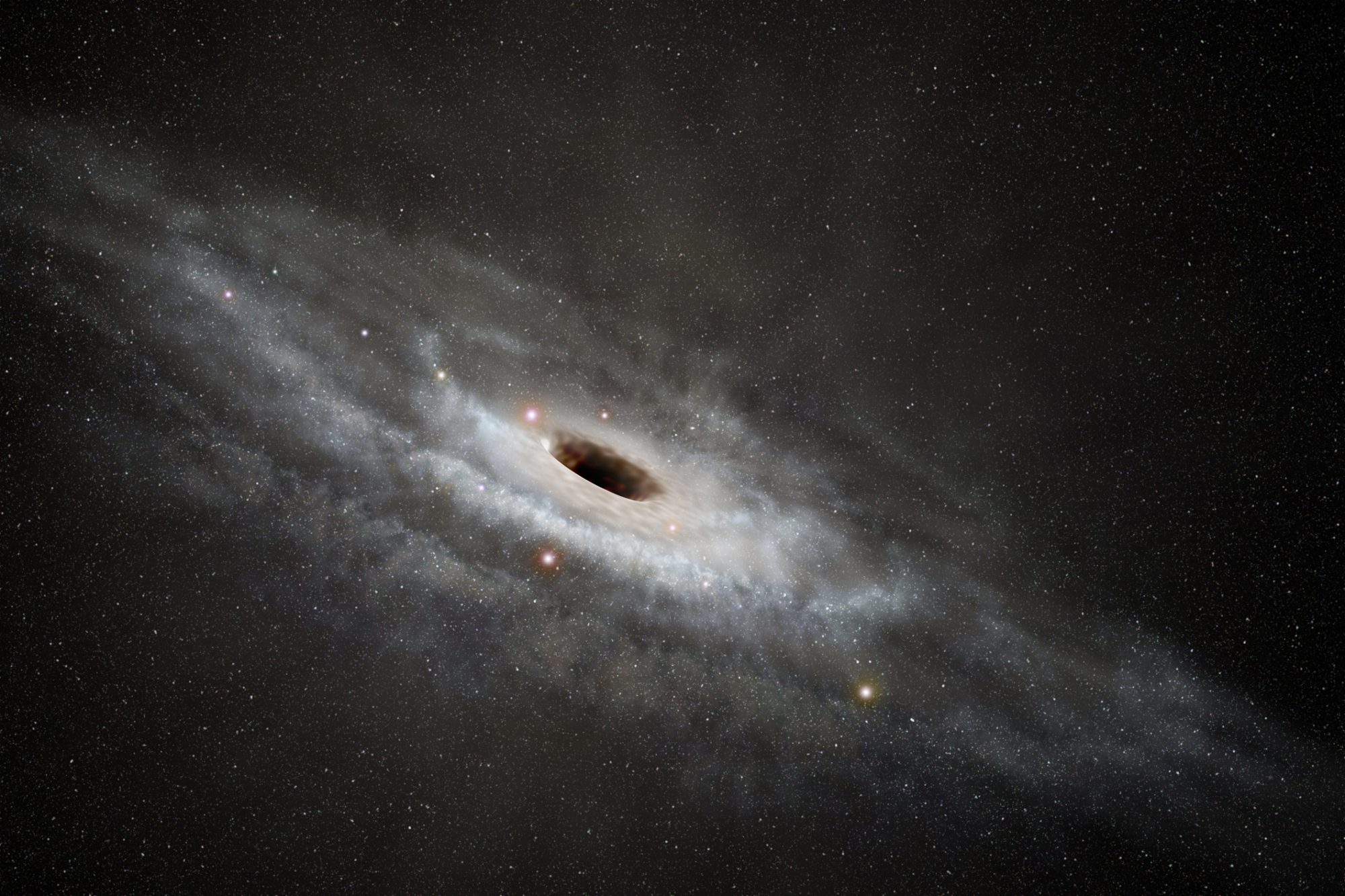
Astronomers have identified one of the oldest “dead” galaxies ever observed and discovered new evidence that supermassive black holes can quietly choke off star formation over time, rather than destroying galaxies in sudden, violent events
The discovery shows us how massive galaxies in the early universe formed stars rapidly and then shut down surprisingly early.
Using observations from the James Webb Space Telescope (JWST) and the Atacama Large Millimeter Array (ALMA), an international research team led by the University of Cambridge studied a distant galaxy known as GS-10578, nicknamed “Pablo’s Galaxy.”
Pablo’s Galaxy is seen as it existed roughly three billion years after the Big Bang, yet it already appears old and inactive.
A giant galaxy that burned out early
Pablo’s Galaxy is exceptionally massive for such an early point in cosmic history, weighing around 200 billion times the mass of the Sun.
Most of its stars formed during a short, intense burst between 12.5 and 11.5 billion years ago. After that, star formation stopped entirely, even though the galaxy itself was still relatively young.
This rapid rise and abrupt shutdown give the galaxy a “lived fast, died young” profile. Pablo’s Galaxy has astonished astronomers, as it lacked new stars and the raw material needed to make them.
The missing fuel mystery
To investigate, researchers conducted nearly 7 hours of deep observations with ALMA, searching for carbon monoxide, a key tracer of cold hydrogen gas. They showed that none was detected. This suggests that the galaxy has almost completely exhausted, or lost access to, the cold gas that fuels star formation.
At the same time, JWST spectroscopy revealed powerful outflows of neutral gas streaming from the galaxy’s central supermassive black hole at speeds of around 400 kilometres per second. These winds are removing tens of solar masses of gas each year, suggesting that any remaining fuel could have been depleted in a few tens to a couple of hundred million years, which is a lot faster than expected for galaxies of similar size.
A slow end
Despite the gas outflows, Pablo’s Galaxy does not show signs of having undergone a catastrophic collision or merger with another galaxy. Its structure resembles a calm, rotating disc. This ruled out a single dramatic event as the cause of its shutdown.
The researchers concluded that the black hole operated through repeated episodes of activity. Rather than ejecting all the gas at once, it appears to have heated or expelled incoming material over many cycles, preventing fresh gas from cooling and settling into the galaxy. Over time, this led to what the team describes as a slow starvation process.
By reconstructing the galaxy’s star formation history, the scientists found evidence for “net-zero inflow.” So the galaxy was never able to refill its gas reservoir after its initial starburst phase.
Explaining a growing cosmic mystery
The findings help explain an emerging population of massive, unexpectedly old-looking galaxies that JWST has revealed in the early universe. Before Webb, these galaxies were thought to be extremely rare. Now they appear to be more common, challenging long-standing models of galaxy evolution.
This study suggests that slow, sustained black hole feedback may be a key mechanism behind their early deaths. Instead of explosive blowouts, gentle but persistent heating and gas removal may have been enough to halt star formation permanently.
The research shows the power of combining ALMA’s deep radio observations with JWST’s infrared spectroscopy. The team has already been awarded additional JWST time to study warmer hydrogen gas in Pablo’s Galaxy, which could reveal more details about how the black hole disrupts gas inflow.Astronomers have identified one of the oldest “dead” galaxies ever observed and discovered new evidence that supermassive black holes can quietly choke off star formation over time, rather than destroying galaxies in sudden, violent events.
The discovery shows us how massive galaxies in the early universe formed stars rapidly and then shut down surprisingly early.
Using observations from the James Webb Space Telescope (JWST) and the Atacama Large Millimeter Array (ALMA), an international research team led by the University of Cambridge studied a distant galaxy known as GS-10578, nicknamed “Pablo’s Galaxy.”
Pablo’s Galaxy is seen as it existed roughly three billion years after the Big Bang, yet it already appears old and inactive.
A giant galaxy that burned out early
Pablo’s Galaxy is exceptionally massive for such an early point in cosmic history, weighing around 200 billion times the mass of the Sun.
Most of its stars formed during a short, intense burst between 12.5 and 11.5 billion years ago. After that, star formation stopped entirely, even though the galaxy itself was still relatively young.
This rapid rise and abrupt shutdown give the galaxy a “lived fast, died young” profile. Pablo’s Galaxy has astonished astronomers, as it lacked new stars and the raw material needed to make them.
The missing fuel mystery
To investigate, researchers conducted nearly 7 hours of deep observations with ALMA, searching for carbon monoxide, a key tracer of cold hydrogen gas. They showed that none was detected. This suggests that the galaxy has almost completely exhausted, or lost access to, the cold gas that fuels star formation.
At the same time, JWST spectroscopy revealed powerful outflows of neutral gas streaming from the galaxy’s central supermassive black hole at speeds of around 400 kilometres per second. These winds are removing tens of solar masses of gas each year, suggesting that any remaining fuel could have been depleted in a few tens to a couple of hundred million years, which is a lot faster than expected for galaxies of similar size.
A slow strangulation, not a violent end
Despite the gas outflows, Pablo’s Galaxy does not show signs of having undergone a catastrophic collision or merger with another galaxy. Its structure resembles a calm, rotating disc. This ruled out a single dramatic event as the cause of its shutdown.
The researchers concluded that the black hole operated through repeated episodes of activity. Rather than ejecting all the gas at once, it appears to have heated or expelled incoming material over many cycles, preventing fresh gas from cooling and settling into the galaxy. Over time, this led to what the team describes as a slow starvation process.
By reconstructing the galaxy’s star formation history, the scientists found evidence for “net-zero inflow.” So the galaxy was never able to refill its gas reservoir after its initial starburst phase.
Explaining a growing cosmic mystery
The findings help explain an emerging population of massive, unexpectedly old-looking galaxies that JWST has revealed in the early universe. Before Webb, these galaxies were thought to be extremely rare. Now they appear to be more common, challenging long-standing models of galaxy evolution.
This study suggests that slow, sustained black hole feedback may be a key mechanism behind their early deaths. Instead of explosive blowouts, gentle but persistent heating and gas removal may have been enough to halt star formation permanently.
The research shows the power of combining ALMA’s deep radio observations with JWST’s infrared spectroscopy. The team has already been awarded additional JWST time to study warmer hydrogen gas in Pablo’s Galaxy, which could reveal more details about how the black hole disrupts gas inflow.