
Although traditional biomanufacturing is based on microbial or mammalian cell culture, plants can be grown in bioreactors and hold enormous promise for use in resource-limited environments
Biomanufacturing today
Biomanufacturing is often defined as the use of microorganisms (such as bacteria, yeast or fungi) or mammalian cells that have been programmed using the tools of synthetic biology to produce important chemicals, fuels, medicines, and materials, from plant derived feedstocks, grown in tanks called bioreactors. Although these products are often referred to as “plant-based”, in reality these biomolecules are made by microbes or animal cells. What is often not well recognized is that plant cells themselves can be reprogrammed as biomanufacturing powerhouses and are particularly well suited for use in low-resource environments such as isolated communities, areas impacted by natural disasters, war zones, and even in space.
Traditional biomanufacturing has evolved worldwide to be highly complex and mostly centralized in a few geographic locations. It requires very expensive stainless-steel infrastructure, highly trained technical personnel, a complex global supply chain, including chemicals and consumables, and is particularly resource intensive, requiring large amounts of power, steam, and chilled water. Biomanufacturing in low resource environments does not exist today, whether it be in remote communities on Earth or in space.
The EPiC project
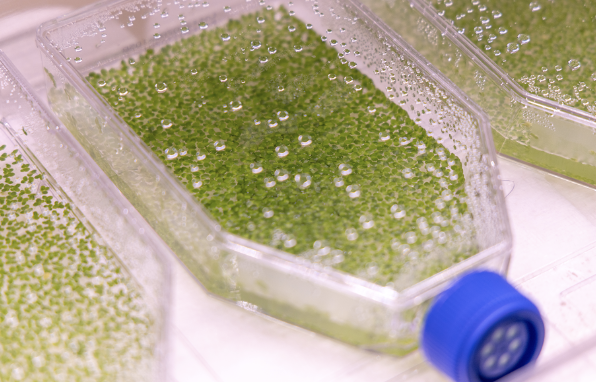
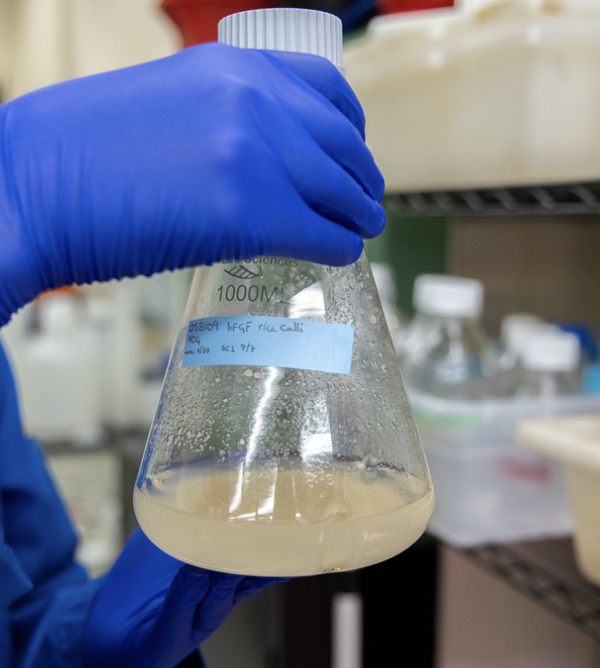
The goal of “Engineered Plants in Culture (EPiC): Biomanufacturing for Low-Resource Environments”, a National Science Foundation funded project (CBET-2428060) in the Future Manufacturing Program is to reimagine biomanufacturing using plants as biofactories at the point of need. Our interdisciplinary academic/industry team, comprised of researchers at UC Davis, Axiom Space, and the Australian Research Council Plants for Space Centre of Excellence, is developing engineered plant cells, plant embryos and fast-growing aquatic plants, grown in contained systems (i.e., bioreactors), as novel and transformative bioproduction platforms. Specifically, we are focusing on transgenic rice cell suspension cultures (1), walnut embryo cultures (2), and duckweed (Lemna sp.) cultures, bioproduction systems that our team has previously worked with.
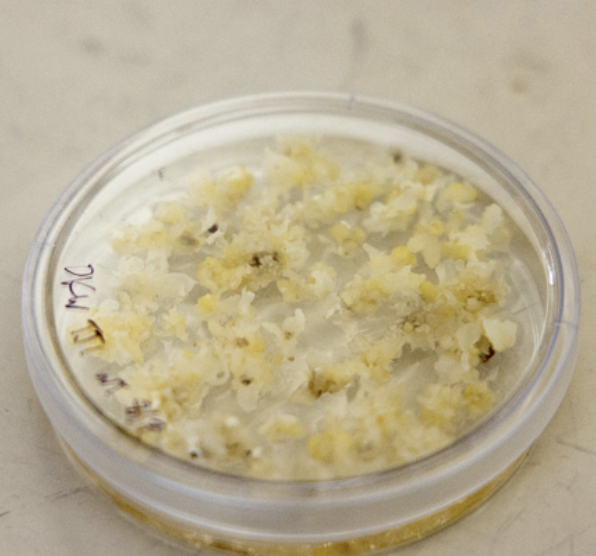
Although the EPiC project recently started in June 2025, it is a four-year project that is addressing basic scientific challenges that are currently barriers to implementing this technology, including:
- Engineering plant host cells to be more efficient at producing biomolecules of interest,
- Recycling of plant biomass as a source of medium nutrients for subsequent plant cell cultures, and
- Optimizing plant gene editing methods.
In addition to addressing these scientific challenges, EPiC is developing novel, fit-for-purpose bioreactors for the different types of plant production hosts that can be modularized, 3D-printed at low cost, replicated on-site, and easily used. To demonstrate these systems under a severely constrained, low resource environment we are developing and testing bioreactors for use with transgenic rice cell cultures and/or walnut embryos in low Earth orbit on the International Space Station. Finally, we are developing and implementing educational and outreach activities that will attract and train students and researchers in this new field.
Why are plants ideal for biomanufacturing in low resource environments?
Plants, as higher eukaryotic organisms, have a vast biosynthetic capability, grow well at ambient temperatures in simple, chemically defined medium, are quite robust to perturbations in environmental conditions and medium composition, and have relatively low oxygen and sugar demands. They can produce medically useful proteins such as monoclonal antibodies, produce a wide variety of natural products and secondary metabolites, and are amenable to metabolic engineering. Plant cells can also produce a significant quantity of engineered protein relatively quickly. High titers of reporter proteins (Green Fluorescent Protein), up to 1 g/L (about 50% of the total soluble protein, or TSP) have been reported for fast growing (doubling time of 11 hr) tobacco BY2 cells in culture through selection and adaptation (3).
Although the growth rate of plant hosts is lower than for microbial and/or animal cell culture, once a sufficient cell density is achieved, they are more amenable for long term production in semicontinuous, continuous or perfusion operations. For example, we have operated transgenic rice cell bioreactors continuously for over 80 days with multiple recombinant protein production cycles (1).
Sustained production over long time periods has many advantages. Not only does it lead to higher productivity (reducing “turnaround times” for harvesting, cleaning, sterilization, inoculation and growth), but it is also less complex, and lowers operating cost (reduces energy for sterilization cycles, cleaning solutions, and number of seed train operations) and environmental impact (water use, disposal of cleaning solutions, generation of steam/energy). And importantly, it also allows for the use of single or multiple use plastic bioreactors (4) in a more cost-effective and sustainable way since they can be used over very long time periods (e.g., 6 months to a year). This feature enables distributed, “scaled out” production systems (larger numbers of distributed smaller sized bioreactors) compared with scaled up systems (centralized facilities with larger working volume bioreactors).
Finally, in all of these systems, because the plant biomass is inherently multicellular and relatively large, ranging from hundreds of microns for plant cell culture aggregates to millimeters for embryos and aquatic plants, they can be easily separated from the medium using gravity sedimentation in the bioreactor or low speed centrifugation. This can be an advantage for recovery of products secreted to the culture medium, compared with cultures that utilize single cells (e.g., bacteria, yeast, animal cells, some algal and fungal cultures), where high speed centrifugation and/or expensive microfiltration unit operations are required to recover the product.
Although plant cells are not what one first thinks of as a “traditional” host organism for biomanufacturing there are a few examples of large-scale commercial processes that use plant cell cultures for production of FDA- approved recombinant therapeutics (5), natural products (6), nutrients/dietary supplements, cosmetic products (7), and pigments (8). The growth of “plant cellular agriculture” has led to many start-ups working on everything from plant-cell culture chocolate and coffee, to cotton fibers – the sky is the limit for plant-based biomanufacturing (for EPiC, in low earth orbit and space)!
References
- K. Macharoen, M. Du, S. Jung, K. A. McDonald, and S. Nandi, “Production of recombinant butyrylcholinesterase from transgenic rice cell suspension cultures in a pilot-scale bioreactor,” Biotech & Bioengineering, vol. 118, no. 4, pp. 1431-1443, Apr. 2021, doi: https://doi.org/10.1002/bit.27638.
- P. A. Zaini et al., “Leveraging Walnut Somatic Embryos as a Biomanufacturing Platform for Recombinant Proteins and Metabolites,” BioTech, vol. 13, no. 4, p. 50, Nov. 2024, doi: https://doi.org/10.3390/biotech13040050.
- S. T. Häkkinen, L. Reuter, N. Nuorti, J. J. Joensuu, H. Rischer, and A. Ritala, “Tobacco BY-2 Media Component Optimization for a Cost-Efficient Recombinant Protein Production,” Front. Plant Sci., vol. 9, p. 45, Jan. 2018, doi: https://doi.org/10.3389/fpls.2018.00045.
- R. W. Maschke, S. Seidel, L. Rossi, D. Eibl, and R. Eibl, “Disposable Bioreactors Used in Process Development and Production Processes with Plant Cell and Tissue Cultures,” in Advances in Biochemical Engineering/ Biotechnology., Berlin, Heidelberg: Springer Berlin Heidelberg, 2024. doi: https://doi.org/10.1007/10_2024_249.
- Y. Tekoah et al., “Large-scale production of pharmaceutical proteins in plant cell culture – the protalix experience,” Plant Biotechnology Journal, vol. 13, no. 8, pp. 1199-1208, Oct. 2015, doi: https://doi.org/10.1111/pbi.12428.
- H. Tabata, “Paclitaxel Production by Plant-Cell-Culture Technology,” in Biomanufacturing, vol. 87, J.-J. Zhong, Ed., in Advances in Biochemical Engineering/Biotechnology, vol. 87., Berlin, Heidelberg: Springer Berlin Heidelberg, 2004, pp. 1-23. doi: https://doi.org/10.1007/b13538.
- R. Eibl, P. Meier, I. Stutz, D. Schildberger, T. Hühn, and D. Eibl, “Plant cell culture technology in the cosmetics and food industries: current state and future trends,” Appl Microbiol Biotechnol, vol. 102, no. 20, pp. 8661-8675, Oct. 2018, doi: https://doi.org/10.1007/s00253-018-9279-8.
- I. Appelhagen et al., “Colour bio-factories: Towards scale-up production of anthocyanins in plant cell cultures,” Metabolic Engineering, vol. 48, pp. 218-232, July 2018, doi: https://doi.org/10.1016/j.ymben.2018.06.004.