
Dr. M.F. Lightstone, P.Eng., FCSME, FCAE, from the Department of Mechanical Engineering at McMaster University, presents a smart-grid approach for cold climate heat pumps aimed at reducing greenhouse gas emissions
Electrically based heating through the implementation of air source heat pumps (ASHPs) can provide significant greenhouse gas (GHG) emission reductions if the electricity supply is predominantly non-carbon based. The additional electrical load can, however, negatively impact the electrical distribution and power generation supply infrastructure.
This article presents a brief summary of the impact of ASHPs on GHG emissions and electrical power requirements for a single-family home located in Toronto, Canada. It illustrates the significant impact that the electrical power supply mix has on emission reductions. It also discusses the use of hybrid heating as a mechanism for electrical demand management.
Electricity generation emissions
To assess the GHG emission reductions attained from switching to ASHPs, the emissions from the electrical power generators must be considered. Within Canada, there is a broad range of emission intensities depending on the extent of fossil fuels used for generation. For example, in provinces with a high reliance on coal for electricity generation, such as in Saskatchewan, the emissions intensity for electrical generation was 630 gCO2/ kWh in 2022. (1)
This contrasts with the Ontario grid which has grid average emissions of around 30-60 gCO2/kWh in 2024 (2) but utilizes natural gas plants (364 gCO2/ kWh) for peak electricity.
Weaknesses in the electricity supply and distribution infrastructure remain a concern. (3) For example, in Alberta in January 2024, the Alberta Electric System Operator issued a public alert that the electrical grid was unable to meet demand and requested consumers to immediately conserve power to avoid rotating outages. (4)
Case study: Detached single-family home in Toronto
A case study illustrating the impact of switching building heating from a high efficiency natural gas furnace to an ASHP for a single-family home is presented. The house was built in 1915 and has about 240 m2 of above grade floor space.
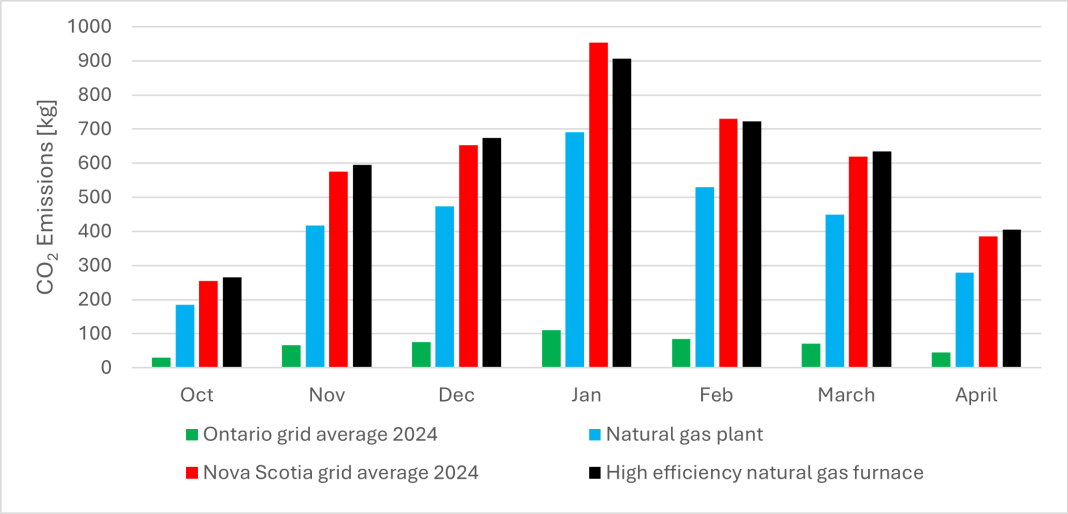
Figure 1 shows the predicted emissions arising from building heating for the period October 2023 to April 2024. A range of emission intensities were considered to explore the impact of the electrical grid on the GHG emissions. To assess the efficacy of ASHPs in other provinces, Halifax Nova Scotia – which has similar winter temperatures to Toronto – was selected. Nova Scotia has a high reliance on coal power plants and has a grid average emission intensity of about 500 gCO2/kWh.
Significant reductions in GHG emissions arise in Ontario using the grid average intensity. Indeed, the total carbon emissions dropped from about 4.2 tonnes using a high efficiency natural gas furnace to about 0.5 tonnes with an ASHP, yielding a reduction of about 88%. If, however, the ASHP electricity is supplied from a natural gas plant, the emissions are about 3.0 tonnes, which is an emission reduction of about 29%. Using the grid average data intensity for Nova Scotia, the GHG emissions are essentially the same as those from a high-efficiency natural gas furnace.
Impact on electrical power requirements
The total electrical energy required to power the ASHP over the full heating season in this case study is about 8300 kWh. For context, the household electricity usage over the same period prior to ASHP installation is about 5000 kWh. This illustrates that electricity consumption will more than double throughout the heating season.
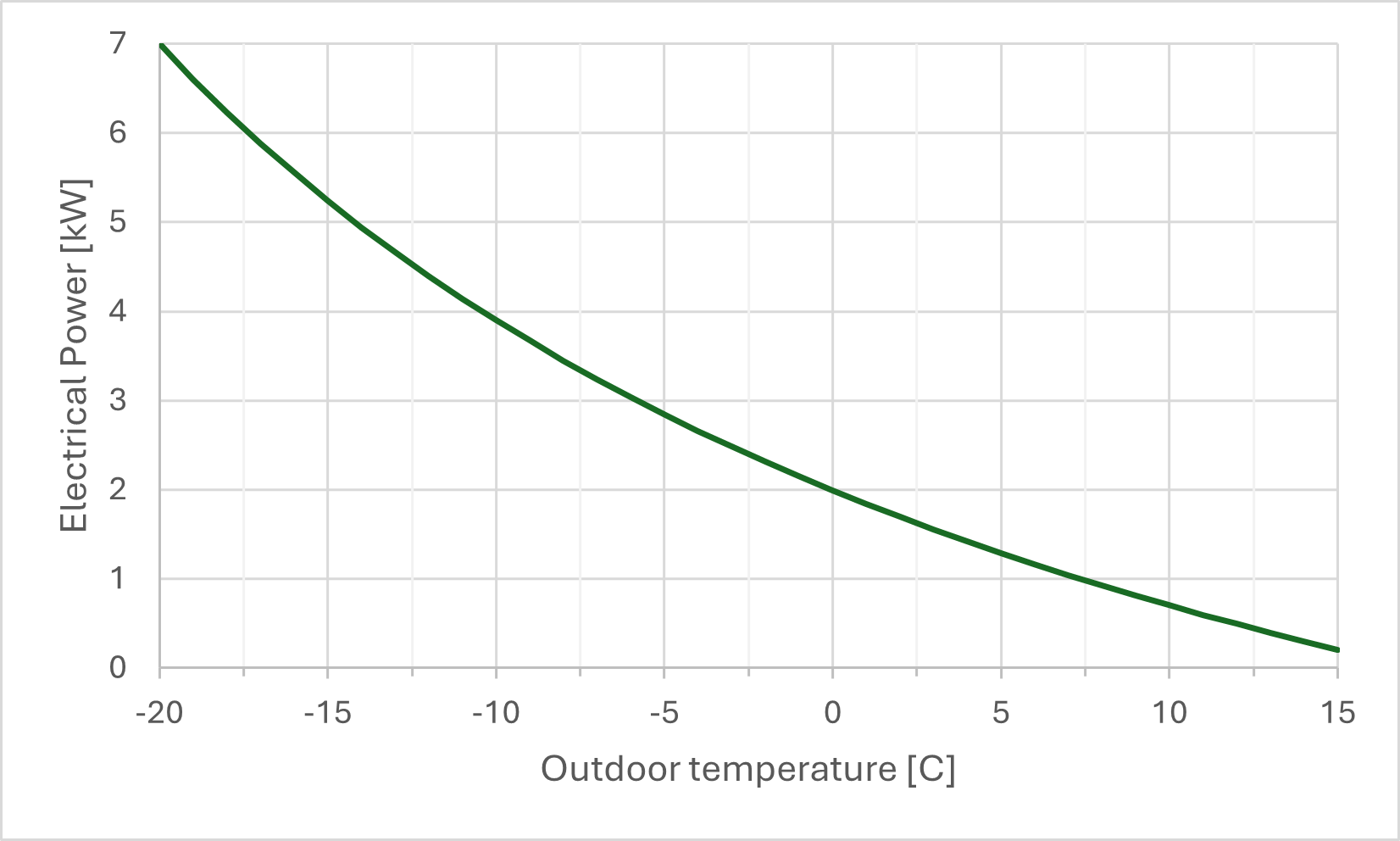
Moreover, the ASHP electrical power requirements are strongly dependent on outdoor air temperature as shown in Figure 2. The power requirements increase significantly with decreasing outdoor temperature. For example, at -10ºC the ASHP will require about 4 kW of electrical power, increasing household power requirements from around 1 kW to 5 kW. This illustrates the substantial impact that scale adoption of heat pumps will have on electrical demands.
Hybrid heating – a smart grid Solution
Hybrid heating uses a combination of an ASHP and a high efficiency natural gas furnace. The furnace can be utilized during periods of extreme cold when the ASHP is less efficient and/or during peak electricity when electrical demand management is required. A hybrid heating pilot project involving 105 homes in London, Ontario Canada in late 2021 (5) achieved an average of 63% electrification of heating. The study concluded that hybrid heating can increase the overall total penetration of ASHPs while still mitigating potential negative electrical grid impacts.
Summary and conclusions
Hybrid heating provides a tool for electricity system operators for electrical demand management. The flexibility provided by a hybrid approach would accommodate highly time-variant renewable generation such as from wind turbines. It allows for the longer-term phasing-in of new non-emitting electrical generation while simultaneously diminishing the use of the natural gas furnace to eventually achieve net-zero emissions.
References
- https://www.cer-rec.gc.ca/en/data-analysis/energy-markets/provincial-territorial-energy-profiles/provincial-territorial-energy-profiles-saskatchewan.html
- https://www.ieso.ca/Powering-Tomorrow/2024/Six-Graphs-and-a-Map-2024-Annual-Planning-Outlook-and-Emissions-Update
- https://news.ontario.ca/en/release/1006663/ontario-launches-expert-panel-to-strengthen-local-electricity-distribution
- https://www.aeso.ca/aeso/newsroom/albertans-asked-to-conserve-power-to-minimize-potential-for-rotating-outages
- https://sustainabletechnologies.ca/home/heating-and-cooling/air-source-heat-pumps/smarter-home-heating/london/