
The Amazon, a critical global climate tipping element, faces destruction due to land transformation. Research by University of Hamburg and iES Landau investigates whether the size and pattern of deforestation matters, suggesting that guiding clearing can mitigate severe regional climate impacts
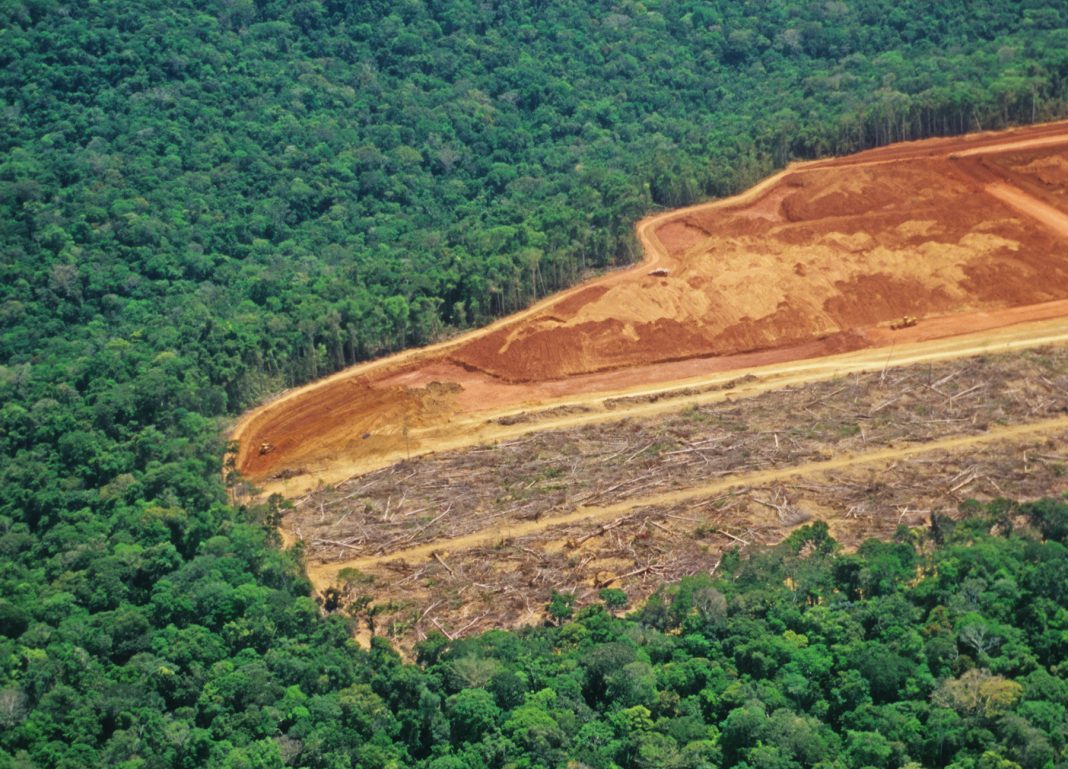
Rising global energy and food demands are driving widespread land transformations, with particularly critical impacts in the Amazon rainforest. As a vital tipping element of the global climate system, the fate of the Amazon has far-reaching consequences. Ongoing – and often unregulated – agrarian colonization leads to forest destruction, and the sheer spatial scale of this deforestation means the impacts are no longer limited to the loss of biotic resources.
Land Cover Changes (LCC) alter physical land surface parameters, modifying the exchange of energy and water, which in turn leads to significant changes in regional and evtl. large scale climate patterns. A key question for researchers is: Does the size and pattern of deforested areas matter, even if the total amount of forest loss remains the same? In other words, if deforestation cannot be stopped entirely, can its negative toll be mitigated by influencing how it occurs?
The Amazon as a regional climate system
While the Amazon is often discussed from a global perspective, recent insights highlight its critical function as a regional climate system. Local land users are not only affected by global climate change but are also increasingly changing their own regional climate through deforestation.
The Amazon plays a central role in recycling water and sustaining the atmospheric moisture transport from the Atlantic Ocean toward the Andes. Removing the forest weakens these self-amplifying moisture cycles, which is a major concern.
It may be naïve to assume that deforestation can be fully stopped in the foreseeable future. Therefore, it becomes crucial to guide the process of clearing. Large continuous clearings may interrupt moisture recycling much more severely than many small patches. Smaller, less-connected clearings allow more potent “edge” and spillover effects of remaining forest and could mitigate regional warming, especially during the dry season.
This suggests that the spatial pattern of deforestation is just as important as the total extent.
The PRODIGY Project
The PRODIGY (Projecting regional and global outcomes via dynamic interplay between biodiversity and yield) project focuses on the Amazon rainforest – a well-documented tipping element – spanning the borders of Bolivia, Brazil, and Peru.
To contribute to the debate on critical transitions and threshold behaviour, PRODIGY designed an integrated Climate modelling approach. This involved implementing very high- resolution, kilometre-scale simulations to specifically identify and quantify the impacts of Amazon LCC on the local and regional climate. These simulations analysed the response of the surface energy and water budget, temperature, and precipitation following deforestation, explicitly accounting for different deforestation extents, patterns, and conversion types to uncover possible nonlinear relationships between forest loss and climate.
Key modelling results on regional climate
Comparative analyses between control simulations (no deforestation) and LCC scenarios revealed a strong influence of deforestation on several components of the regional climate system:
Radiation and Energy Balance:
- During the dry season, forest conversion increases the Bowen ratio (the ratio of sensible to latent heat), shifting the balance in favour of sensible heat flux (heating the air).
- During the rainy season, the increased albedo (reflectivity) of cleared areas reduces the shortwave radiation balance.
Temperature:
- In high-precipitation months, the reduced shortwave radiation on cleared areas is associated with a slight decrease in daily maximum temperatures.
- Crucially, dry season changes in the Bowen ratio result in significant overwarming and a sharp rise in temperature in affected areas. This signal is strongest for the conversion of forest to agricultural land, with daily minimum temperatures increasing by up to 3 K. Strong warming signals are closely correlated with the spatial clearing patterns.
Precipitation:
- Changes in precipitation are strongly decoupled from clearing patterns due to advective processes.
- However, land use analysis shows a seasonal pattern:
- In rainy months, precipitation over remaining forest areas increases with growing clearing rates, while cleared areas see a reduction.
- In the dry season, negative precipitation signals tend to dominate over remaining forest areas, while cleared areas see a slight increase.
The total annual precipitation may stay almost the same, but the seasonal timing can shift, leading to longer dry spells and more intense wet periods. Modelling how precipitation responds to patch size is less clear because of current model limitations, highlighting the need for model improvements in terms of resolution, complexity and spatial extension.
Implications for policy and water availability
These modelling results demonstrate that changing landscape structures caused by deforestation and the associated spatial differentiation of radiation and energy fluxes intensify local to regional temperature and humidity gradients. This, in turn, likely contributes to a season-specific intensification/attenuation of convective processes.
Although this finding does not confirm a general aridification of the region due to progressive deforestation, the scenario results suggest that an ongoing destruction of the Amazon rainforest, particularly during the dry season, will exacerbate future implications of global warming at the regional level and impair water availability, especially in rainforest areas not yet affected by deforestation.
The main take-home messages from this research are clear:
- Deforestation changes the regional climate, not solely the global climate.
- If deforestation cannot be stopped, it can still be guided to reduce negative impacts.
- Smaller, dispersed patches appear less harmful for regional temperature and potentially precipitation.
4. Improved climate models are needed to provide scientifically grounded guidance for policymakers.