
The HOLiFOOD consortium is reimagining food safety risk assessment for the benefit of all stakeholders in the food chain
Why does risk analysis need to be improved?
Food safety is a crucial element in sustainable food production and food security. Current food safety management, however, is reactive, focusing on known hazards. Already, the World Health Organization estimates that foodborne diseases cause 23 million cases of illness and 4,700 deaths every year in Europe, despite the high level of food safety standards in the European Union (EU). The Rapid Alert System for Food and Feed database, which reports incidents of food safety contaminations in the EU, shows more than 3,000 notifications every year.
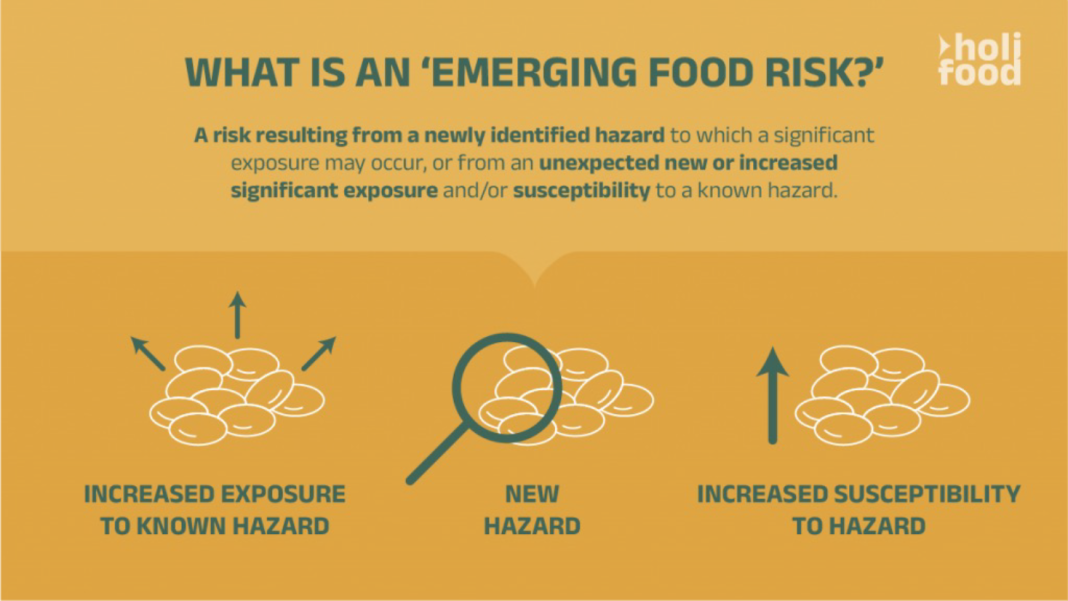
Meanwhile, food systems are becoming increasingly vulnerable to food safety hazards due to drivers of change, including climate change, circularity, and geopolitical changes. Known hazards are becoming more unpredictable, and relatively new hazards could emerge or their exposure could increase (see figure 1).
To achieve a secure and resilient food system, improvements to key components in the risk analysis framework are necessary. A proactive approach is needed, considering the drivers of change, both known and emerging hazards, as well as environmental, economic, and social aspects in food safety management.
The HOLiFOOD project
The main focus of the HOLiFOOD project, funded through the European Commission’s Horizon Europe Program, is on improving the food safety risk analysis framework in Europe. By doing so, the project aims to support the early detection of food risks and ensure a safe and sustainable food system.
Key aspects of the project include:
- Improve data and knowledge sharing infrastructures by developing an integrated European data and knowledge exchange infrastructure for the identification, assessment and mitigation of (emerging) food safety issues.
- Develop early warning and emerging risk prediction systems to identify and monitor existing and emerging food safety risks.
- Develop holistic risk assessment methods and tools to support regulation in a changing global environment.
- Codesign with stakeholders using citizen science, to integrate knowledge exchange.
- Develop targeted and non-targeted detection methods for existing and emerging hazards.
The project focuses on three supply chains, namely, poultry, maize, and lentils.
Developing an integrated European data and knowledge exchange infrastructure
To reach the specific objective of designing and developing an Integrated European Data and Knowledge Exchange Infrastructure – to power an ecosystem of decision support systems for the identification, assessment and mitigation of (emerging) food safety issues – an HOLiFOOD infrastructure was designed and set up that is integrated with software systems that already support food risk mitigation decisions for multiple actors in the supply chain.
The HOLiFOOD infrastructure interlinks and utilises existing software systems, including FOODAKAI (Agroknow) for predictive risk assessment, WFSR decision support tools for microbial and mycotoxin hazard classification models, and CREME Global for secure hosting, model publication, and API gateway services.
Together, these integrations enable a harmonised infrastructure that moves beyond isolated risk models to interoperable data and model services. HOLiFOOD dashboards demonstrate practical applications for emerging risk detection for the three commodities, (poultry, maize, and lentils) that the project focuses on and a variety of hazards, including mycotoxins, pesticides and microbial hazards.
Early warning and emerging risk prediction systems
Food safety monitoring systems enable early risk detection; however, current approaches typically focus on known hazards, which limits timely mitigation. The HOLiFOOD project provides the application of AI and large-scale data analysis using new, systemic approaches to data collection, processing, and analysis. In the HOLiFOOD project, data is extracted relevant to drivers of change for food safety risks from open sources such as authorities, databases, and the European Media Monitor. These drivers are utilised for AI models that address existing and emerging food safety risks.
Besides AI models, enormous amounts of data have been gathered, cleaned, and pooled. This resulted in curated corpora of text and in a large CompreHensive European Food Safety database. Furthermore, Holistic AI classification models were developed to predict the presence of mycotoxins in cereals. The output of these models is visualised in the HOLiFOOD platform infrastructure.
Develop holistic risk assessment methods and tools to support regulation in a changing global environment
The project embeds food safety risks into a comprehensive cost-benefit analysis of the food system, assessing both the positive and negative health, environmental, and economic dimensions. Three case studies (poultry, maize, and lentils) are analysed across the same three countries, with climate change as the main driver of change.
An assessment using Multi-Criteria Decision Analysis, which integrates health (nutrition, chemical/microbial safety), environmental, and economic dimensions, has been developed for poultry and lentils. A Risk-Benefit Assessment (RBA) using the Disability- Adjusted Life Year (DALY) metric for health impacts has been considered for a case study on maize. A generalised holistic risk assessment framework is expected to be in place at the end of the project.
Codesign with stakeholders to integrate knowledge exchange
As part of the codesign strategy, three living labs with experts, stakeholders and end-users have been held. This way of co-production with stakeholders ensures the effective adoption of the developed methods and tools.
Development of (non-)targeted detection methods
In addition to the knowledge-sharing infrastructure with its models and AI tools, emerging risk identification models/classification models have been developed. This development is being done both on targeted and untargeted methods for the detection of emerging and existing chemical and biological hazards.
For untargeted analysis, an AI-based software tool was developed to assess high-resolution mass spectrometric (HRMS) data files for emerging chemical hazards, such as new types of contaminants. The application of AI to this technology is still in its infancy, but major advances have been achieved in the HOLiFOOD project. Targeted analyses have also been developed. For example; detection of glyphosate in maize based on an immunochromatographic test, a rapid colorimetric DNA aptamer-based assay for detection of fumonisin B1 in maize, or a highly sensitive biosensor using plasmonic transduction for the determination of tyramine in poultry meat.
Further progress has been made in developing new techniques to analyse the persistence of emerging and pathogenic microorganisms in target food matrices and environments. In particular, virus titration methods are used to detect and quantify infectious viruses on sprouted alfalfa seeds, or challenge-test protocols are employed to evaluate heat resistance and cold-surface resistance.
Key takeaways
In conclusion, HOLiFOOD provides a proof-of-concept for a novel infrastructure that operationalises predictive modelling for food safety, strengthens Europe’s capacity for data-driven decision-making, and lays the groundwork for broader adoption and exploitation of new technologies in risk assessment and management.