A team of researchers at the University of Trento provides a perspective on the role that soft actuators and energy harvesters play in building the mechatronic devices of the future
A paradigm shift in mechatronics
As mechatronic technologies become increasingly pervasive, their evolution is moving toward softer, more adaptable shapes. Traditional rigid robots, once confined to industrial settings, are giving way to flexible systems designed to collaborate safely with humans and handle delicate tasks, embracing the principles of soft robotics. (1) Regarded as a key strategic area by the European Commission,(2) soft robotics represents a vision for increasingly integrated and pervasive robotic systems.
However, the potential of soft mechatronic devices extends far beyond traditional robotics, challenging our very notion of what “robots” can be and how they can impact fields not traditionally associated with them.
Building on the fast-paced progress in flexible electronics, soft mechatronics is opening new frontiers – from wearable haptic interfaces and force-feedback systems that distribute user electronics across the human body, to energy harvesters that use their intrinsic compliance to recover power from wind and water streams, even at larger scales, using energy resources that would otherwise remain untapped.
Actuators and energy sources: A bottleneck for soft machines
At the heart of soft mechatronics lie some highly critical elements: the actuators that convert electrical energy into motion – often referred to as “artificial muscles” (3) – and, conversely, the harvesters that draw energy from mechanical sources to power electrical loads. Designing transducers that fit within soft machines remains a significant challenge. Traditional motors and generators rely on bearings, rare-earth magnets, mechanical transmissions, or bulky fluidic machinery – technologies well-suited for traditional industrial applications but poorly adapted to the flexible motion typical of soft systems.
To overcome these limitations, researchers have explored various active materials that are inherently capable of responding to external stimuli. Among these, electroactive polymers (EAPs) have been regarded as one of the most promising technologies since the early 2000s, thanks to their fast response – reaching up to the acoustic range – their ability to stretch by more than 100% during actuation (and over 200% in generation mode), and their high power densities, comparable to or better than those of traditional drives. (4)
Yet, EAPs’ potential comes with challenges, such as limited reliability upon cyclic electro-mechanical loading, and the need for highly stretchable electrodes, which challenge the capabilities of conventional flexible electronics manufacturing processes.
Zipping actuators: Combining polymers and fluid for stronger artificial muscles
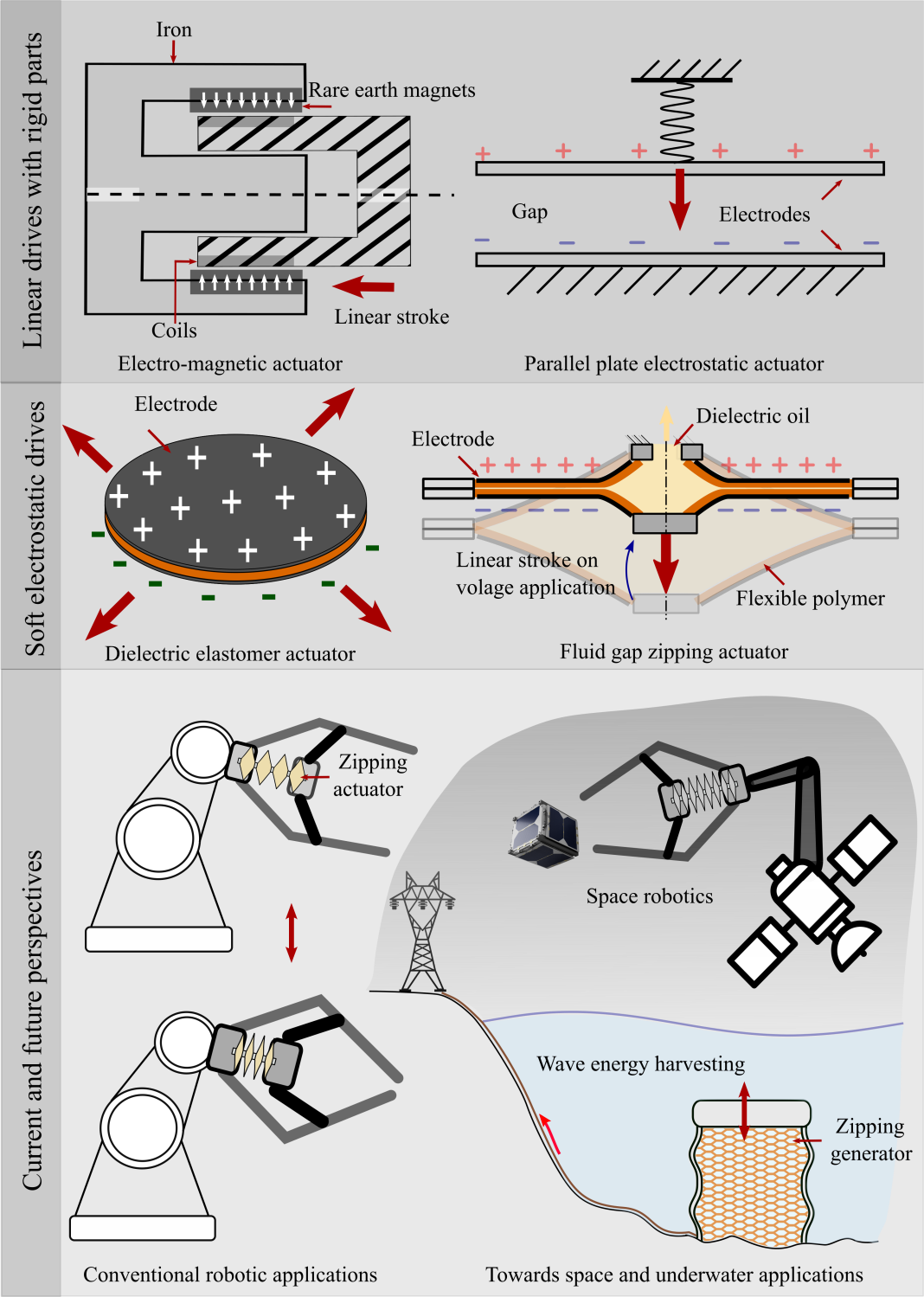
While EAPs have traditionally relied on stretchable rubber-like materials such as dielectric elastomers, recent years have seen the rise of a new class of soft transducers, called fluid-gap “zipping” devices. (5) Also known as HASELs or dielectric fluid transducers, these systems are variable capacitors composed of a flexible dielectric polymer shell filled with a dielectric fluid and equipped with thin, flexible but inextensible electrodes. Because they use industrially established manufacturing processes and materials – such as the polymers employed in capacitor films and the insulating oils used in high-voltage transformers – these devices offer improved reliability and industrial potential compared to rubber-based EAPs.
Research at leading institutions, such as the Max Planck Institute and EPFL, and the early commercial initiatives it has inspired, have led to robotic devices demonstrating remarkable performance – power densities on the order of hundreds of watts per kilogramme and contractions exceeding 40% of their initial length. (6,7,8) These advances have already enabled a range of prototypes, from soft grippers and adaptive surfaces to variable-focus lenses and wearable tactile interfaces. Beyond robotics, exploratory initiatives are extending their use to energy harvesting, including concepts for large-scale electrostatic zipping generators in wave-energy systems. (9)
The flEAP project: Pushing the boundaries of zipping actuators
The flEAP project aims to push electrostatic fluid-gap actuators to their limits, bringing them into applications that are highly challenging to conventional machinery. The project has been funded by the European Research Council and is carried out at the University of Trento, in Italy.
The flEAP project is looking into space applications, where the performance of conventional drives is limited by strict requirements in terms of lubrication, thermal management, and material compliance, and underwater applications, where drives need to operate at high pressure, with sealed air gaps and shields to protect sensitive parts such as coils and magnets from water.
Electrostatic zipping provides a solution to develop actuators capable of working in a vacuum, turning the vacuum itself into an active material. The idea is to use variable vacuum gaps – made of the same atmosphere present in open space or on some planetary surfaces – in place of the liquid dielectric. Initial studies have shown that vacuum-gap linear actuators can achieve power densities up to 40 times those of their liquid-based counterparts. (10) Moreover, unlike electromagnetic motors, they heat up by only a few degrees during operation, as they generate forces using static charges rather than currents.
But liquid-based zipping devices are also a promising solution for underwater applications, as they intrinsically rely on sealed gaps and can react to external hydrostatic pressure through uniform pressurisation of their own gap, while preserving their ability to deform.
Among others, this could allow the development of robots for underwater exploration, debris removal, and seabed sampling – solutions that have already been identified as a natural application for zipping actuators – but also modular wave-energy converters made of large arrays of electrostatic generation units, capable of deforming while complying with and adapting to the wave profile.
Bringing electrostatic actuation and energy harvesting beyond their traditional comfort zone could unlock new opportunities in emerging sectors and redefine the boundaries of soft mechatronics.
CLICK HERE for references