Michael Bevington discusses strategies for recognising and reducing the impact of manufactured electromagnetic fields (EMFs) and radiation, focusing on EHS triggers, risk reduction, and long-term non-thermal guidelines
Electromagnetic hypersensitivity (EHS) can be prevented by removing the man-made electromagnetic fields (EMFs) and radiation that cause it. EHS and its adverse symptoms exist only in the presence of EMFs. Society needs to ensure the safety of EMFs, as with other substances to which some people are hypersensitive.
This article addresses three issues. First, it reviews five common precursors or triggers of EHS. Secondly, it provides ten methods for removing or reducing EMFs. Thirdly, it lists guidelines with long-term non-thermal limits for sensitive groups, including people with EHS.
Common precursors or triggers leading to EHS
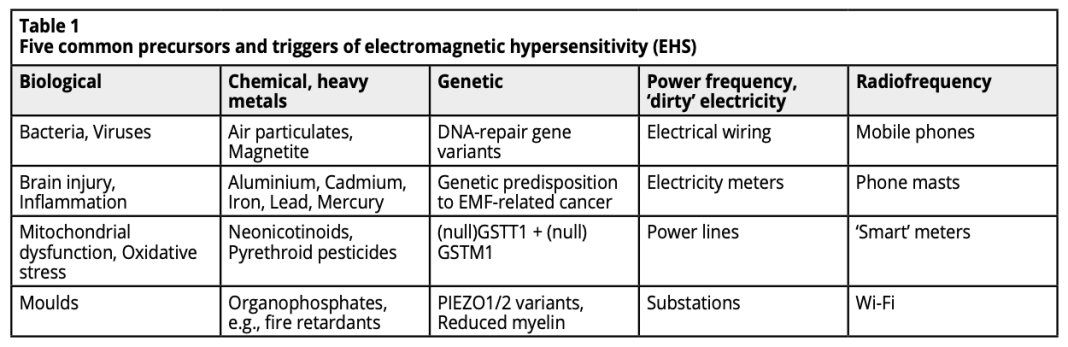
Several precursors or triggers are usually combined in causing EHS, but differently for different people (Table 1). Of the five, the most common, aside from EMFs, are chemicals and genetics. Chemical exposures include pesticides from farm spraying and mercury dental amalgams. Some genetic haplotypes are nearly ten times more common in EHS people than others. Myelin, which insulates the electrically conductive axons in the nervous system, is important for three reasons. Firstly, children have less myelin than adults. Secondly, myelin can be attacked by some illnesses or viruses. Thirdly, myelin is affected by EMFs, and the primary sensors PIEZO1/2 are associated with hypersensitivity. The most common trigger, of course, is intense exposure to EMFs, often through the installation or presence of phone masts, Wi-Fi, smart meters, an electricity meter, or overhead cables. Exposure to chemicals and EMFs can be reduced, but genetics and viruses are more challenging.
Ways to remove or reduce harmful EMFs
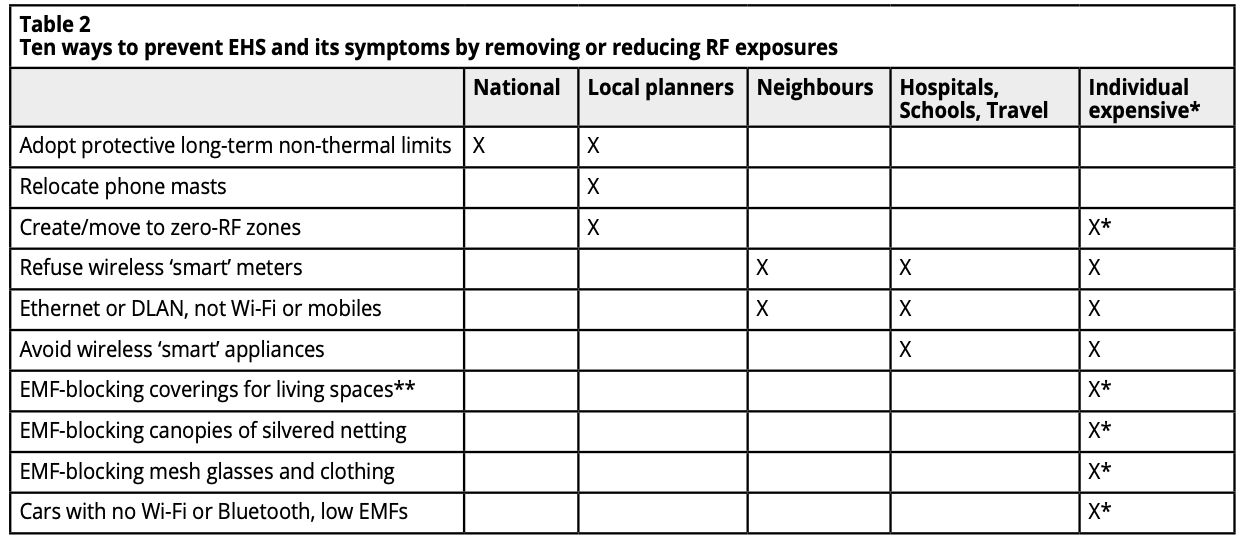
Removing or reducing man-made EMFs (Table 2) can help prevent EHS and its disabling symptoms. The most effective solution is for governments to adopt long-term non-thermal protective limits, replacing the ICNIRP’s unprotective short-term thermal limits (see below). In addition, local authority planners should keep masts away from residences, schools, hospitals, and workplaces, and create zones with no or very low levels of man-made EMFs.
Individuals and their neighbours should refuse wireless ‘smart’ meters and replace Wi-Fi with wired networks. Individuals can also protect rooms or purchase protective canopies, EMF-blocking glasses, and garments, though these are expensive.
![[1] Sensitive includes people with EHS, children, pregnant women, the elderly, and the ill. [2] For over four hours.](https://www.openaccessgovernment.org/wp-content/uploads/2025/12/Screenshot-2025-12-02-at-17.16.41.png)
Non-thermal long-term Guidelines
Many countries still lack the most effective means of prevention, namely the adoption of long-term, non-thermal protective limits (Table 3). The ICNIRP’s short-term thermal limits, based on Schwan’s invalidated hypothesis of 1953 that the only adverse effect of RF-EMF is heat, are unprotective for people with EHS, since EHS is caused by non-thermal exposures. Three of the four sets of non-thermal guidelines listed provide limits for sensitive groups, including the 1.2 % to 3.6 % of the population severely affected by EMFs, as well as pregnant women, children, the elderly, and the ill. A safe limit may be 0.02 V/m, at which mobile phones can still receive signals. Protective limits will prevent people with extreme EHS from being forced to live in cars or tents in the woods and also help conserve wildlife, plants, and animals.
There are various RF meters that are easy to use. These allow everyone to check the quality of their environment at home, school, and work. They are essential for people with EHS to assess an area’s safety. They help parents, teachers, and employers to provide a healthy environment.