
Debra Inglis and Sudarsana Poojari provide an update on Canada’s grapevine clean plant program, run in partnership with Brock University’s Cool Climate Oenology and Viticulture Institute, industry’s Canadian Grapevine Certification Network, with support from the Canadian Food Inspection Agency
Grapevines around the world can carry viruses and diseases, which, in turn, can negatively impact fruit quality and yield, and the resultant wine quality. (1) It is critical that growers have access to clean (virus-free) planting material, as once infected with a virus, there is no curing the vine. At present, Canada lacks a large-scale domestic supply of certified clean plant material (rootstock and grafted vines) and heavily relies on France and the United States to source vines and rootstock. A domestic source of propagated clean grapevines will provide Canada independence from reliance on foreign plant material and offer domestic biosecurity to Canada’s $11.6 billion CAD grape and wine industry, (2) improving risk management and long-term sustainability in an era of globalization. Research and infrastructure investments at Brock University’s Cool Climate Oenology and Viticulture Institute (CCOVI) will increase Canada’s capacity to host novel rootstocks suitable for Canadian grape growing conditions, introduce disease-resistant cultivars into the national grapevine repository, and ensure the required quantities of certified plant material are available to grapevine nurseries, grape growers, and custom propagators.
Why clean plant programs matter
Grapes are among the world’s most economically important fruit crops, contributing to national and regional economies. The viticulture industry around the world faces major challenges, including viral diseases that threaten vineyard health and productivity. Over a hundred viruses have been associated with grapevines globally. Grapevine leafroll-associated virus 3 (GLRaV-3) and Grapevine red blotch virus (GRBV) are among the most destructive and economically significant viruses. (3) If neglected, these viruses alone could cost tens of thousands of dollars per acre, depending on disease prevalence, disease onset, and regional economics.
Clean plant programs are critical in Canada because they reduce the heavy economic losses caused by viral diseases and secure reliable access to healthy planting material. CCOVI at Brock University is a national research hub in this space for grapevines. Combining advanced virus diagnostics, grapevine germplasm management, and state-of-the-art infrastructure, CCOVI implements a comprehensive Clean Plant Program in close partnership with industry and federal partners. The clean plant framework brings scientific knowledge to the areas of testing, epidemiology, mitigation strategies, and monitoring of certified grapevine material, providing nurseries and growers with confidence in ‘starting clean’ by planting disease-free vines.
CCOVI and Brock’s leadership
CCOVI is positioned to support Canada’s grape and wine sector through multi-partner investments that link federal agencies, industry groups, and academic researchers in a coordinated certification system. The Viticulture Innovation and Next-generation Oenology (VINO) Solutions project, led by Debra Inglis and funded by the Ontario Research Fund Research Excellence program (ORF RE), is investing in innovative technologies for Canada’s grapevine clean plant program under the sub- projects of ‘START-CLEAN’ and ‘STAY- CLEAN’. (4)
In addition, Brock University’s Clean Agriculture for Sustainable Production (CASP)-Field Infrastructure project (5) is expanding clean plant research ‘from lab to field’ by creating a dedicated research farm where clean grapevine production, evaluation of climate resilient material, and precision agriculture research are integrated. Within this framework, CCOVI’s mandate includes producing certified virus-free grapevines, maintaining a national germplasm repository, and providing diagnostic and advisory assistance to growers.
Sudarsana Poojari’s program at CCOVI focuses on grapevine virology, disease epidemiology, and clean plant systems, integrating field surveys, molecular diagnostics, and translational tools to reduce virus pressure in commercial vineyards. His lab combines high- throughput sequencing (HTS), conventional and real-time PCR, and targeted assay development to detect a broad panel of grapevine viruses.
Germplasm repository and micropropagation
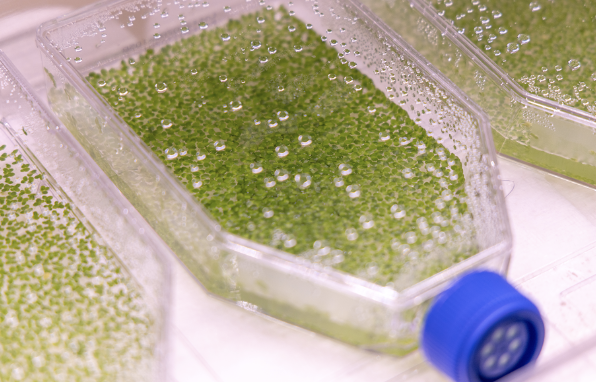
CCOVI hosts a national grapevine germplasm and clean plant collection in which elite-performing cultivars and rootstocks are maintained as virus-tested, genetically authenticated source plants for nurseries and propagation programs. Dr Poojari’s lab has adopted and optimized microshoot tip tissue culture therapy to eliminate viruses while preserving clonal identity, significantly shortening the time required to regenerate virus-free material from infected stock. These micropropagation and graft-based in vitro systems provide scalable, rapid clonal multiplication of clean vines, allowing the repository to expand and respond quickly to industry demand for specific cultivars and climate-resilient selections that are important to Canada.
Diagnostics, high-throughput sequencing, and new Brock infrastructure
The Clean Plant Program at Brock integrates High Throughput Sequencing (HTS) – based virus diagnostics with PCR confirmation, leveraging robotics, bioinformatics, and whole-genome analysis to move beyond multi-assay testing toward a single, comprehensive screening platform.
Through the CASP Field Infrastructure project, Brock is developing a dedicated farm with screenhouses and greenhouses built to plant pest containment standards, and foundation vineyards that will house and multiply clean stock under controlled, vector-free conditions. (5) This new infrastructure enables side-by-side use of HTS, greenhouse indexing, and field performance evaluation, effectively linking diagnostic pipelines with on-farm verification of vine health, resilience, and clonal performance.
National partnerships
CCOVI’s clean plant work is closely aligned with the Canadian Grapevine Certification Network (CGCN), which coordinates national standards for propagation material and provides an industry interface for certification and technology transfer. Collaboration with the Canadian Food Inspection Agency (CFIA), particularly through genomics-based initiatives like CLEANSED (6), helps harmonize HTS diagnostics for domestic material, accelerating safe access to new varieties.
A sustainable industry for the future
Building resiliency in grape production is an integrated process that starts with developing propagation and diagnostic tools needed to generate clean grapevines for the national repository, and continues with identifying new varieties to add to the collection that have improved resistance to winter damage and disease infection while maintaining quality oenological traits. Assessing grape varieties for suitability to the industry cannot stop merely at evaluating vineyard performance; the wines produced must reflect desirable market trends with consumer appeal. CCOVI welcomes the opportunity to continue working hand in hand with our industry partners to solve challenges and ensure a prosperous, sustainable industry for the future.
References
- Fuchs, M. (2025). Grapevine viruses: Did you say more than a hundred?. J Plant Pathol. 107, 217–227. https://doi.org/10.1007/s42161-024-01819-5
- Economic Forensics and Analytics Inc. (2022). Canada’s Wine Economy—Growth and Innovation Through Global Challenges. THE ECONOMIC IMPACT OF THE WINE AND GRAPE INDUSTRY IN CANADA 2019, Available at http://www.winegrowerscanada.ca/wp-content/uploads/2022/08/RPT-Canadian-Wine-Economic-Impact-2019-1.pdf Wine Growers Canada. (Accessed January 12, 2026)
- Vemulapati, B.M.; Ghoshal, K.; Lerat, S.; Mcfadden- Smith, W.; Fall, M.L.; Úrbez-Torres, J.R.; Moffet, P.; Boyes, I.; Phelan, J.; Bennouna, L.; et al. Metagenomic Profiling of the Grapevine Virome in Canadian Vineyards. Agriculture 2025, 15, 1532. https://doi.org/10.3390/agriculture15141532.
- Inglis, Debra (2026). Resiliency strategies to overcome challenges facing the Canadian grape and wine sector. Open Access Government January 2026, pp 412-413. Available at Open Access Government (Accessed January 12, 2026)
5. Majtenyi, Cathy (2024). CCOVI awarded $2.4M for grape, wine research under Sustainable Canadian Agricultural Partnership, Brock News. Available at http://brocku.ca/brock-news/2024/03/ccovi-awarded-2-4m-for-grape-wine-research-under-sustainable-canadian-agricultural-partnership/ (Accessed January 12, 2026)
6. Poojari, S, Zhang, X., and Rott, M. 2021-2026. Clean Plant Extraction and Sequencing Diagnostics (CLEANSED) for Clean Grapevines in Canada. Available at https://genomecanada.ca/project/clean-plant-extraction-sequencing-diagnostics-cleansed-clean-grapevines-canada/. (Accessed January 12, 2026)