PD Dr Philipp Girichidis, Prof Dr Ralf S Klessen and Dr Stefan Reissl at Heidelberg University’s Centre for Astronomy provide insights into our place in the Milky Way and the Local Bubble
The region of the Milky Way in which the solar system resides is far from uniform. We are embedded in a low-density cavity known as the Local Bubble, a structure several hundred light-years across that has been shaped by the cumulative action of multiple supernova explosions over the past 10-15 million years. (1,2)
Although the cavity cannot be observed directly from a single vantage point, its existence is inferred from dust extinction measurements, the distribution of nearby molecular clouds, and its multi-wavelength emission. Understanding its origin and present- day properties is crucial for interpreting the local interstellar medium and for placing our immediate surroundings into the broader context of galactic evolution.
A central challenge in studying the Local Bubble stems from our position inside it. Observationally, we only see boundary surfaces projected onto the sky, with every line of sight sampling a different combination of density, magnetic field configuration, and temperature. To overcome these limitations, we use three-dimensional magnetohydrodynamical simulations that follow the evolution of gas, magnetic fields, stellar feedback, and cosmic rays over tens of millions of years. (3,4,5) These simulations produce bubble-like structures comparable to the observed Local Bubble. By subjecting them to detailed post-processing, we can interpret multi-wavelength data in a physically consistent way.
Irregular shell structure shaped by turbulence and supernovae
A first element of this interpretation concerns the geometry and density structure of the bubble’s boundary. Observations show that the Local Bubble is surrounded by a fragmented network of filaments, ridges, and molecular clouds rather than a smooth shell. Successive supernova shock waves expand into a turbulent, magnetised medium, compressing swept-up gas in highly irregular patterns. From the perspective of an observer inside the bubble, the resulting differential extinction closely resembles the complex three- dimensional dust maps derived from Gaia and complementary surveys. (6) The irregularity of the bubble walls is therefore not an anomaly, but a natural consequence of stellar feedback acting in a realistic interstellar environment.
Gamma rays as tracers of past supernova activity
The bubble’s energetic state offers further insight. Gamma-ray emission traces interactions of cosmic rays with interstellar gas and thus reflects both the density distribution and the region’s dynamical history. In simulations, expanding shells from multiple supernovae create interacting fronts where gas accumulates in compressed layers. (7) Once permeated by cosmic rays, these layers become bright in gamma rays. Regions where individual bubbles collide or merge show especially strong compression and enhanced emissivity. Such features qualitatively match observations from the Fermi satellite and suggest that today’s gamma-ray signature of the Local Bubble retains a memory of the supernovae that formed it.
Soft X-Ray variability and the hot interior of the bubble
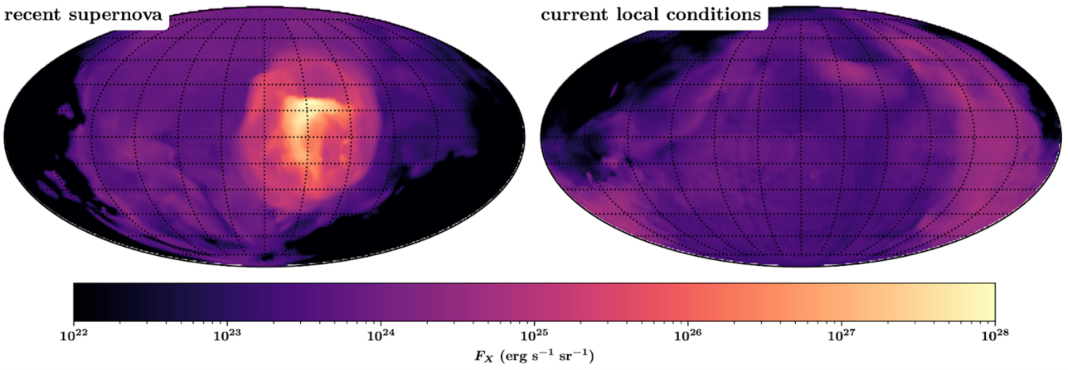
A third informative tracer is the soft X-ray emission from the bubble’s hot interior. Observationally, the soft X-ray sky displays strong spatial variability, which has long complicated efforts to infer the physical state of the local hot gas. Simulations clarify this behaviour: the hot plasma responsible for the emission is not uniformly distributed but concentrated in extremely high-temperature pockets formed immediately after supernova explosions. These regions occupy only a tiny fraction of the bubble’s volume, yet dominate its X-ray luminosity while they remain sufficiently hot. As the gas cools and expands, the emission fades dramatically, implying that the bubble’s total X-ray output can vary by several orders of magnitude on timescales of 10⁴–10⁵ years. This variability naturally explains the patchy appearance of the soft X-ray sky (Fig. 1).
A coherent formation scenario: Layered shells, cooling gas, and cosmic rays
Taken together, the structural, dynamical, and thermal analyses converge on a coherent physical scenario. The Local Bubble is the cumulative result of several supernova explosions originating from moving stellar groups that have passed through the region over the past few million years. Each explosion expanded into an interstellar medium already shaped by earlier shocks and large-scale gas flows, creating a layered and irregular shell structure. Magnetic fields contributed to guiding these flows and the resulting morphology of the compressed gas. Radiative cooling and gravitational instabilities fragmented parts of the shell into the molecular clouds observed today in the solar neighbourhood. Cosmic rays permeated the expanding cavities and continue to interact with the gas in the bubble walls, producing the observed gamma-ray emission. The interior remains filled with hot, low-density plasma whose X-ray signature evolves rapidly depending on the timing of the most recent supernova events.
The power of synthetic observations across the electromagnetic spectrum
The strength of the simulation-based approach lies in its ability to connect diverse observational tracers within a single physical framework. By producing synthetic observations across multiple wavelengths, we can test how changes in environmental conditions, feedback strength, or magnetic field geometry affect the appearance of the bubble. This not only refines our interpretation of the Local Bubble, but also sheds light on the broader population of bubbles and superbubbles that permeate star- forming galaxies. Such structures play a fundamental role in galactic ecology by redistributing energy and momentum, regulating star formation, shaping the multiphase interstellar medium, and providing channels through which radiation and cosmic rays propagate.
By combining high-resolution simulations with modern observational datasets, we can now reconstruct with increasing accuracy the history and current state of our galactic neighbourhood. The emerging picture is that of a dynamic, evolving cavity whose structure and emission properties encode the interplay between stellar evolution and the interstellar medium over millions of years. In this sense, the Local Bubble serves both as a fossil record of past supernova activity and as a laboratory for understanding how stellar feedback sculpts galaxies. It defines our immediate cosmic home within the Milky Way.
References
- Zucker et al. (2022): Star formation near the Sun is driven by expansion of the Local Bubble Nature, Volume 601, p.334-337
- O’Neill et al. (2024): The Local Bubble Is a Local Chimney: A New Model from 3D Dust Mapping The Astrophysical Journal, Volume 973, id.136, 21 pp.
- Walch et al. (2015): The SILCC (SImulating the LifeCycle of molecular Clouds) project – I. Chemical evolution of the supernova-driven ISM Monthly Notices of the Royal Astronomical Society, Volume 454, p.238-268
- Girichidis et al. (2016): The SILCC (SImulating the LifeCycle of molecular Clouds) project – II. Dynamical evolution of the supernova-driven ISM and the launching of outflows Monthly Notices of the Royal Astronomical Society, Volume 456, p.3432-3455
- Girichidis et al. (2018): The SILCC project – V. The impact of magnetic fields on the chemistry and the formation of molecular clouds Monthly Notices of the Royal Astronomical Society, Volume 480, p.3511-3540
- Maconi et al. (2023): Modelling Local Bubble analogs: synthetic dust polarization maps Monthly Notices of the Royal Astronomical Society, Volume 523, pp.5995-6010
- Maconi et al. (2025): Modeling Local Bubble analogs: II. Synthetic Faraday rotation maps Astronomy & Astrophysics, Volume 698, id.A84, 19 pp.