

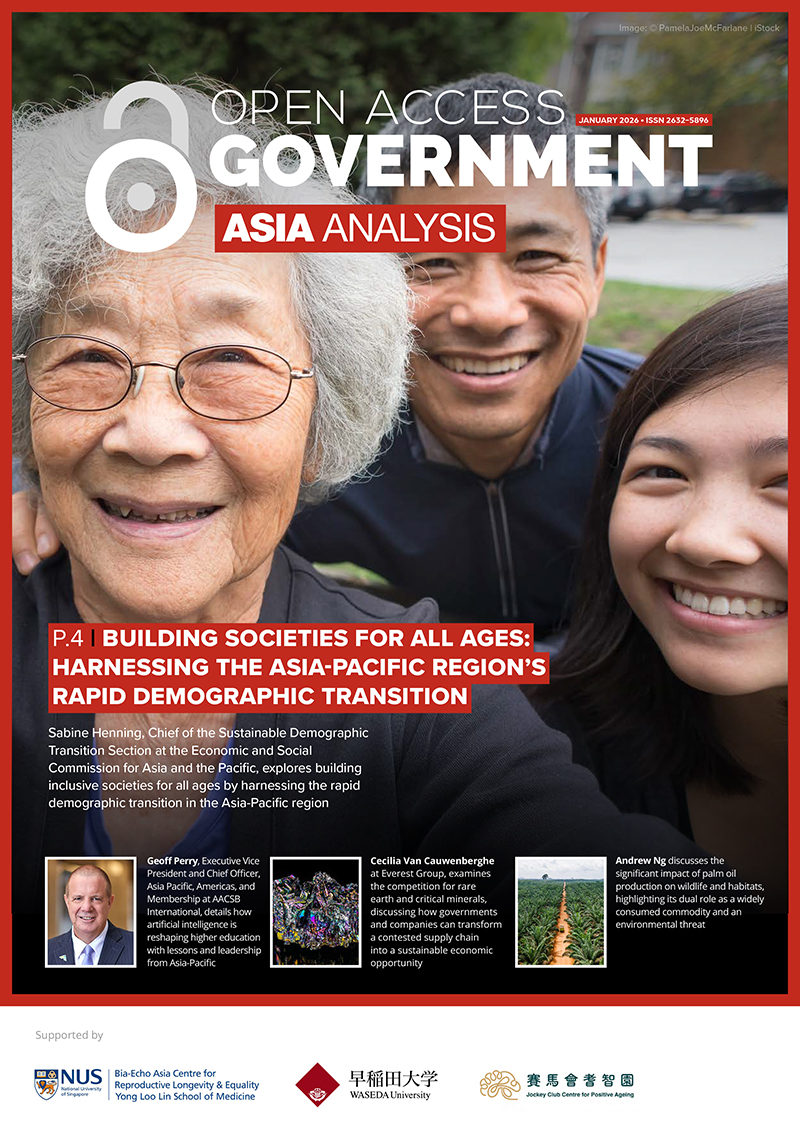
As we usher in 2026, we proudly present the latest edition of Asia Analysis.
Within these pages, you will find a wealth of compelling insights and in-depth analyses that are not only informative but also poised to ignite a sense of optimism as you reflect on your aspirations and strategies for the year to come
One notable contributor is Sabine Henning, Chief of the Sustainable Demographic Transition Section at the Economic and Social Commission for Asia and the Pacific (ESCAP). We are pleased to share her insights on building inclusive societies for all ages by leveraging the rapid demographic transitions occurring in the Asia-Pacific region. This piece explores progress in ageing policy, considering the region’s previously rapid population growth, which is now projected to peak at approximately 5.1 billion people by the early 2050s before beginning to decline, and what still needs to be accomplished.
Returning contributor Geoff Perry, Executive Vice President and Chief Officer for the Asia-Pacific, Americas, and Membership at AACSB International, discusses how artificial intelligence is transforming higher education and highlights lessons and leadership from the Asia-Pacific region. As technology evolves from content generation to assessment and curriculum design, Perry emphasises the importance of shifting focus from mere implementation to intent – identifying meaningful applications of AI and demonstrating the continued relevance of business education.
Additionally, Andrew Ng, Senior Manager of the Landscape Program at Earthqualizer, examines the significant effects of palm oil production on wildlife and habitats. He highlights the dual nature of palm oil as both a widely consumed commodity and an environmental threat. Did you know that palm oil is one of the most versatile ingredients used in a variety of products, ranging from food items to cosmetics and biofuels?
We also recommend an in-depth special feature by Cecilia Van Cauwenberghe from Everest Group. This piece explores the competition for rare earth elements and critical minerals, discussing how governments and companies can turn a contested supply chain into a sustainable economic opportunity. Today, nearly every high-value technology, such as electric vehicles, wind turbines, smartphones, semiconductors, defence systems, and advanced energy storage, depends on these materials.
We are excited to invite you to our upcoming editions, where we will showcase a diverse range of contributors from both the region and beyond. These contributors will share their valuable perspectives and in-depth analyses on critical policies and research that significantly impact Asia. Join us as we explore these compelling insights that aim to foster understanding and drive meaningful discussion.