
For decades, astronomers have believed they understood how giant stars scatter the chemical building blocks of life across the galaxy
However, a new study of a nearby red giant star shows that this long-standing idea may be incomplete
Observations of the star R Doradus reveal that starlight and stardust alone are not powerful enough to drive the vast stellar winds that enrich interstellar space with essential elements such as carbon and oxygen.
The findings, led by researchers at Chalmers University of Technology in Sweden, challenge an assumption about how matter circulates through the cosmos and ultimately becomes part of planets, atmospheres, and living organisms.
The importance of giant stars
Red giant stars are ageing, bloated versions of stars like our Sun. As they near the end of their lives, they lose enormous amounts of material through stellar winds. These winds carry atoms forged inside stars into interstellar space, where they later become part of new stars, planets, and potentially life itself.
Astronomers have always thought that these winds are powered by radiation pressure, starlight pushes against newly formed dust grains in the star’s outer atmosphere, driving gas and dust outward into space.
While this theory has worked well on paper, direct observational tests have been limited.
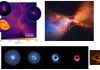
R Doradus, located just 180 light-years from Earth, offered a rare opportunity to examine this process in detail. It is one of the closest and brightest red giant stars, making it an ideal laboratory for studying stellar winds.
Peering into the star’s dusty atmosphere
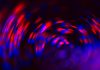
Using the SPHERE instrument on the European Southern Observatory’s Very Large Telescope in Chile, researchers observed light scattered by dust grains around R Doradus.
The dust grains turned out to be extremely small and made of familiar materials such as silicates and alumina. These grains were then tested in advanced computer simulations that modelled how strongly starlight could push them.
The result was unexpected and showed that the grains were simply too small to receive enough force from starlight to escape the star’s gravity and drive the observed stellar wind.
Understanding the whole story
The presence of dust alone, it turns out, does not guarantee that radiation pressure can launch powerful winds. Although the dust around R Doradus is illuminated by the star, the push from the light is insufficient to account for the mass loss astronomers observe.
This discovery does not mean that dust plays no role at all, but it does suggest that other mechanisms must be helping stars shed their outer layers. The traditional picture of dust-driven winds, at least for stars like R Doradus, appears to be incomplete.
Searching for new drivers of stellar winds
Previous observations of R Doradus with the ALMA telescope have revealed giant, bubbling structures on the star’s surface, caused by powerful convection. Stellar pulsations or sudden episodes of intense dust formation may also lift material away from the star.
These processes could work together to create a more complex and dynamic mechanism for launching stellar winds than previously assumed.
Understanding how red giant stars lose mass is essential for explaining how galaxies evolve and how the ingredients for life are distributed through space. In several billion years, our own Sun is expected to become a red giant similar to R Doradus, shedding its outer layers into the cosmos.
By revealing that the process is more intricate than once thought, this study reshapes scientists’ understanding of stellar life cycles and the cosmic journey of life’s atoms.