
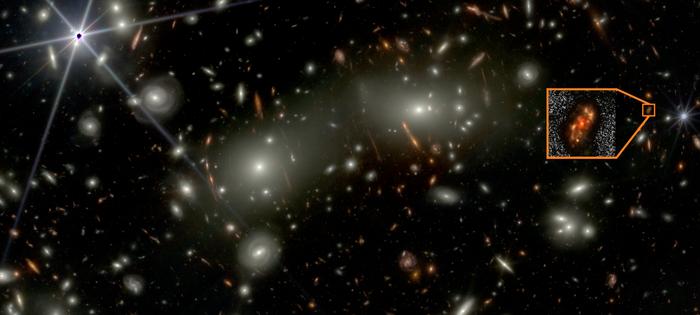
A new discovery challenges the cosmic timeline: the James Webb Space Telescope (JWST) has spotted Alaknanda, a massive, well-formed grand-design spiral galaxy that existed just 1.5 billion years after the Big Bang
Using the powerful James Webb Space Telescope (JWST), researchers have identified a remarkably mature, grand-design spiral galaxy (Alaknanda)—a shape strikingly similar to our own Milky Way—that existed just 1.5 billion years after the Big Bang.
Named Alaknanda (after the Himalayan river), the galaxy was spotted by Rashi Jain and Yogesh Wadadekar of the National Centre for Radio Astrophysics (NCRA) at the Tata Institute of Fundamental Research (TIFR) in Pune. The existence of such a well-formed system so early in the cosmos challenges prevailing models of galaxy formation, which predicted the early universe should only host chaotic, irregular structures. The findings have been published in the European journal, Astronomy & Astrophysics.
A structure that defies expectations
Classic spiral galaxies, defined by two clear, symmetric arms, were long thought to require several billion years to assemble. This process demands a stable, rotating disk of gas that remains undisturbed by violent galactic collisions, allowing for the slow development of spiral arms via phenomena like density waves.
Alaknanda, however, exhibits these mature characteristics with astonishing speed. The galaxy, which spans about 30,000 light-years across, already possesses a well-defined central bulge and two sweeping, symmetric spiral arms. Furthermore, it is a powerhouse of star formation, churning out new stars at a rate approximately 20 times faster than the present-day Milky Way, equivalent to roughly 60 solar masses annually. About half of Alaknanda’s stars appear to have formed in a mere 200 million years—a blink of an eye in cosmic terms.
“Alaknanda has the structural maturity we associate with galaxies that are billions of years older,” explains Rashi Jain, the study’s lead author. “Finding such a well-organised spiral disk at this epoch tells us that the physical processes driving galaxy formation—gas accretion, disk settling, and possibly the development of spiral density waves—can operate far more efficiently than current models predict.”
Magnified view of the early universe
The team was able to capture the galaxy’s structure in such stunning detail thanks to a cosmic alignment. Alaknanda lies in the background of the massive Abell 2744 galaxy cluster, also known as Pandora’s Cluster. The cluster’s enormous gravity acts as a natural magnifying lens, a phenomenon known as gravitational lensing, which magnified Alaknanda’s light and made its faint structure twice as bright for JWST’s powerful instruments.
Jain and Wadadekar leveraged an extensive dataset from JWST, analysing images through 21 different filters. This wealth of information—part of the UNCOVER and MegaScience surveys—allowed them to precisely estimate key parameters such as the galaxy’s distance, stellar mass (approximately ten billion solar masses), and its rapid star formation rate.
Rewriting the cosmic timeline
The discovery of Alaknanda provides compelling evidence that the early universe was far more developed and dynamic than previously assumed. While JWST has revealed other early disk-shaped galaxies, Alaknanda stands out as one of the clearest examples of a textbook “grand-design” spiral at such a remote time.
“Alaknanda reveals that the early Universe was capable of far more rapid galaxy assembly than we anticipated,” says Yogesh Wadadekar, the study’s co-author. The rapid formation and organisation of this galaxy in just a few hundred million years compels astronomers to rethink the mechanisms of galaxy formation. Scientists are now debating whether Alaknanda’s arms arose from the steady accretion of cold gas, allowing density waves to carve out the patterns, or from a temporary disturbance caused by a smaller companion galaxy. Future observations will aim to measure the galaxy’s rotational dynamics to help resolve these competing formation scenarios.
This finding is a significant step in understanding the cosmic journey—showing that the conditions for stable, complex structures, and ultimately worlds like ours, may have emerged far earlier than anyone once thought.