
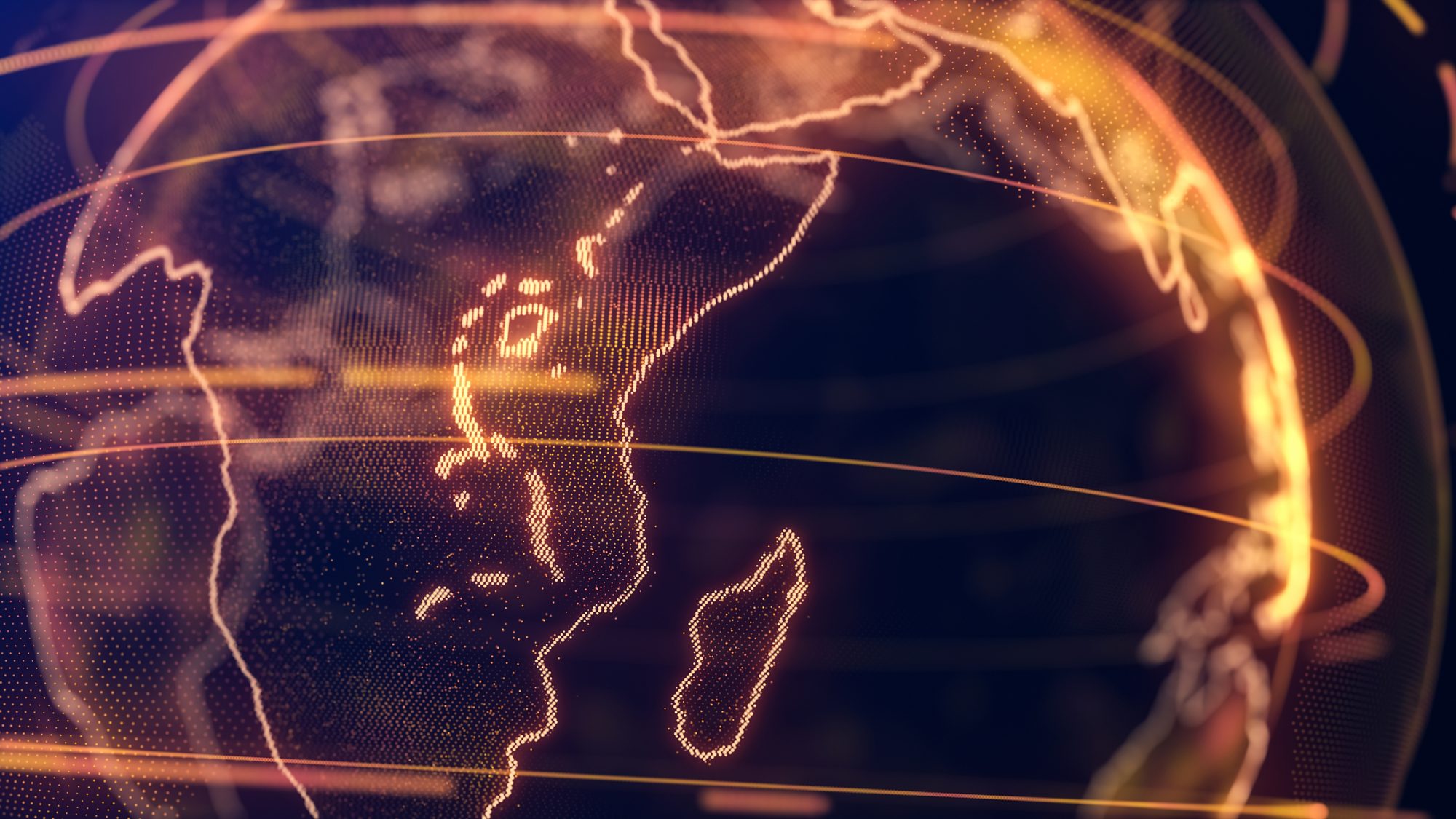
Scientists in Germany have reached a major milestone in climate research by creating the most detailed digital replica of Earth ever built
This advanced simulation, often described as a “digital twin” of the planet, promises to deepen our understanding of how Earth’s climate may change in the decades ahead.
Developed by researchers at the Max Planck Institute for Meteorology, the model represents a huge leap beyond traditional climate simulations. By combining extreme computing power with cutting-edge climate science, the team has created a virtual Earth capable of capturing planetary processes at a near-local scale.
A planet rebuilt cell by cell
A huge part of this innovation is resolution. Previous global climate models divided the planet into grid cells tens of kilometres wide. This new digital twin narrows that distance to just 1.25 kilometres. As a result, Earth is reconstructed using roughly 672 million individual cells.
Half of these cells represent land and ocean surfaces, while the other half simulate the atmosphere above them. Each cell interacts with its neighbours, allowing the model to recreate the complex exchanges of heat, water, gases, and energy that drive Earth’s climate system.
This level of detail allows scientists to observe processes that were previously blurred or entirely invisible at global scales.
Fas weather, slow climate
The model stands out for its resolution and for how it separates and reconnects Earth’s processes. Researchers designed it around two interacting systems.
The first is a fast system focused on weather. Using the advanced ICON modelling framework, the simulation captures wind patterns, rainfall, cloud formation, and energy flows with remarkable precision. This enables the representation of local storms, mountain winds, and ocean currents far more accurately than before.
The second is a slow system that tracks long-term climate processes. This includes the carbon cycle, changes in vegetation and ecosystems, chemical interactions in the oceans, and the gradual buildup or release of greenhouse gases.
By linking these fast and slow processes, the digital twin achieves a level of realism approximately 40 times greater than that of earlier climate models.
Why these changes in climate science
Earth’s climate is shaped by countless connections between land, sea, air, and life itself. A shift in ocean temperature can alter atmospheric circulation, which can then affect rainfall, ecosystems, and carbon storage thousands of kilometres away.
This new simulation allows scientists to explore those connections in detail. It can help predict regional changes in heat, rainfall, ice loss, and sea levels with far greater confidence. For policymakers and planners, this could eventually mean more reliable projections for climate adaptation and risk management.
One particularly important application lies in understanding the Atlantic Meridional Overturning Circulation, a powerful ocean current that helps keep Europe relatively mild. Changes in this system could have major consequences, and the new model offers an unprecedented tool for studying its future behaviour.
A glimpse of what’s next
While the digital twin is not intended for everyday weather forecasts, it hints at a future where long-term climate predictions become far more precise. By accurately representing both rapid weather events and slow planetary shifts, scientists are moving closer to models that can reliably project climate decades in advance.
As computing power continues to grow, digital Earth simulations like this one may become essential tools for navigating a changing planet.