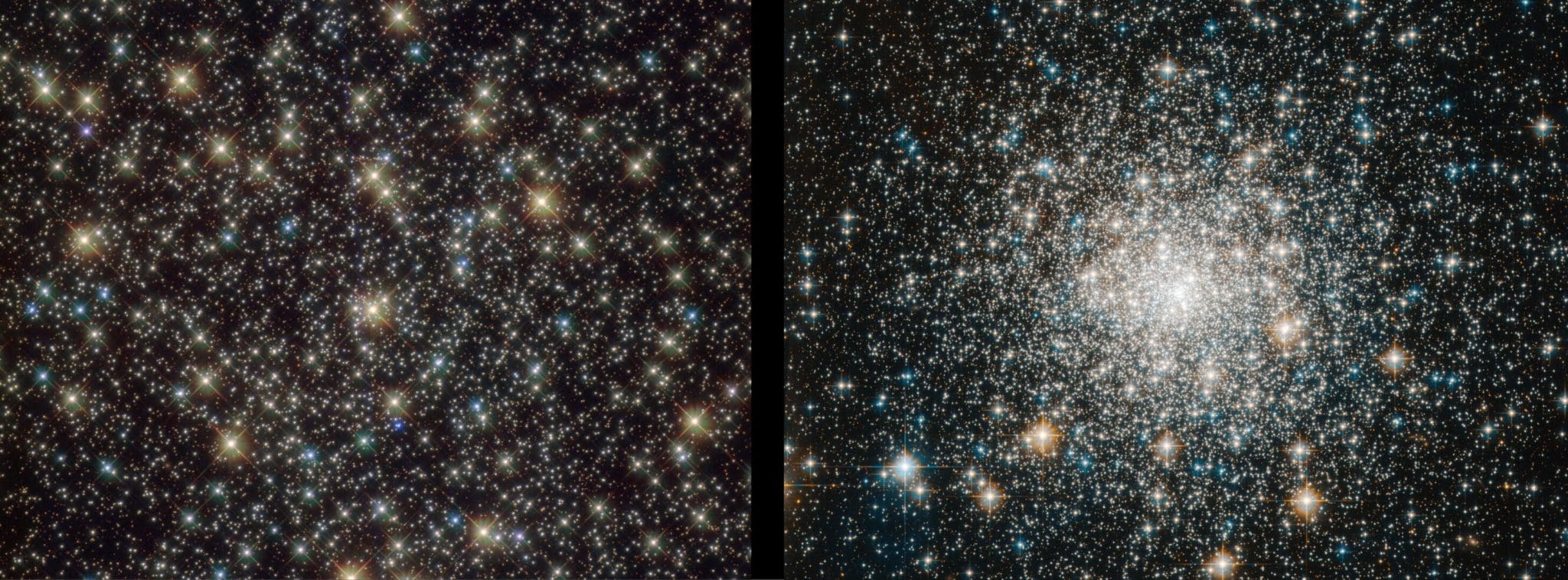
New Hubble Space Telescope data confirms that “blue straggler” stars maintain their youthful glow by siphoning fuel from binary companions. This process occurs most frequently in quiet, low-density cosmic neighbourhoods where stellar pairs survive
Astronomers have announced a breakthrough in a 70-year-old cosmic mystery. Using the NASA/ESA Hubble Space Telescope, an international research team has identified how certain stars, known as “blue stragglers,” manage to appear billions of years younger than they actually are.
The findings, published in Nature Communications, reveal that these stars do not achieve their youthful glow through violent collisions, as previously thought. Instead, they thrive through long-term partnerships in quieter, less crowded regions of space.
Ancient star clusters
Most stars in a globular cluster are the same age, having formed from the same cloud of gas billions of years ago. As these clusters age, their stars typically become redder and cooler. Blue stragglers are the exception. They are hotter, more massive, and shine with a brilliant blue light that suggests they are in the prime of their youth.
To understand this phenomenon, researchers analysed ultraviolet data from 48 different globular clusters in the Milky Way. This study produced a catalogue of over 3,000 blue stragglers, the largest ever assembled. By comparing clusters with different densities, the team looked for patterns in where these stars were most likely to appear.
The secret of stellar partnerships and stellar cannibalism
The study found that blue stragglers are most common in low-density clusters. In these “peaceful” environments, stars have more room to exist in binary systems—pairs of stars that orbit one another.
Within these pairs, a process of “stellar cannibalism” occurs. A larger star can siphon hydrogen fuel from its smaller companion or merge with it entirely. This extra mass effectively resets the star’s internal clock, allowing it to burn hotter and brighter, appearing much younger to observers on Earth.
Survival of the quietest
In the past, many scientists believed that blue stragglers were formed by stars physically crashing into each other in crowded areas. However, the Hubble data showed the opposite. In extremely dense clusters, the constant movement and gravitational tugging of nearby stars actually break binary pairs apart before they can create a blue straggler.
“Crowded star clusters are not a friendly place for stellar partnerships,” explained Enrico Vesperini of Indiana University. In these tight quarters, the very systems needed to keep a star “young” are destroyed.
This discovery highlights how much a star’s environment shapes its life story. While some stars age predictably in isolation, others in the right neighbourhood find ways to stay forever young.