
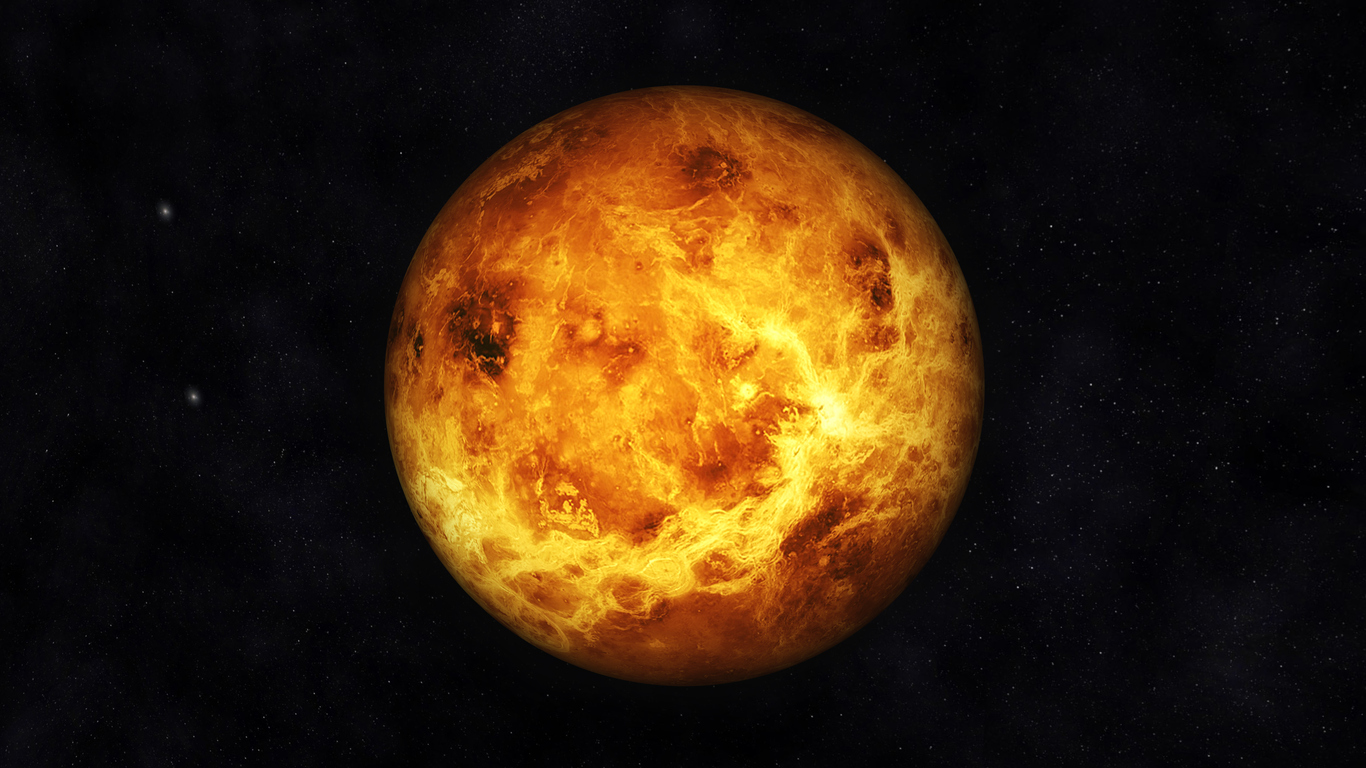
Scientists at the University of Trento have discovered new evidence of an empty lava tube beneath the surface of Venus
The discovery of this lava tube is the first time a structure has been shown on the planet Venus.
The discovery was published in Nature Communications and is based on radar data collected by NASA’s Magellan mission in the early 1990s.
A volcanic planet under the clouds
Venus’ surface is dominated by lava plains, massive volcanic rises, and long lava channels, suggesting a geological history shaped largely by volcanic activity.
Before this discovery, however, the direct evidence of underground volcanic structures, such as lava tubes, has always been confusing.
On Earth, lava tubes form when the surface of a lava flow cools and hardens, creating an insulating crust while molten lava continues to flow beneath. When the eruption ends, it can leave behind long, hollow conduits. Similar structures have already been identified on the Moon and Mars, but confirming their existence on Venus has previously been challenging due to the planet’s thick, opaque atmosphere.
Using radar to see below the surface
Because Venus is permanently shrouded in dense clouds, optical imaging of its surface is impossible. This means that instead, scientists must rely on radar, which can penetrate the clouds and reveal surface features.
Between 1990 and 1992, NASA’s Magellan spacecraft mapped most of Venus using Synthetic Aperture Radar, creating a global dataset that is still being used for discoveries decades later.
Researchers from the University of Trento focused on areas showing signs of localised surface collapses, known as skylights. On Earth and other planetary bodies, these pits often form when the roof of a lava tube partially collapses, revealing the void below. By applying advanced imaging techniques developed to detect underground conduits, the team analysed radar reflections around these features.
A giant lava flow at Nyx Mons
The analysis revealed a large subsurface cavity in the region of Nyx Mons, which is a volcanic area named after the Greek goddess of the night. The structure is interpreted as a lava tube with an estimated diameter of about 1 kilometre, a roof thickness of at least 150 meters, and an empty void extending to a depth of at least 375 meters.
These dimensions place the Venusian lava tube among the largest known in the Solar System. It exceeds the size of most terrestrial lava tubes and even those predicted for Mars, reaching the upper limits of what has been proposed on the Moon.
Massive lava tubes on Venus
Venus’s physical conditions may be particularly favourable for forming large lava tubes. The planet’s lower gravity allows underground cavities to remain stable at greater sizes, while its dense atmosphere helps lava flows cool rapidly at the surface, creating thick insulating crusts. This combination may explain why lava channels and tubes on Venus appear larger and longer than those found elsewhere.
Although radar data can only confirm the portion of the cavity near the skylight, the surrounding terrain and the presence of similar pits suggest that these subsurface conduits could extend for at least 45 kilometres.
This discovery has important implications for upcoming missions to Venus. ESA’s Envision and NASA’s VERITAS spacecraft will carry next-generation radar systems capable of producing much higher-resolution images. Envision will also include a subsurface radar sounder designed to probe hundreds of meters below the surface, potentially detecting lava tubes even when no skylights are visible.