

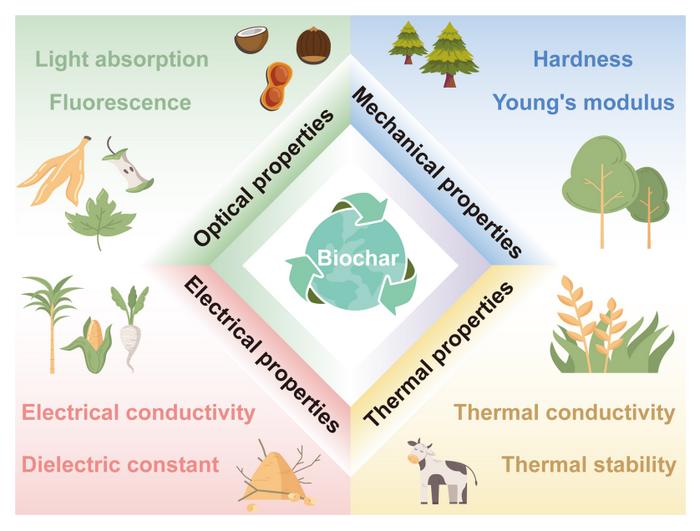
Researchers have mapped the “physical genome” of biochar, creating a framework to link its internal structure to performance. This breakthrough enables the precision design of sustainable carbon materials for energy, construction, and environmental technology
Scientists have reached a significant milestone in materials science by mapping the “physical genome” of biochar. A comprehensive review published in Biochar X on January 29, 2026, introduces a framework that treats the internal structure of biochar as a set of inheritable building blocks. This approach moves the field away from traditional trial and error and toward the precise design of carbon materials for energy, construction, and environmental technology.
Biochar is produced by heating organic waste in low-oxygen environments. While it is commonly used for soil health and carbon sequestration, this new research highlights its potential as a sophisticated technical material. By linking atomic-scale bonding to macroscopic performance, the researchers have created a roadmap for the next generation of sustainable carbon products.
Defining the physical genome
The physical genome concept is inspired by materials informatics. It identifies specific structural features—such as pore connectivity, defect density, and graphitic domains—that determine how biochar behaves. These “genetic” traits are dictated by the type of feedstock used and the specific conditions of the heating process, such as temperature and duration.
Rather than viewing porosity or electrical conductivity as isolated traits, the framework treats them as interconnected systems. For example, the researchers found that the way carbon atoms are ordered influences both how the material conducts electricity and how long it remains stable in the environment. This holistic view allows scientists to predict how a change in production will affect the final product’s performance.
Synergies in material performance
The study reveals that biochar’s most valuable functions often come from “cross-property synergies.” A specific carbon network might provide mechanical strength while simultaneously allowing for electron transport. These overlapping traits enable biochar to serve diverse roles, including:
- Energy storage:
- Using micropores for supercapacitor electrodes.
- Electromagnetic shielding:
- Utilising graphitic structures to block interference.
- Thermal management:
- Leveraging porous architectures to act as insulators.
- Water purification:
- Using high surface areas for advanced filtration.
Biochar: Transitioning to precision design
Despite the versatility of biochar, the researchers noted that previous studies were often fragmented, focusing on only one or two properties at a time. The physical genome framework aims to unify these findings. By measuring multiple properties within the same biochar system, scientists can establish predictive relationships.
The authors suggest that combining controlled synthesis with data-driven modelling will allow for “precision-engineered biochar.” This would transform the material from a simple soil additive into a customisable platform for high-value applications, such as solar-driven water evaporation and low-carbon building materials. This shift represents a major step toward a circular economy where waste is converted into high-performance technology.