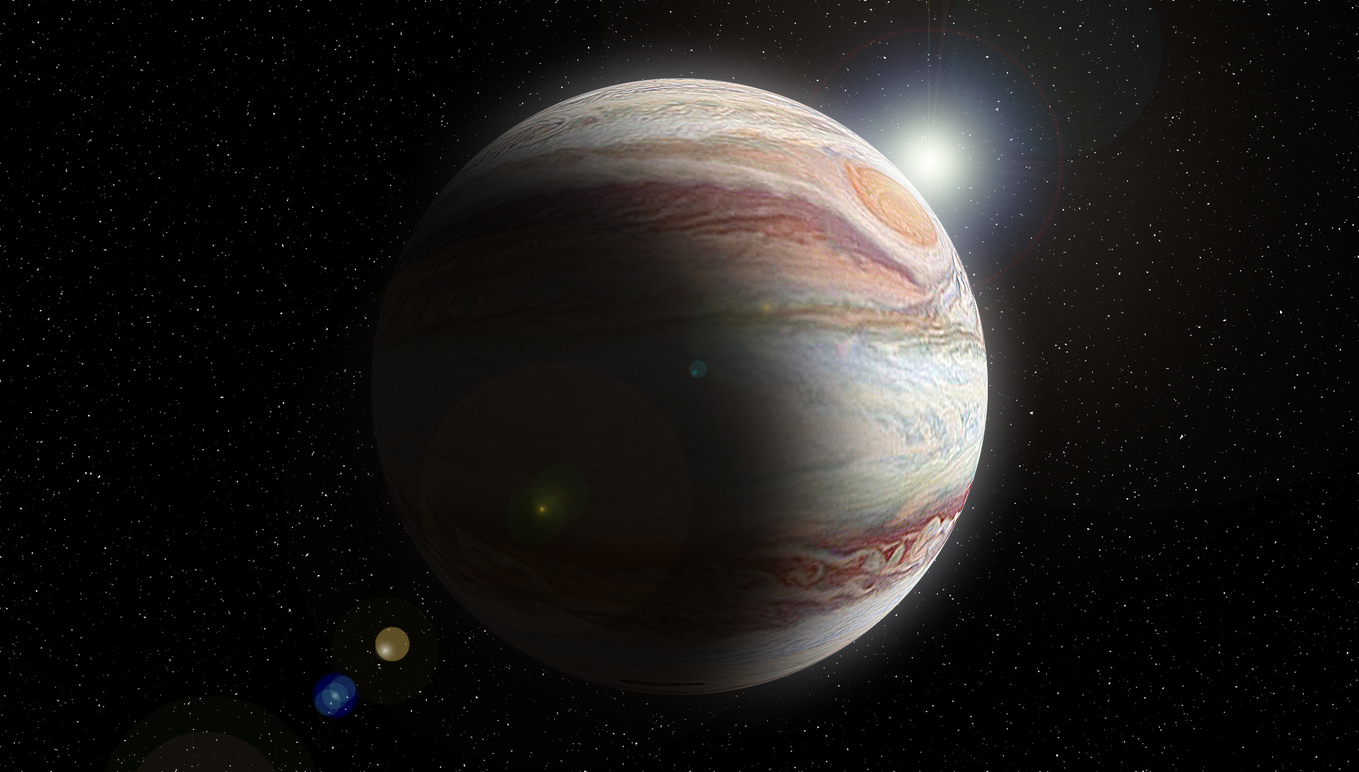
Astronomers have recently found new evidence to explain how massive “super Jupiters” form around distant stars
Using data from NASA’s James Webb Space Telescope (JWST), researchers studied a planetary system 133 light-years away and found that its giant planets likely formed in a similar way to Jupiter.
The discovery centres around the detection of sulfur in one of the planets’ atmospheres. This finding offers important clues about how these enormous worlds came into existence.
A distant system of giant worlds
The star system HR 8799 lies in the constellation Pegasus. It hosts four massive planets, each between five and 10 times the mass of Jupiter. These planets orbit far from their star, at distances ranging from 15 to 70 astronomical units. For comparison, Earth is just one astronomical unit from the Sun.
Because these planets are both extremely large and located so far from their star, astronomers have always debated how they formed. Traditional planet formation theory, known as core accretion, suggests that planets grow gradually. Tiny dust grains stick together to form pebbles, which build into rocky cores. Once a core becomes massive enough, it attracts surrounding gas and ice, eventually forming a gas giant.
However, another theory called gravitational instability suggests that some massive planets form more like stars. Many scientists suspected that distant super Jupiters might form this way. The new findings suggest otherwise.
A key clue in sulfur
Researchers focused particularly on the planet HR 8799 c. Using JWST, they analysed the planet’s atmosphere and detected sulfur as hydrogen sulfide.
This detail is important because sulfur-containing compounds would exist as solids in the cold disk of material surrounding a young star. That means sulfur would have been incorporated into a growing rocky core before the planet gathered large amounts of gas.
In addition to sulfur, the three innermost planets in the system were found to contain higher levels of heavy elements such as carbon and oxygen compared to their parent star. This enrichment further supports the idea that these planets formed through the gradual buildup of solid material. These findings were published in the journal Nature Astronomy.
The planets in HR 8799 are roughly 10,000 times fainter than their star, making them extremely difficult to study. JWST’s spectrograph was not originally designed for observing such faint planetary signals next to bright stars.
To overcome this, researchers developed new data-processing techniques to isolate the planets’ light. They also refined atmospheric models to interpret the complex spectral signatures captured by the telescope. The JWST’s high sensitivity enabled the detection of molecules that had never been identified in these worlds.
Expanding the boundaries of planet formation
The discovery pushes the current limits of where core accretion can occur. Previously, it was uncertain whether rocky cores could form at such great distances from a star. The HR 8799 system suggests that even massive planets far from their host star can grow through the same gradual process that shaped Jupiter.
These findings provide valuable new data for astronomers studying planet formation. As JWST continues observing distant worlds with unprecedented detail, scientists expect even more insights into how planetary systems form.