

David Littler from enChoice UK discusses the AI governance in the public sector, focusing on bridging the gap between its adoption and control
AI acceleration without the guardrails
Across both public and private sectors, organisations are adopting artificial intelligence (AI) at a remarkable speed. Leaders view AI as transformative, increasing productivity and unlocking insights from information previously buried in enterprise systems. Tools like Microsoft 365 Copilot are being deployed rapidly as organisations race to capture early advantages.
AI adoption is moving quickly, but data governance has not kept pace. This widening gap has become one of the most immediate and consequential risks facing organisations today.
The hidden risk of AI governance
Traditional enterprise content systems are built on decades of governance discipline. They enforce permission structures, classification policies, retention rules, and audit trails. However, when data is passed into an AI environment, much of that governance context disappears. AI systems often ingest and “learn” from documents without preserving the access controls that protected them.
This disconnect creates scenarios where AI tools surface sensitive or regulated material to users who were never authorised to see it. Even more challenging, once an AI has embedded patterns from a document, it may continue to use that information long after the underlying file has been deleted or restricted.
The cost problem with AI data consumption
AI models process whatever they are given, regardless of business relevance. When AI systems are granted access to complete historical archives or the wide array of content repositories in an organisation, the required processing resources increase sharply. This often results in substantial, unplanned operational expenses.
A growing number of organisations are discovering that AI costs are not primarily about usage; they are about data volume. The more the model is allowed to ingest, the more expensive it becomes to maintain, query, and update.
The need for ongoing content cycling
A key insight emerging from advanced AI cost modelling is that relevance is not static. The value of content changes over time, and so should its accessibility to AI systems. Not all information deserves to remain continuously available to AI models. As business priorities shift, older material may lose operational value while new content becomes essential.
By continually reviewing which content is made available to AI, adding new high-value information and removing outdated or low-value material, organisations can keep their AI knowledge base current while controlling ongoing compute costs. This dynamic approach ensures the AI works with the most meaningful content without being burdened by the noise of irrelevant data.
The fragmented enterprise content landscape
AI’s challenges are compounded by the fragmented nature of enterprise information. Organisations typically store content in a variety of systems, including legacy ECM platforms, cloud repositories, project workspaces, collaborative drives, and departmental archives. Within these silos, content tends to fall into three main categories.
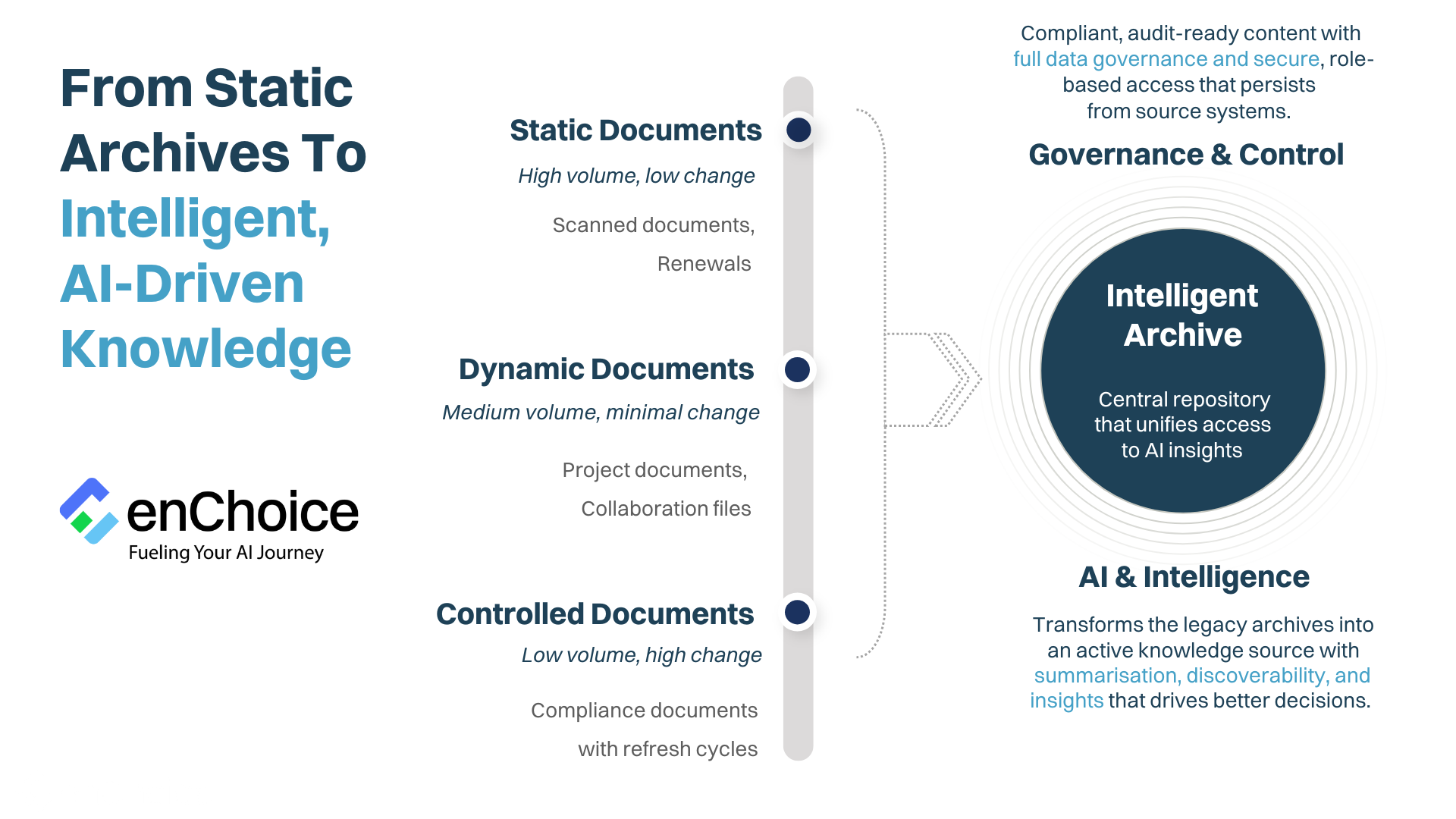
Static documents, including archival or scanned materials that change rarely. Dynamic documents consisting of project files and documents that evolve as teams collaborate. Controlled documents, including compliance records and policy-driven materials that require strict oversight.
Each of these content types carries different governance expectations, and AI tools are not designed to navigate these distinctions without help. When AI treats all content uniformly, risk and inefficiency quickly emerge.
The solution: A governed intermediary layer
The best approach, and one that enChoice has been advocating, is to establish a governed, cost-efficient intermediary layer between enterprise systems of record and the AI platforms consuming their information. This intermediary layer ensures that AI receives only the correct information, under the right conditions, and always with source-level governance preserved.
enChoice encore, the technology foundation for this model, connects to existing ECM and content systems without needing migration or reorganisation. It preserves original permissions and classifications while exposing information to AI in a structured, policy-aware manner.
This creates a safe, controlled channel through which AI can learn, query, and summarise enterprise content.
Unlocking the value of legacy archives without replacing them
A significant benefit of this approach is the ability to transform legacy archives into modern knowledge sources. Rather than replacing or consolidating existing systems, a costly and disruptive effort, the intermediary layer overlays intelligence and access control onto what is already in place.
Static archives become searchable, dynamic files become safely accessible, and controlled documents retain their compliance posture. And none of it requires tearing out or replacing core systems.
A governance-first model for compliance and insight
This governance-first architecture ensures that every AI response can be traced back to its authorised source. In regulated industries, this traceability is essential. Organisations gain confidence that AI is operating within the same compliance boundaries that have long governed their enterprise content.
And as business needs evolve, the intermediary layer ensures that AI access evolves with them, removing outdated content, adding new material, and maintaining the principle that AI should see only what is relevant, authorised, and valuable.
The future of enterprise knowledge is governed and dynamic
AI is reshaping how organisations work, but without strong governance and cost discipline, the risks grow as fast as the opportunities. The ability to dynamically control what content AI can access will become one of the most critical levers in an enterprise’s AI strategy.
The organisations that succeed will be those that pair rapid AI adoption with equally rapid governance evolution.
A governed intermediary layer provides that foundation, enabling AI to deliver powerful insight while preserving security, compliance, and financial control.
The future of enterprise knowledge is not just AI-enabled. It is governed, dynamic, and continuously optimised, unlocking value from existing information safely, efficiently, and intelligently.
To explore how enChoice can help your organisation, contact David Littler at dlittler@enchoice.com

This work is licensed under Creative Commons Attribution-NonCommercial-NoDerivatives 4.0 International.