
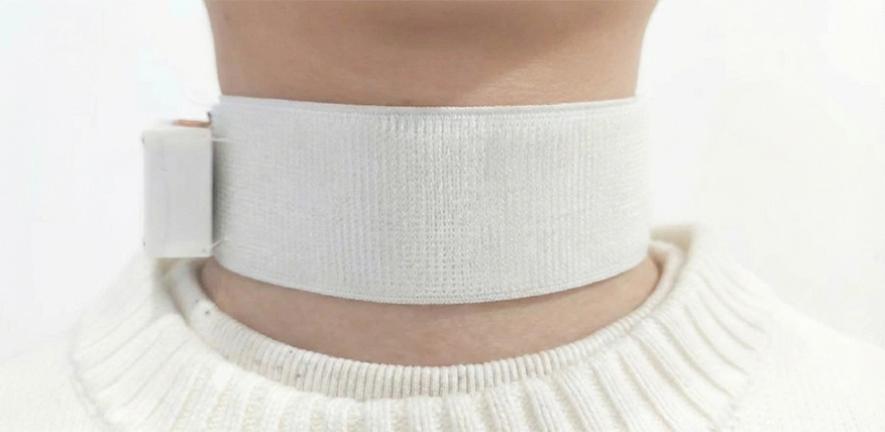
Cambridge researchers developed Revoice, an AI wearable that decodes silent speech, helping stroke patients with dysarthria communicate naturally
Cambridge researchers have created Revoice, a wearable, AI-driven communication device that helps stroke patients with dysarthria regain their ability to speak by decoding subtle throat vibrations and heart signals into natural words and sentences.
The soft, flexible choker uses sensitive sensors and AI to turn mouthed speech into real-time conversation, offering a non-invasive alternative to standard assistive technology for greater independence.
The findings are reported in Nature Communications.
How Revoice works: technology and trials
The Revoice device uses a combination of ultra-sensitive sensors and artificial intelligence to decode speech signals and emotional cues, enabling individuals with post-stroke speech impairment to communicate naturally.
The device’s signals are processed by two AI agents: one reconstructs words from fragments of silently mouthed speech, and the other interprets emotional state and contextual information, expanding short phrases into complete sentences.
The trial involved five patients with dysarthria, a common type of post-stroke speech impairment. The device achieved word and sentence error rates of 4.2% and 2.9%, respectively, and operates differently from existing assistive speech technologies that require eye tracking or brain implants.
Restoring communication and independence
Dysarthria, or dysarthria in combination with aphasia, develops in around 50% of people who experience a stroke. The condition causes weakness in the muscles of the face, mouth, and vocal cords. It affects people in different ways, but most often causes an inability to speak clearly, slurred or slow speech.
“When people have dysarthria following a stroke, it can be extremely frustrating for them, because they know exactly what they want to say, but physically struggle to say it, because the signals between their brain and their throat have been scrambled by the stroke,” said Professor Luigi Occhipinti from Cambridge’s Department of Engineering, who led the research. “That frustration can be profound, not just for the patients, but for their caregivers and families as well.”
“Patients can generally perform the repetitive drills after some practice, but they often struggle with open-ended questions and everyday conversation,” continued Occhipinti. “And as many patients do recover most or all of their speech eventually, there is not a need for invasive brain implants, but there is a strong need for speech solutions that are more intuitive and portable.”
The study’s participants reported a 55% increase in satisfaction, indicating that the Revoice device could help stroke patients regain their ability to communicate and regain independence.
The device was able to transform one participant’s request of “we go hospital” into “Even though it’s getting a bit late, I’m still feeling uncomfortable. Can we go to the hospital now?” The sensors in the Revoice device detected the wearer’s frustration from their elevated heart rate, and that it was getting late at night.
Extensive clinical trials will be required before the device can be made widely available. The researchers hope that future versions will include multilingual capabilities, a broader range of emotional states, and fully self-contained operation for everyday use.
“This is about giving people their independence back,” said Occhipinti. “Communication is fundamental to dignity and recovery.”