
Seismologists have discovered hidden faults at the Mendocino Triple Junction by tracking tiny earthquakes. This new five-piece model reveals complex tectonic movements that could significantly reshape our understanding of California’s future seismic hazards
Deep beneath the rugged coastline of Northern California, where the San Andreas Fault meets the Cascadia Subduction Zone, the Earth is far more fractured than previously believed. According to a study published in the journal Science, researchers have used data from thousands of tiny earthquakes or micro-earthquakes to map a hidden tectonic landscape. This discovery could redefine our understanding of seismic risk in the region.
The study is a collaborative effort between the U.S. Geological Survey (USGS), UC Davis, and CU Boulder. It focuses on the Mendocino Triple Junction, which is the volatile meeting point of three major tectonic plates: the Pacific, the North American, and the Gorda.
The iceberg beneath the surface
For decades, the Triple Junction was viewed as a relatively straightforward intersection of three plates. However, surface observations only tell part of the story. Lead author David Shelly of the USGS compared the region to an iceberg. He noted that while you can see a bit at the surface, you have to figure out the configuration underneath to understand the full picture.
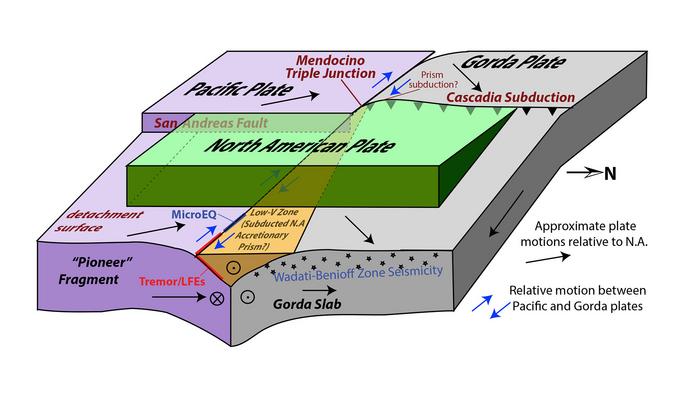
By tracking low-frequency earthquakes, which are tiny tremors thousands of times weaker than those felt by humans, the team discovered that the region actually consists of five moving pieces rather than three. These micro-earthquakes act as a diagnostic tool. They illuminate the hidden boundaries where plates rub against each other deep in the crust.
Hidden fragments and subduction
The researchers’ new model reveals two “ghost” fragments that are driving seismic activity from below.
- The pioneer fragment:
- South of the junction, the Pacific plate is dragging a slab of ancient rock known as the Pioneer fragment underneath the North American plate. This fragment is a remnant of the prehistoric Farallon plate. This fault boundary is horizontal and completely invisible from the surface.
- The North American breakoff:
- To the north, a piece of the North American plate itself has broken off. It is currently being pulled down into the Earth’s mantle alongside the sinking Gorda plate.
These hidden structures explain long-standing mysteries like the 1992 magnitude 7.2 Petrolia earthquake. That quake occurred at a much shallower depth than standard models predicted. The new data shows that the subducting surface is higher and closer to the crust than previously assumed.
A new map for seismic hazards
To confirm their findings, the team looked at how these deep faults respond to tidal forces. Just as the Sun and Moon pull the tides, they exert gravitational pressure on tectonic plates. The researchers found that micro-earthquakes increased precisely when tidal forces aligned with the plates’ movement. This alignment confirmed the location of these newly discovered fault planes.
Understanding these hidden geometries is critical for residents of Northern California. Co-author Amanda Thomas, a professor at UC Davis, explained that it is hard to predict seismic hazards without understanding these underlying processes. By identifying exactly where the plates are grinding, seismologists can better estimate where the next major earthquake might originate and how the ground will shake when it arrives.