

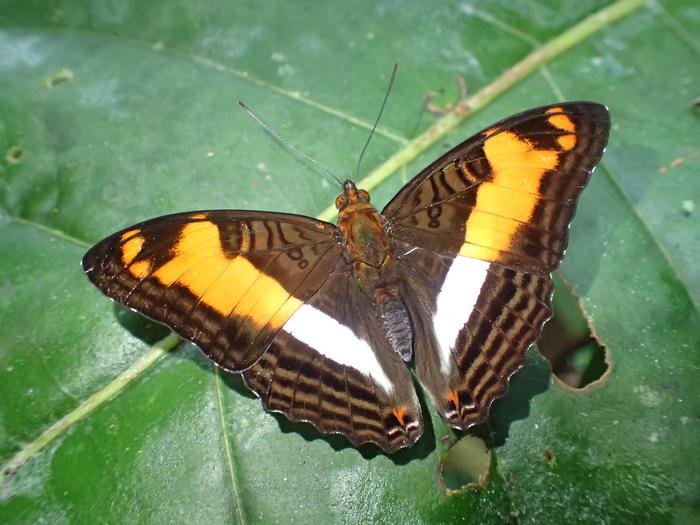
A new study of Adelpha butterflies reveals that tropical species evolve mimicry patterns faster than temperate ones, providing rare evidence for a “biodiversity feedback loop” driven by complex interactions between predators and their prey
For over a century, scientists have been baffled by the genus Adelpha, a group of butterflies native to North and South America. These insects present a “hopeless tangle” of classification because distantly related species often look identical, while members of the same species can appear radically different.
A new study published in the journal Systematic Entomology has finally untangled this evolutionary knot, revealing a “supercharged” biodiversity feedback loop that supports a theory first proposed by Alfred Russel Wallace.
Evasive mimicry
Most mimetic butterflies, such as the Monarch, protect themselves by being toxic. Predators learn to avoid their bright patterns after a single bitter, sickening meal. However, researchers found that Adelpha butterflies do not seem to be chemically protected. Instead, lead author Erika Páez and curator Keith Willmott suggest they employ “evasive mimicry.”
These butterflies are characterised by erratic flight, sharp dives, and rapid changes in direction. In experiments using paper models, birds quickly learned that chasing these “fast” butterflies was a waste of energy. This strategy, where multiple species adopt a “uniform” to signal to predators that they are too difficult to catch, is known as Müllerian mimicry.
The study identified three primary patterns—COCALA, IPHICLUS, and SALMONEUS—that act as evolutionary currents, drawing different species toward a shared appearance to increase their collective survival.
Latitudinal links to evolution
The research provides the first known correlation between latitude and the rate of mimicry evolution. By sequencing DNA and RNA from 83 of the 87 known Adelpha species, the team reconstructed a 25-million-year family tree. They discovered that species in the tropics evolve new mimicry patterns at a significantly faster rate than those in temperate regions like North America.
This finding supports the “biotic interactions” theory of biodiversity. In the stable, warm environments of the tropics, the complex dance between predators and prey creates a feedback loop.
More species lead to more complex interactions, which in turn spur the evolution of new traits and further diversification. This confirms Wallace’s 19th-century intuition that equatorial lands are “unintermittingly subject to those complex influences of organism upon organism.”
Untangling genomic analysis
The study’s genomic analysis solved several long-standing taxonomic puzzles:
- Ancestral patterns: The IPHICLUS pattern (long white bands) was identified as the oldest, appearing over 20 million years ago and remaining largely stable through inheritance.
- Independent evolution: The COCALA and SALMONEUS patterns were found to have evolved independently multiple times, proving they are responses to external predatory pressure rather than shared ancestry.
- A new genus: A mysterious group of Andean butterflies that shared traits with both Adelpha and northern Limenitis butterflies was found to be distinct. They have been placed into a newly established genus, Adelphina.
Despite these breakthroughs, much remains unknown. Female Adelpha are rarely seen as they stay in the high forest canopy, and researchers are still investigating whether some species might combine evasive flight with low-level toxicity.