
Large public-sector buildings, such as hospitals, face a host of critical challenges, one of the most pressing being meeting higher standards for occupant health and sustainability without increasing operational costs. In the HVAC sphere, modern air handling systems, such as the Rhoss ADV DNAIR, make this easily achievable. Roberto Malozzi, MD for Klima-Therm, explains
As the UK continues to tighten the environmental and health-based regulatory requirements of its buildings, the HVAC industry must adopt technologies that deliver ever higher air quality, lower lifecycle costs, outstanding energy savings, and the best possible occupant wellbeing.
Nowhere is this more obvious than in the government’s New Hospitals Programme (see box) and in broader public sector decarbonisation commitments, which are driving a fundamental rethink of HVAC infrastructures. At the centre of this transformation lies an essential yet often overlooked component: air handling.
Requirements for air handling units (AHUs)
Basic air handling units (AHUs) have a relatively simple function – to move, condition, and filter air. However, in today’s challenging environment, marked by mounting concerns over airborne pathogens, stringent European energy standards, and heightened expectations for indoor air quality, AHUs must do far more than ventilate. They need to actively support infection control, occupant wellbeing, energy reduction, and long-term sustainability, especially in healthcare applications.
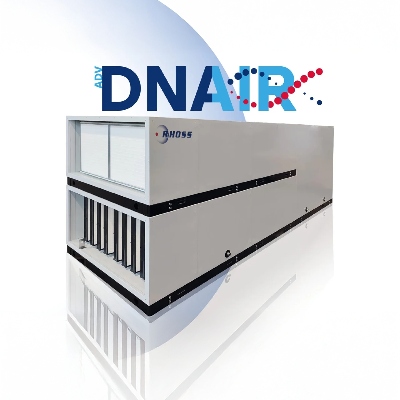
Cutting-edge technologies, such as the Rhoss ADV-DNAIR air handling unit, available in the UK from Klima-Therm, demonstrate just how far the industry has evolved. By combining advanced filtration, intelligent energy management, and high-performance ventilation, this next-generation solution shows what public buildings should be aiming for as they undergo upgrades in the years ahead.
The ADV-DNAIR integrates energy- efficient components, including high-efficiency fans, electronically commutated (EC) motors, advanced heat recovery systems, and low-leakage casings. It offers outstanding performance, including an airflow range of 0.25 to 28 m3/s, more than 120 configurable models, and total air sealing (MB50P certified) under EN1886.
The zero bypass filter frames ensure 100% air filtration, and an advanced anti-condensation structure guarantees no thermal bridges, preventing condensation and reducing the risk of microbial growth and damage to the structure.
The patented self-supporting hybrid structure of the ADV-DNAIR achieves high energy efficiency certified by Eurovent, eliminating air leaks and condensation risks. The device’s advanced filtration system ensures that all air passes through total-seal filter frames, improving filtration efficiency and indoor air quality, with options up to ePM1 95%.
Klima-Therm’s approach
Leading distributor Klima-Therm does not simply supply AHUs such as the Rhoss ADV-DNAIR from a catalogue; it can also design and upgrade old equipment and, where possible, recover heat from the exhaust unit, dramatically reducing energy consumption.
Indeed, Klima-Therm stands out as an exceptional leader in the HVAC and climate-control industry, consistently demonstrating a commitment to innovation, reliability, and customer- focused solutions. The company’s dedication to delivering high- performance systems, whether in cooling, heating, energy recovery, or advanced ventilation, reflects a deep understanding of modern sustainability requirements and real-world application needs.
Its portfolio – which includes ultra-high efficiency chillers, heat pumps, air conditioning systems, air handling units, and bespoke solutions tailored to specific needs, such as those for data centres or the railway industry – showcases cutting-edge technologies that not only enhance comfort but also significantly reduce energy consumption, aligning perfectly with global goals for environmental responsibility.
However, what truly elevates Klima-Therm is the blend of technical expertise and genuine passion evident in every project they undertake. Its expert team brings a rare combination of engineering insight and practical experience, ensuring that each installation, from the simplest unit to the most complex system integration, meets the highest standards of efficiency and durability.
The importance of effective air-handling technology in healthcare
This pressing need for pioneering air-handling technology, combined with industry expertise, especially in healthcare facilities, is highlighted by the fact that these facilities operate under a particularly demanding combination of clinical, regulatory, and environmental requirements.
Furthermore, hospitals tend to have consistently high occupancy levels, with patients, visitors, and staff circulating throughout the day and often through the night. Many departments, such as emergency services, intensive care units, imaging suites, and laboratories, operate 24/7, placing continuous strain on building systems and increasing energy consumption.
In addition, clinical operations rely on stable indoor conditions, so temperatures must remain within tight tolerances, humidity must be controlled to protect equipment and limit microbial growth, and ventilation rates must be sufficient to maintain indoor air quality while supporting patient comfort and safety.
Layered onto these operational demands is growing pressure to reduce utility costs and meet aggressive sustainability targets. Healthcare organisations are increasingly expected to demonstrate environmental stewardship, comply with evolving energy regulations, and pursue carbon reduction initiatives.
The challenge is especially acute because many facilities operate aging infrastructure with legacy HVAC systems, outdated controls, and energy-intensive equipment that can be difficult or costly to modernise.
Hospitals, in particular, face a rigorous set of requirements due to the need to maintain highly controlled environments. Operating rooms, isolation rooms, pharmacies, and sterile processing departments must uphold strict air-change rates, pressure relationships, and filtration standards to prevent the spread of contaminants and ensure compliance with infection- control protocols.
The emergence of COVID-19 intensified these expectations, prompting health systems worldwide to re-evaluate ventilation strategies, expand negative- pressure capabilities, and develop more flexible HVAC solutions that can adapt rapidly to changing conditions. As a result, hospitals now operate with heightened awareness of airborne infection risks, further increasing their dependence on reliable, energy- intensive environmental controls.
This complex interplay underscores the importance of thoughtful, data-driven building management strategies that can reduce energy use, lower costs, and support healthier indoor environments without compromising the quality of care. In particular, it stresses the importance of specifying advanced HVAC technology such as the ADV-DNAIR AHU.

This work is licensed under Creative Commons Attribution-NonCommercial-NoDerivatives 4.0 International.