
Researchers have converted orange peel waste into a high-efficiency biochar that removes 97% of toxic industrial dyes from wastewater. This sustainable dual-activation method turns agricultural byproducts into a reusable, low-cost solution for global water pollution
Scientists have developed a sustainable method to convert discarded orange peels into a powerful material that removes toxic industrial dyes from wastewater. The study, published in the journal Biochar X, addresses two environmental crises at once: the massive accumulation of citrus processing waste and the global prevalence of water pollution.
Orange peels make up nearly half of a fruit’s mass and are typically burned or sent to landfills. By repurposing this biomass, researchers have created a “biochar” adsorbent that effectively cleans contaminated water while supporting a circular economy.
Enhanced dual-activation technology
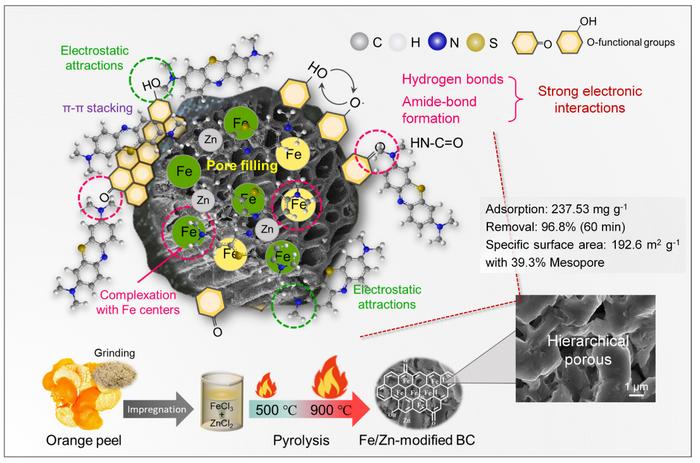
The research team used a specialised dual-activation process involving zinc chloride and iron chloride. This chemical treatment transforms the organic waste into a material with a “hierarchically porous” structure—essentially creating a vast network of microscopic and nanometre-scale holes that significantly increases the surface area available for trapping pollutants.
Lead author Lei Zhang explained that this modification allows the biochar to go beyond simple filtration. The material features multiple active sites that use chemical bonding and electrostatic attraction to lock onto dye molecules.
Rapid and reliable performance
In laboratory trials, the material (named Fe/Zn-OPBC500) targeted methylene blue, a common synthetic dye used in the textile industry. Key performance results included:
- High efficiency:
- Removed nearly 97% of the dye within just one hour.
- Large capacity:
- Each gram of biochar could hold over 237 milligrams of dye.
- Durability:
- The material remained effective even after cleaning and reuse 7 times.
The biochar also maintained its cleaning power across various water conditions, suggesting it could be used in real-world industrial environments where water pH and temperature often fluctuate.
Future environmental applications
Beyond cleaning textile runoff, the researchers believe this engineered carbon material could be adapted to target other industrial contaminants. By tailoring the surface chemistry of the biochar, it may be possible to remove heavy metals or other chemical toxins from water supplies.
This breakthrough provides a scalable roadmap for turning common food waste into high-value environmental technology. As industrial dye production exceeds 700,000 tons annually, these orange peel filters offer a low-cost, renewable alternative to traditional, expensive water-treatment methods.